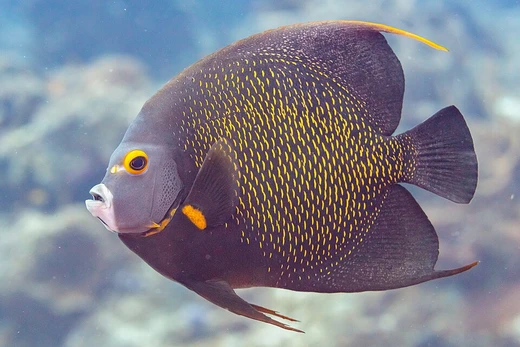
Yellowfin angelfish (Centropyge flavipectoralis)
Source-cited species reference: taxonomy from WoRMS, biology from FishBase, conservation from IUCN Red List, description from Wikipedia.

Centropyge flavipectoralis, known commonly as the yellowfin angelfish or moonbeam angelfish, is a marine ray-finned fish, a marine angelfish belonging to the family Pomacanthidae. It is native to the Indian Ocean.
- Scientific name
- Centropyge flavipectoralis
- Authority
- Randall & Klausewitz, 1977
- Family
- Pomacanthidae
- Order
- Acanthuriformes
- Maximum length
- 10 cm
- Depth range
- 3–20 m
- Habitat zone
- reef-associated
- Iucn red list
- Least Concern
Appearance and Taxonomic Identity
The yellowfin angelfish presents a striking contrast of colors against its predominantly brown body. Metallic blue stripes run along the flanks, while the pectoral fin stands out in vivid yellow — a feature so defining that it anchors the species' scientific name. The Latin epithet flavipectoralis translates directly to "yellow pectoral," a nod to that single bright accent. In terms of fin architecture, the dorsal fin bears fourteen to fifteen spines paired with fourteen to fifteen soft rays, while the anal fin carries three spines and sixteen to eighteen soft rays. The fish reaches a modest maximum total length of ten centimetres, roughly four inches. Taxonomically, it sits within the family Pomacanthidae and the genus Centropyge, though some authorities further assign it to the subgenus Centropyge. The species was formally described in 1977 by American ichthyologist John Ernest Randall and his German collaborator Wolfgang Klausewitz, who designated Lively Rock off Trincomalee, Sri Lanka, as the type locality.
Geographic Range and Habitat Preferences
Native to the Indian Ocean, the yellowfin angelfish occupies a relatively compact stretch of coastal waters. Its documented range spans the Maldives, the waters around Sri Lanka, and the Andaman Sea, extending from the Thai coastline southward to the northern shores of Sumatra. Within this region, the species favors depths between three and twenty metres, a band that places it comfortably within the reach of recreational divers. Rather than thriving in lush coral gardens, this angelfish gravitates toward rubble-strewn seabeds where coral growth is sparse and patchy. It is typically observed in small groups, suggesting a degree of social cohesion, and tends to position itself over substrates that offer at least partial cover. This preference for broken, uneven terrain with limited living coral distinguishes its habitat niche from that of many other reef-dwelling pomacanthids, which often rely on dense, structurally complex coral formations for shelter and foraging.
Diet and Group Dynamics
The yellowfin angelfish is an opportunistic forager whose diet centers on algae, small worms, and crustaceans. This mixed menu reflects the nature of its preferred habitat — rubble-laden seabeds with only limited coral growth — where such food sources are readily available among broken rock and sediment. Rather than patrolling the open water column or perching on exposed coral heads, this species typically feeds close to the substrate, picking at algal films and small invertebrates that colonize the uneven terrain. Socially, the yellowfin angelfish is not a solitary dweller. It is most often encountered in small groups, suggesting a loose social structure that may offer collective vigilance against predators. These groups tend to remain in areas that provide at least some cover, indicating that while the fish are comfortable in relatively open rubble fields, they still value the security of nearby shelter. The combination of a varied benthic diet and small-group living paints a picture of a fish well adapted to the patchy, structurally simple environments of the Indian Ocean's mid-depth reefs.
In the Aquarium Trade
Despite its modest size — a maximum of ten centimetres makes it a manageable candidate for home aquaria — the yellowfin angelfish remains an infrequent sight in the aquarium trade. The primary barrier to popularity is aesthetic: compared to the bold, high-contrast coloration of many other angelfish species, the yellowfin's largely brown body with metallic blue flank stripes and a single yellow pectoral fin simply does not command the same visual impact on a store shelf or in a display tank. Its relative drabness, as aquarists put it, dampens consumer demand. Yet those who do acquire the species report a notable advantage: the yellowfin angelfish has a reputation for hardiness in captivity. This combination of low visual spectacle and high survivability creates an interesting niche. It is a fish that rewards patience and an appreciation for subtler coloration over flash, appealing to hobbyists who value resilience and natural behavior over the dramatic displays that typically drive the ornamental fish market.
Frequently Asked Questions
Who is Yellowfin angelfish (Centropyge flavipectoralis)?
The yellowfin angelfish, also called the moonbeam angelfish, is a small marine ray-finned fish in the angelfish family Pomacanthidae. It was formally described by Randall and Klausewitz in 1977 and is native to the Indian Ocean.
What are Yellowfin angelfish (Centropyge flavipectoralis)'s powers/role?
As a member of the Pomacanthidae family, it feeds on small invertebrates and algae found on reef structures, helping control algal growth on coral habitats. It typically inhabits depths between 3 and 20 metres, where it forages among rocky outcrops and coral heads.
Why is Yellowfin angelfish (Centropyge flavipectoralis) important?
It contributes to the biodiversity of Indian Ocean reef ecosystems by occupying a specific niche as a small, benthic predator. Its presence also signals a healthy reef community, since it depends on intact coral and rock substrates for shelter and food.
Where can I find Yellowfin angelfish (Centropyge flavipectoralis)?
This species is restricted to the Indian Ocean and is typically encountered at depths of roughly 3 to 20 metres. Divers and snorkelers looking for it should focus on rocky reef areas and coral formations within that depth band.
Spotted an error? Know more?
Reader corrections go straight into our review queue. Suggest an edit · How this site is sourced