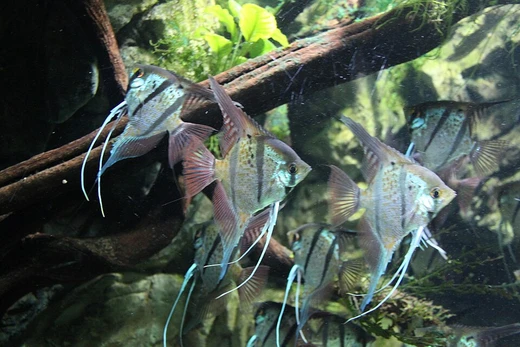
Orange angelfish (Centropyge fisheri)
Source-cited species reference: taxonomy from WoRMS, biology from FishBase, occurrence map from GBIF, conservation from IUCN Red List, description from Wikipedia.

Centropyge fisheri, the orange angelfish, whitetail angelfish, damsel angelfish, yellowtail angelfish, Hawaiian flame angelfish, Fisher's angelfish, Fisher's dwarf angelfish or Fisher's pygmy angelfish, is a species of marine ray-finned fish, a marine angelfish belonging to the family Pomacanthidae. It is found in the Indo-Pacific region.
- Scientific name
- Centropyge fisheri
- Authority
- (Snyder, 1904)
- Family
- Pomacanthidae
- Order
- Acanthuriformes
- Maximum length
- 8.399999618530273 cm
- Depth range
- 10–95 m
- Habitat zone
- reef-associated
- Iucn red list
- Least Concern
- Gbif occurrence records
- 644
Taxonomic Complexity and Shifting Boundaries
The classification of Centropyge remains one of the more tangled problems in marine angelfish systematics. Although the genus currently encompasses thirty-five recognized species, it is formally paraphyletic: the genera Genicanthus and the polyphyletic Apolemichthys are nested within Centropyge rather than standing as separate lineages. Within the genus, three subgenera are recognized. Xiphypops groups together the C. acanthops complex—C. acanthops, C. argi, C. aurantonota, and C. resplendens—while Paracentropyge contains C. boylei, C. multifasciata, and C. venusta. Both of these subgenera are monophyletic, and researchers have voiced support for elevating them to full genus rank. The remaining species fall under the nominate subgenus Centropyge, which is notably not monophyletic. Adding to the confusion, different taxonomic studies have delineated different species complexes within the genus, reflecting varying definitions of what constitutes a species complex. The result is a group whose internal boundaries continue to shift as phylogenetic evidence accumulates.
Sexual Fluidity Within the Harem
Social hierarchy in Centropyge is inseparable from sexual identity. In the wild, these small angelfish organize themselves into haremic groups consisting of a single dominant male surrounded by several females. The species are protogynous hermaphrodites: every individual begins its adult life as a female, and the dominant member of a group can transition to male within a matter of days if the social structure shifts. This rapid forward sex change is a hallmark of the group, yet the reverse process—reverting from male back to female—is possible when an individual's social standing changes, though it unfolds over a considerably longer period. Remarkably, at least one species, C. ferrugata, demonstrates the ability of males to complete this reversal, a trait that appears unique among protogynous fish. Visually, telling the sexes apart is challenging; females tend to be slightly shorter with more rounded fins, but these differences are subtle. The tight coupling between dominance status and reproductive role means that a single death or behavioral shift in a harem can trigger a cascade of sex changes across the group.
Life in the Reef Aquarium
Keeping a Centropyge in a home aquarium demands patience and a well-established environment. These dwarf angelfish thrive best in matured reef tanks, where stable, high-quality water and abundant live rock mimic the conditions of their natural reef habitat. In the wild, members of the genus graze on algae, sponges, and small benthic invertebrates, so a generous supply of well-cured live rock serves as a critical dietary supplement in captivity. This is not merely a nutritional concern: an underfed Centropyge is prone to nipping at corals and other sessile invertebrates, turning a peaceful reef into a damaged one. Behaviorally, newly introduced dwarf angels are often quite reclusive, retreating into corals, caves, and crevices for extended periods. Over time, however, once they have claimed and established their territory, they grow noticeably bolder and more interactive. This transition depends heavily on having compatible tank mates and a tank large enough to support their territorial instincts without constant conflict.
A Small Genus with Global Reach
Centropyge occupies a distinctive niche among marine angelfish. As ray-finned members of the family Pomacanthidae, these species are found across all three major tropical ocean basins—the Atlantic, Indian, and Pacific—making them one of the most geographically widespread genera in their family. Despite this broad distribution, they remain small: no species in the genus exceeds fifteen centimeters in length, a size that sets them apart from the much larger angelfish of other genera. The genus currently comprises thirty-five recognized species, a number that reflects both their diversity and the ongoing taxonomic work to sort out species complexes and subgeneric boundaries. Their ecological strategy is equally consistent across the group: they inhabit reef environments, feed on benthic organisms, and organize socially into haremic units of one dominant male and multiple females. This combination of small size, wide oceanic range, and a shared social-biological template makes Centropyge a remarkably cohesive genus, even as its internal classification continues to be refined by new phylogenetic evidence.
Frequently Asked Questions
Who is Orange angelfish (Centropyge fisheri)?
Centropyge fisheri is a small marine angelfish in the family Pomacanthidae, originally described by Snyder back in 1904. Collectors and hobbyists know it by a handful of common names, including Fisher's dwarf angelfish, Hawaiian flame angelfish, and whitetail angelfish.
What are Orange angelfish (Centropyge fisheri)'s powers/role?
As a compact reef-dweller topping out at roughly 8.4 cm, it occupies one of the smaller size classes within the angelfish family. It forages among coral structures in the open Indo-Pacific, filling a niche typical of dwarf Centropyge species.
Why is Orange angelfish (Centropyge fisheri) important?
It adds to the species richness of Indo-Pacific coral-reef communities and can serve as a useful indicator of reef condition. Its bright coloration and manageable size also make it a sought-after subject in the marine aquarium hobby.
Where does Orange angelfish (Centropyge fisheri) live?
This is a strictly saltwater species native to the broader Indo-Pacific region, recorded at depths from about 10 m down to 95 m. It is absent from freshwater and brackish systems, thriving only in marine reef and slope habitats.
Spotted an error? Know more?
Reader corrections go straight into our review queue. Suggest an edit · How this site is sourced