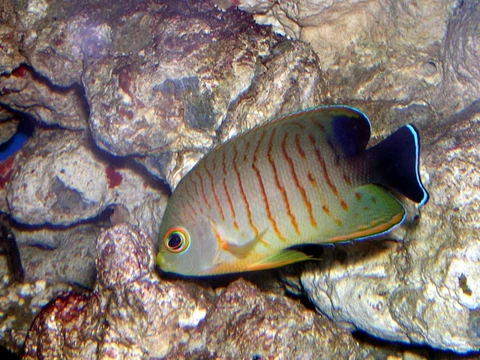
Blacktail angelfish (Centropyge eibli)
Source-cited species reference: taxonomy from WoRMS, biology from FishBase, occurrence map from GBIF, conservation from IUCN Red List, description from Wikipedia.

NasserHalaweh · CC BY-SA 4.0
Centropyge eibli, the blacktail angelfish, red stripe angelfish, orangelined angelfish, or Eibl dwarf angel is a species of marine ray-finned fish, a marine angelfish belonging to the family Pomacanthidae. It is found near reefs in the Indo-Pacific.
- Scientific name
- Centropyge eibli
- Authority
- Klausewitz, 1963
- Family
- Pomacanthidae
- Order
- Acanthuriformes
- Maximum length
- 15 cm
- Depth range
- 3–30 m
- Habitat zone
- reef-associated
- Iucn red list
- Least Concern
- Gbif occurrence records
- 236
A Study in Colour and Camouflage
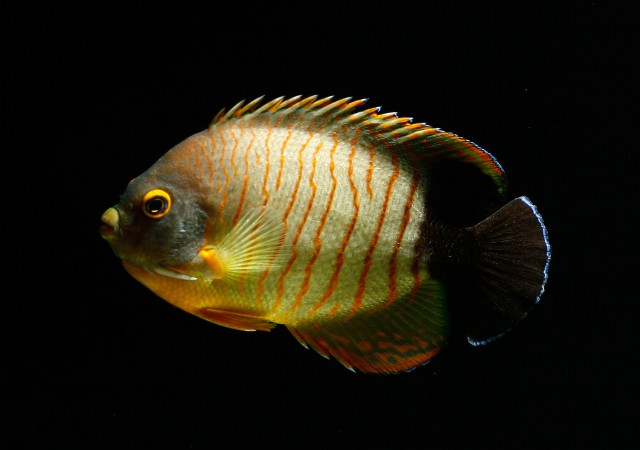
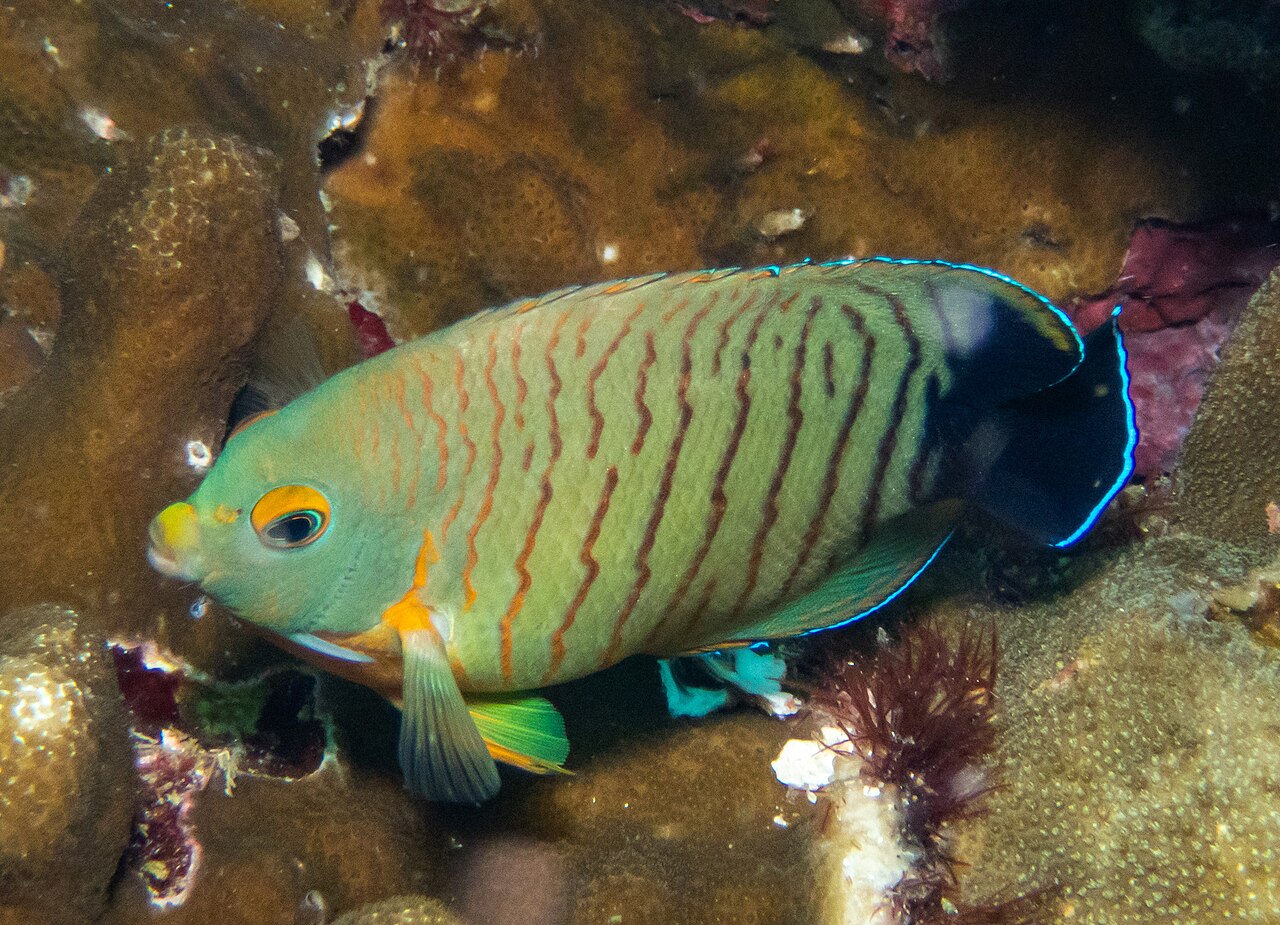
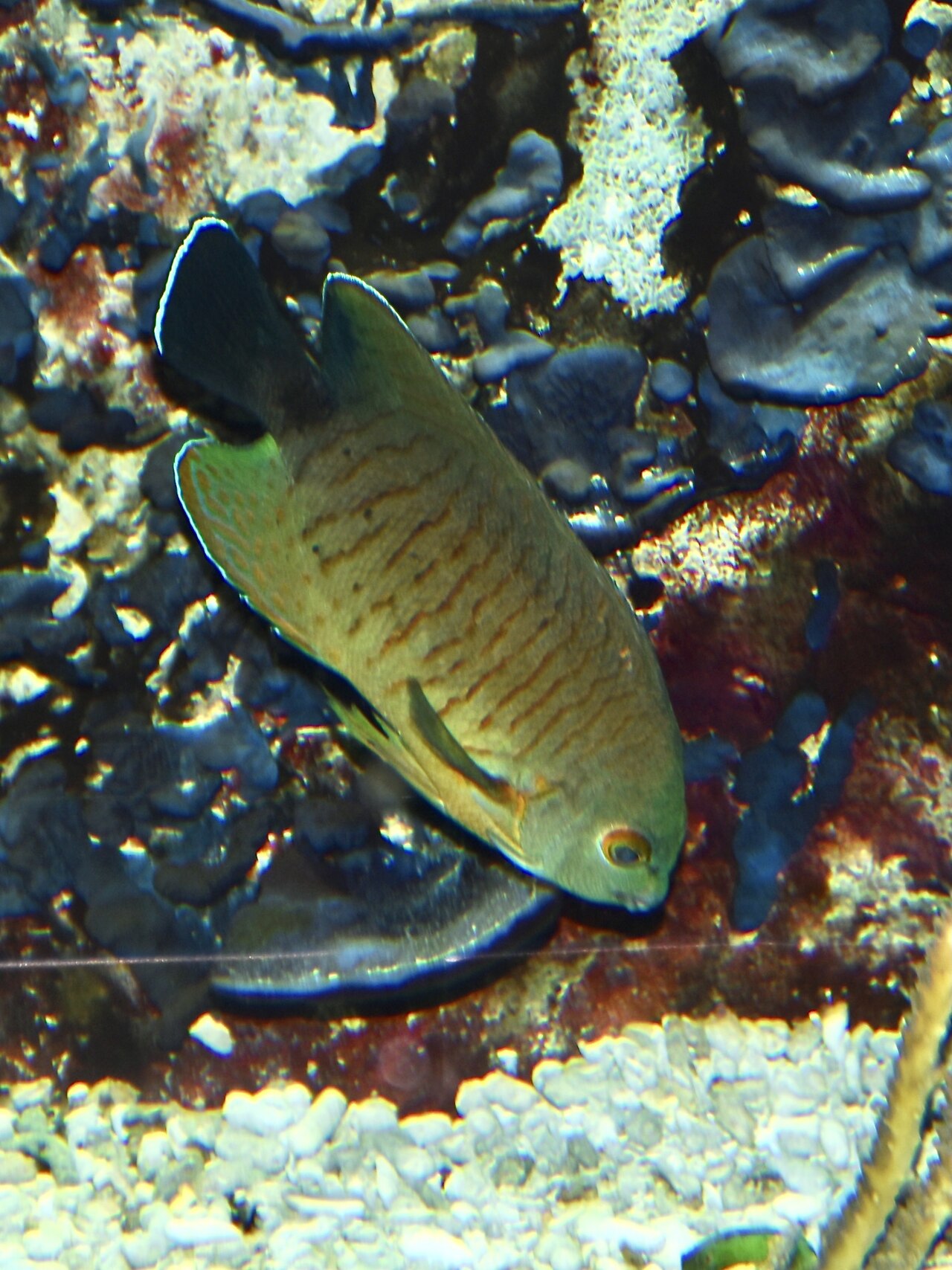
The blacktail angelfish presents a striking yet understated palette. Its body is predominantly greyish, broken up by thin, wavy vertical bars in a rust tone that run along the flanks. A vivid orange ring frames the eye, drawing attention to the fish's face. The most dramatic feature, however, is the tail: the caudal peduncle and the caudal fin itself are solid black, but the very rear edge of that fin flashes a brilliant blue. This particular combination of markings has proven so effective that the juvenile Indian Ocean Mimic Surgeonfish, Acanthurus tristis, has evolved to resemble the small, darting angelfish as a defensive strategy against predators. In terms of fin architecture, the dorsal fin carries fourteen spines backed by fifteen to seventeen soft rays, while the anal fin bears three spines and seventeen to eighteen soft rays. Despite this intricate design, the species remains modest in size, reaching a maximum total length of just fifteen centimetres, roughly six inches.
Range and Reef Habitat
The blacktail angelfish occupies a broad swath of the eastern Indian Ocean. Its range stretches from the Maldives and Sri Lanka southward to north-western Australia, and eastward through Indonesia as far as the island of Flores. Within Australian waters, records place it at Christmas Island, Ningaloo Reef, the Rowley Shoals, Scott Reef off Western Australia, and Ashmore Reef in the Timor Sea. The species favours relatively shallow water, typically between three and twenty-five metres, where dense stands of coral thrive. It is most often encountered in sheltered lagoons and on Seward reefs, though it will also be found in tidal channels where currents run. This preference for structurally complex, coral-rich environments ties the angelfish closely to reef ecosystems across its wide Indo-Pacific range, from the Maldives and Sri Lanka to the scattered reefs of northern Australia.
Harem Life and Sex Change
In the wild, the blacktail angelfish does not roam alone. It is typically encountered in small social groups consisting of a single dominant male and several females, a structure commonly described as a harem. The group feeds mainly on algae, foraging among the dense coral formations that define its habitat. Perhaps the most remarkable aspect of its biology is its reproductive strategy. The species is a protogynous hermaphrodite, meaning every individual begins life as a female. Should the dominant male in a harem disappear, the most dominant female among the remaining group will change sex to male. This mechanism ensures continuity of the social unit without the need to recruit a new individual from outside. The system allows the group to maintain its structure even in the face of loss, a practical adaptation for a small, reef-dwelling fish navigating the complex social and ecological demands of its Indo-Pacific environment.
Discovery, Naming, and the Aquarium Trade
The blacktail angelfish was first formally described in 1963 by the German ichthyologist Wolfgang Klausewitz, who designated Castle Bay on Tillanchong in the Nicobar Islands as the type locality. The specific name honours Irenäus Eibl-Eibesfeldt, the ethologist and ichthyologist who collected some of the original type specimens. Within the genus Centropyge, some authorities place this species in the subgenus Centropyge. Taxonomists have also documented hybridisation events: where C. eibli co-occurs with Centropyge vrolikii, the two can interbreed, and similar hybridisation with C. flavissima has been recorded at Christmas Island and the Cocos (Keeling) Islands. In the aquarium trade, the blacktail angelfish appears as a recognised but not ubiquitous presence. Specimens exported to European and North American markets are most commonly shipped through Sri Lanka, making the island a key transit point for this small reef fish.
Gallery
Frequently Asked Questions
Who is Blacktail angelfish (Centropyge eibli)?
Centropyge eibli is a small marine angelfish in the family Pomacanthidae, originally described by Klausewitz back in 1963. Fishkeepers and reef enthusiasts also call it the red stripe angelfish, orangelined angelfish, or Eibl dwarf angel. It tops out at roughly 15 cm in total length.
What are Blacktail angelfish (Centropyge eibli)'s powers or role on the reef?
It acts as a grazer, picking algae and tiny invertebrates off coral surfaces, which helps keep reef structures from being smothered. It operates between 3 and 30 meters depth across Indo-Pacific reef systems. Its bold orange-and-black markings double as camouflage among branching corals and as a visual signal to conspecifics.
Why is Blacktail angelfish (Centropyge eibli) important to the reef community?
By continuously cropping algal films, it gives newly settled coral polyps a fighting chance against overgrowth, making it a quiet keystone of reef health. Marine biologists often use its presence as a quick field indicator that a reef is structurally intact and biologically active. It also features prominently in the marine aquarium trade, which in turn drives public interest in protecting Indo-Pacific reefs.
Where can I find Blacktail angelfish (Centropyge eibli) in the wild?
Its range spans reef habitats throughout the Indo-Pacific, from the western Pacific to the eastern Indian Ocean. It favors areas with live coral cover and rocky outcrops at depths of about 3 to 30 meters. Global occurrence records contributed to databases such as GBIF help map its exact localities across that broad region.
Spotted an error? Know more?
Reader corrections go straight into our review queue. Suggest an edit · How this site is sourced