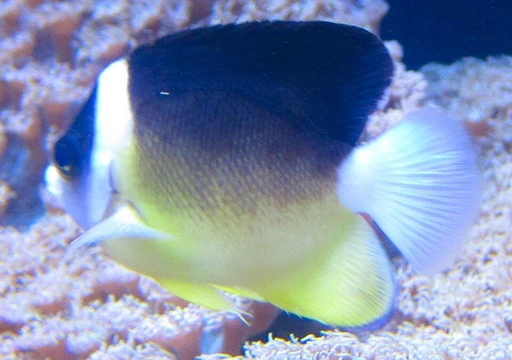
Abe's angelfish (Centropyge abei)
Source-cited species reference: taxonomy from WoRMS, biology from FishBase, conservation from IUCN Red List, description from Wikipedia.

Centropyge abei (Abe's angelfish) is a species of marine ray-finned fish, a small marine angelfish belonging to the family Pomacanthidae. It is found in the western Pacific Ocean.
- Scientific name
- Centropyge abei
- Authority
- Allen, Young & Colin, 2006
- Family
- Pomacanthidae
- Order
- Acanthuriformes
- Maximum length
- 9.079999923706055 cm
- Depth range
- 110–155 m
- Habitat zone
- demersal
- Iucn red list
- Least Concern
Morphology and Coloration
Abe's angelfish is a compact marine species reaching a maximum total length of just 9.1 centimetres, a truly pygmy stature among the angelfish family. Its body presents a bold two-tone pattern: the lower two-thirds and the flanks are a vivid yellow, while the upper third of the back, the entire dorsal fin, and the top of the head are solid black. Separating these zones is a broad white bar positioned just ahead of where the dorsal fin originates, extending upward to at least the upper margin of the gill cover. The tail fin and the narrow caudal peduncle are likewise white, creating a clean break at the rear. The dorsal fin itself is notably high and flattened, stretching longer and with a gentler arch than in most other members of the genus Centropyge, the sole exception being C. colini. Fin counts are precise: thirteen spines and seventeen soft rays in the dorsal, three spines and eighteen soft rays in the anal. Juveniles display a softer, less defined version of the adult pattern and may carry a pale white stripe along the tail.
Range and Habitat
Abe's angelfish occupies a scattered footprint across the western Pacific Ocean. Documented localities include the waters off northern Sulawesi, the island nation of Palau, the southern reaches of Japan, and Holmes Reef situated in the Coral Sea off the coast of Queensland, Australia. This distribution underscores a preference for isolated reef systems rather than continuous continental shelves. In terms of vertical range, the species inhabits depths from as shallow as five metres down to a remarkable 155 metres, placing it far deeper than most of its close relatives in the genus. It favours substrates composed of variably sized rubble, and is also recorded from outer reef slopes, steep drop-offs, and submerged caves. The thermal window is narrow, with recorded temperatures of twenty to twenty-one degrees Celsius. These cooler, deeper conditions set it apart from many of its shallow-water congeners and align with the shared deep-reef adaptations it holds in common with its closest relative, C. colini.
Discovery and Taxonomic History
The species was not formally described until 2006, when Gerald Allen, Forrest Young, and Patrick L. Colin published its scientific account. The type locality was recorded as the southeast side of Manado Tua, on Sulawesi. The specific epithet honours Yoshitaka Abe, director of the Japanese public aquarium Aquamarine Fukushima, whose institution funded the very expedition during which the type specimen was collected. This naming links the fish's scientific identity directly to the institutional support that made its discovery possible. Within the genus Centropyge, the species appears closest to C. colini, the two sharing a suite of morphological and ecological traits associated with deeper reef habitats. However, taxonomic placement is not entirely settled; some authorities treat the species as incertae sedis within the genus, reflecting ongoing uncertainty about its precise phylogenetic position among the pygmy angelfishes.
Deep-Water Adaptations and Comparative Traits
Abe's angelfish and its closest relative C. colini stand apart from the rest of the genus Centropyge through a shared suite of traits associated with deeper reef life. Both species are found in relatively deep water compared to their congeners, and both display a small face with large eyes set quite far forward on the head. The dorsal fin in C. abei is notably longer and less arched than in most other pygmy angelfishes, a morphological trait it shares with C. colini and which distinguishes the pair from the remainder of the genus. These fish are recorded from rubble fields of variably sized fragments, outer reef slopes, steep drop-offs, and caves, suggesting a lifestyle tied to complex reef structures at depth. Their narrow thermal preference of twenty to twenty-one degrees Celsius further separates them from warmer, shallower relatives. The combination of these morphological, ecological, and thermal traits underscores a distinct evolutionary trajectory within the angelfish family, one shaped by the demands of cooler, deeper reef environments.
Frequently Asked Questions
What is Abe's angelfish (Centropyge abei)?
Abe's angelfish is a small, deep-water species of marine angelfish belonging to the family Pomacanthidae. It is a ray-finned fish native to the western Pacific Ocean, typically encountered well below the recreational diving zone.
How big does Abe's angelfish (Centropyge abei) get?
This species tops out at roughly 9 centimeters in total length, making it a notably compact angelfish. Its small stature is in line with the Centropyge genus, which tends to produce some of the tiniest members of the angelfish family.
Where can I find Abe's angelfish (Centropyge abei) in the wild?
Abe's angelfish lives in the western Pacific Ocean, favoring deep reef habitats at depths of approximately 110 to 155 meters. Because of that depth range, it is rarely seen by recreational divers and is more often documented by deep-water survey expeditions.
Who named Abe's angelfish (Centropyge abei) and when was it described?
The species was formally described in 2006 by the taxonomic team of Allen, Young, and Colin. It was placed in the order Acanthuriformes and the family Pomacanthidae, confirming its identity as a small, deep-water angelfish.
How is Abe's angelfish (Centropyge abei) related to other angelfish?
As a member of the genus Centropyge, it shares close kinship with other small, deep-water angelfishes scattered across the Indo-Pacific. Within the broader Pomacanthidae family it sits alongside both colorful reef species and other deep-sea forms, but its restricted depth range and compact size set it apart from many of its shallower relatives.
Spotted an error? Know more?
Reader corrections go straight into our review queue. Suggest an edit · How this site is sourced