
Green sea feather (Caulerpa sertularioides)
Source-cited species reference: taxonomy from WoRMS, biology from SeaLifeBase, occurrence map from GBIF, description from Wikipedia.
Caulerpa sertularioides, also known as green feather algae, is a species of seaweed in the Caulerpaceae family found in warm water environments.
- Scientific name
- Caulerpa sertularioides
- Authority
- (S.G.Gmelin) M.Howe, 1905
- Family
- Caulerpaceae
- Order
- Bryopsidales
- Depth range
- 3–110 m
- Habitat zone
- sessile
- Gbif occurrence records
- 4,139
Classification (WoRMS)
Full classification as recorded by WoRMS: Kingdom: Plantae · Phylum: Chlorophyta · Class: Ulvophyceae · Order: Bryopsidales · Family: Caulerpaceae · Genus: Caulerpa.
Accepted name: Caulerpa sertularioides · Authority: (S.G.Gmelin) M.Howe, 1905 · Taxonomic status: accepted · AphiaID: 144474.
Synonyms and superseded combinations recorded for this taxon: Caulerpa plumaris (Forsskål) C.Agardh, 1823; Caulerpa sertularioides f. typica Børgesen, 1907; Corradoria plumaris (Forssk.) Trevisan; Fucus plumaris Forsskål, 1775; Fucus sertularioides S.G.Gmelin, 1768.
Source: World Register of Marine Species (WoRMS) — https://www.marinespecies.org/aphia.php?p=taxdetails&id=144474 (CC BY 4.0). Accessed 2026-09-23.
Biology and life history (SeaLifeBase)
Measured values published by SeaLifeBase for Caulerpa sertularioides. Only fields the database actually holds for this species are shown; these are database values, not aquarium guidance.
Depth range: 3–110 m · Habitat zone: sessile · Fishery importance: commercial.
SeaLifeBase notes: Used for human consumption as food and medicine: antifungal, lowers blood pressure; source of sitosterol, caulerpin, and caulerpicin, palmitic acid (Ref. 80758). Grows on sandy to sandy-rocky substrate in calm, shallow and protected areas on reef flats; commonly associated with seagrasses (Ref. 80758).
Source: SeaLifeBase species summary (SpecCode 119655) — https://www.sealifebase.se/summary/Caulerpa-sertularioides.html (CC BY-NC 3.0 — non-commercial use only). Accessed 2026-09-23.
Distribution and occurrence records (GBIF)
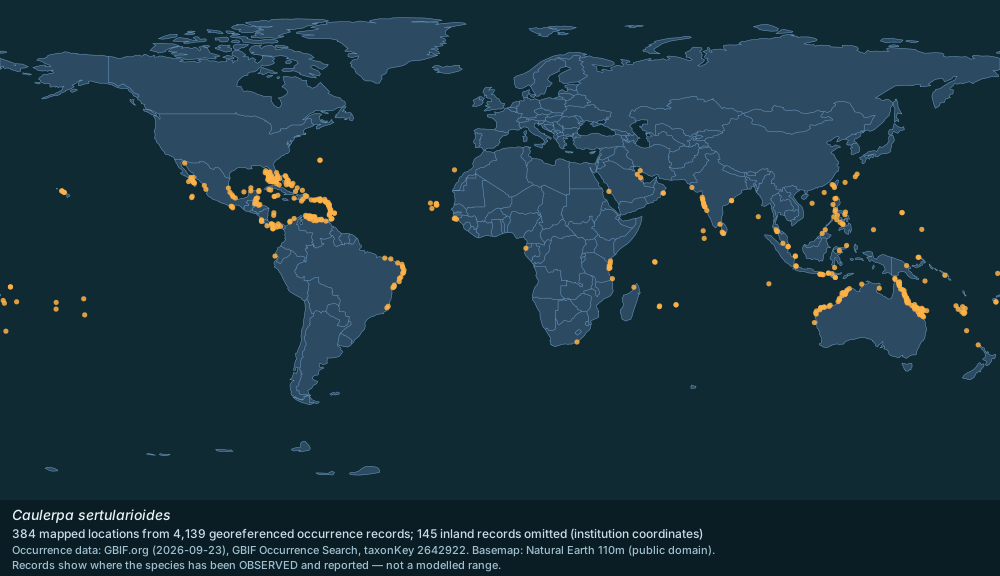
4,139 georeferenced occurrence records for Caulerpa sertularioides are published through GBIF from 92 countries or marine areas. The map above plots 384 distinct locations from a sample of 3,000 records, omitting 145 inland records that carry an institution's coordinates rather than a collection site; it shows where the species has been observed and reported, not a modelled range.
Most records by country or area: United States of America (799); Mexico (522); Australia (376); Venezuela (Bolivarian Republic of) (289); Brazil (287).
The full country table, WoRMS marine regions and the sampling notes are on this species' Distribution page.
Source: GBIF Occurrence Search (taxonKey 2642922) — https://www.gbif.org/occurrence/search?taxon_key=2642922&has_coordinate=true (records CC0 / CC BY); WoRMS distribution records (MarineRegions) — https://www.marinespecies.org/aphia.php?p=taxdetails&id=144474 (CC BY 4.0); Natural Earth 110m basemap — https://www.naturalearthdata.com/ (public domain). Accessed 2026-09-23.
Description and natural history (Wikipedia)
The seaweed has a pale to dark-green thallus that typically grows to outward to around 0.35 to 2 m. It has feather-like fronds that arise from a common stolon. Each of the fronds is upright and branched. The oppositely arranged branchlets are cylindrical to needle-shaped with upcurved tips with a blunt point at the end. Each branchlet has a length of 3 to 11 mm and is attached to a cylindrical axis in the middle with a diameter of 1 to 1.5 mm. Each axis connects each frond to a creeping stolon with a diameter of 2 to 2.5 mm and a length of up to 2 m. Stolons are branched out to slim points and rhizoids then form from bottom surface these fork and penetrate the sandy substrate firmly anchoring the seaweed to the seafloor.
The species was first formally described by the botanist and taxonomist Marshall Avery Howe in 1905 as part of the work Phycological studies - II. New Chlorophyceae, new Rhodophyceae and miscellaneous notes as published in the Bulletin of the Torrey Botanical Club. The basionym is Fucus sertularioides as described by Samuel Gottlieb Gmelin in 1768.
The species is found widely through tropical waters. In the United States it is found from North Carolina to Florida. It is also found throughout the Caribbean around Bermuda, Bahamas, Greater and Lesser Antilles and in the Gulf of Mexico and in the southern Atlantic Ocean to Brazil (Taylor 1979). It is also found in the Pacific Ocean along the Great Barrier Reef in Australia, Papua New Guinea, Philippines and Palau. In Western Australia, it is found along the coast in the Kimberley region extending south to the Gascoyne.
The species is usually part of coastal and estuarine environments where it grows in sandy areas, as seagrass beds or on and around mangrove roots. It is mostly found as a shallow-water specimen to depths of around 10 m although sparse individuals have been taken from depths of up to 110 m.
Source: Wikipedia: Caulerpa sertularioides — https://en.wikipedia.org/wiki/Caulerpa_sertularioides (CC BY-SA 4.0). Accessed 2026-09-23.
Gallery
Related in Green sea feather
Links follow this subject's own source article.
Elsewhere in Green sea feather
Spotted an error? Know more?
Reader corrections go straight into our review queue. Suggest an edit · How this site is sourced