
Toothed stolon (Caulerpa cupressoides)
Source-cited species reference: taxonomy from WoRMS, biology from SeaLifeBase, occurrence map from GBIF, description from Wikipedia.
Caulerpa cupressoides, commonly known as cactus tree alga, is a species of seaweed in the Caulerpaceae family. Green alge of Caulerpa genus are salty and pungent in style and are consumed by several marine cultures around the world.
- Scientific name
- Caulerpa cupressoides
- Authority
- (Vahl) C.Agardh, 1817
- Family
- Caulerpaceae
- Order
- Bryopsidales
- Depth range
- 0–70 m
- Habitat zone
- sessile
- Gbif occurrence records
- 3,101
Classification (WoRMS)
Full classification as recorded by WoRMS: Kingdom: Plantae · Phylum: Chlorophyta · Class: Ulvophyceae · Order: Bryopsidales · Family: Caulerpaceae · Genus: Caulerpa.
Accepted name: Caulerpa cupressoides · Authority: (Vahl) C.Agardh, 1817 · Taxonomic status: accepted · AphiaID: 144467.
Synonyms and superseded combinations recorded for this taxon: Caulerpa cupressoides var. typica Weber Bosse, 1898; Caulerpa triangularis Mazé & Schramm, 1878; Chauvinia cupressoides (M.Vahl) Trevisan, 1849; Chauvinia indica Sonder ex Kützing, 1857; Fucus cupressoides Vahl, 1802.
Source: World Register of Marine Species (WoRMS) — https://www.marinespecies.org/aphia.php?p=taxdetails&id=144467 (CC BY 4.0). Accessed 2026-09-23.
Biology and life history (SeaLifeBase)
Measured values published by SeaLifeBase for Caulerpa cupressoides. Only fields the database actually holds for this species are shown; these are database values, not aquarium guidance.
Depth range: 0–70 m · Habitat zone: sessile · Fishery importance: commercial.
SeaLifeBase notes: Used for human consumption as food and medicine: antifungal, lowers blood pressure (Ref. 80758). Maximum depth from Ref. 102144. Inhabits sandy substrate with coral rocks in calm, shallow areas and moderately exposed habitats. It may form large colonies on sandy shallows, attached to shells, stones, and coral fragments or anchored on the sand. While quite able to grow luxuriantly in warm shallow tidepools or lagoons, this species is apparently not adapted to shaded habitats (Ref. 80758).
Source: SeaLifeBase species summary (SpecCode 123240) — https://www.sealifebase.se/summary/Caulerpa-cupressoides.html (CC BY-NC 3.0 — non-commercial use only). Accessed 2026-09-23.
Distribution and occurrence records (GBIF)
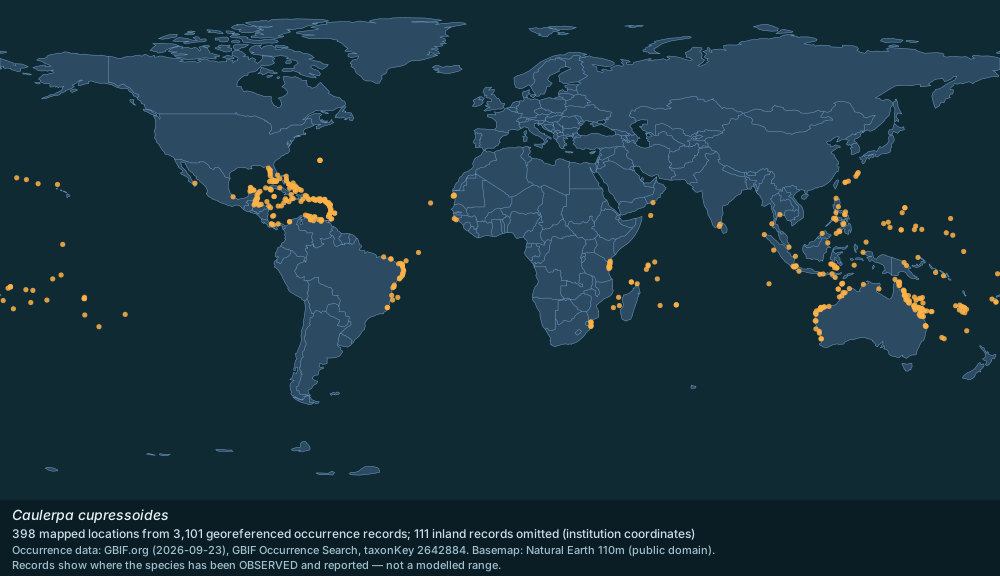
3,101 georeferenced occurrence records for Caulerpa cupressoides are published through GBIF from 82 countries or marine areas. The map above plots 398 distinct locations from a sample of 3,000 records, omitting 111 inland records that carry an institution's coordinates rather than a collection site; it shows where the species has been observed and reported, not a modelled range.
Most records by country or area: Australia (699); Brazil (444); United States of America (306); Puerto Rico (128); Belize (97).
The full country table, WoRMS marine regions and the sampling notes are on this species' Distribution page.
Source: GBIF Occurrence Search (taxonKey 2642884) — https://www.gbif.org/occurrence/search?taxon_key=2642884&has_coordinate=true (records CC0 / CC BY); WoRMS distribution records (MarineRegions) — https://www.marinespecies.org/aphia.php?p=taxdetails&id=144467 (CC BY 4.0); Natural Earth 110m basemap — https://www.naturalearthdata.com/ (public domain). Accessed 2026-09-23.
Description and natural history (Wikipedia)
The plant has runners that are overlaid by sand rising up to thick stalks that split into heavy upright branches that are in turn lined with rows of short think branchlets. The length can vary from 2 to 25 cm with a tall slender habit to a short bushy habit. It is a coenocytic species that grows well in shallow protected areas with sandy bottoms.
It is found around much of the world including the Americas between Florida and Brazil including most of the islands of the Caribbean. Both coasts of Africa as far south as South Africa and many of the islands in Atlantic, Indian and Pacific Oceans.
The species was described by Carl Adolph Agardh in 1817 as a part of the work Synopsis algarum Scandinaviae, adjecta dispositione universali algarum. The specific epithet is taken from Latin, meaning cypress like. A synonym is Fucus cupressoides.
Several variations of the species exist including:
Caulerpa genus consists of species that are resistant to herbivorous fishes due to its high content of sesquiterpenes and other phytochemicals that act as a chemical defense against herbivorous fishes. These chemical compounds are researched in order to find new compounds that can be used as antiviral, antimicrobial, cytotoxic, immunostimulatory, anti-obesity, cardioprotective, hepatoprotective and hypolipidemic medications.
The sulfated polysaccharides were detected in Caulerpa cupressoides var. flabellata, collected from Nísia Floresta in Brazil. These unique polysaccharides had anticoagulant, antioxidant, and immunostimulatory activities, which suggest potential biomedical applications. However, polysaccharides extracted from these species did exhibit dose-dependent anticoagulant activities in the intrinsic and extrinsic pathways.
Seaweeds are rich sources of lectins, which are glycoproteins of nonimmune origin that bind reversibly to specific mono or oligosaccharides, without exerting any enzymatic activity on these carbohydrates. Lectins, carbohydrate-binding proteins, are known as anti-nociceptive and anti-inflammatory agents, had been detected in Caulerpa cupressoides var. lycopodium, collected from Pacheco in Brazil. Current analgesia-inducing drugs such as opioids and nonsteroidal anti-inflammatory drugs are not helpful in all cases because of their side effects and low potency, so the search for alternatives with minimal side effects began in Caulerpa cupressoides species.
In one research study, Caulerpa cupressoides lectins were injected in mice. When those lectins are injected 30 min prior to acetic acid, the mice inhibited writhing response in a dose-dependent manner; however, the antinociceptive effect was strongly reduced when lectins were combined with their binding sugar mucin, which on its own did not modify the nociceptive response induced by acetic acid.
One study conducted on rats demonstrated that the administration of Caulerpa cupressoides lectins has a potential antinociceptive and anti-inflammatory effect, with a mechanism that is partially dependent on TNF-α, IL-1β, COX-2 and ICAM-1 inhibition, and independent from the opioid system and NO/cGMP/PKG/K+ATP channel pathway.
The single dose of lectin from Caulerpa cupressoides injected over seven consecutive days in mice did not show any signs of toxicity; furthermore, the animal body weight and the weight of essential organs such as liver, kidney, or heart appeared normal suggesting that usage of such lectins could be safe for further analysis.
Source: Wikipedia: Caulerpa cupressoides — https://en.wikipedia.org/wiki/Caulerpa_cupressoides (CC BY-SA 4.0). Accessed 2026-09-23.
Gallery
Related in Toothed stolon
Links follow this subject's own source article.
Elsewhere in Toothed stolon
Spotted an error? Know more?
Reader corrections go straight into our review queue. Suggest an edit · How this site is sourced