
Sea mustard (Caulerpa brachypus)
Source-cited species reference: taxonomy from WoRMS, biology from SeaLifeBase, occurrence map from GBIF, description from Wikipedia.

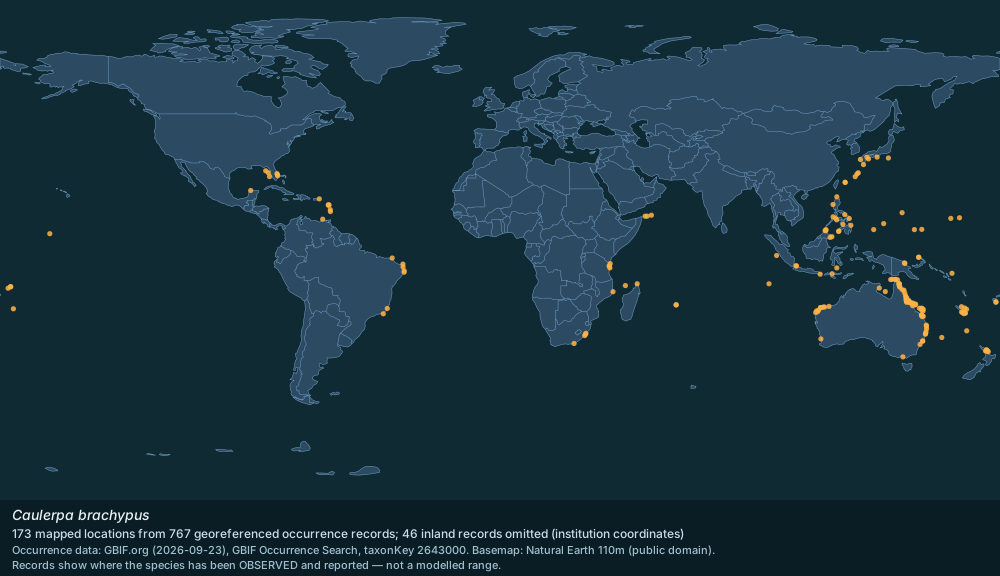
Distribution map plotted from GBIF.org occurrence records; basemap Natural Earth 110m · GBIF records CC0 / CC BY; Natural Earth public domain
Caulerpa brachypus is a species of seaweed in the Caulerpaceae family. It was first described in 1860 by the Irish botanist William Henry Harvey, having been collected during the North Pacific Exploring and Surveying Expedition of 1853 to 1856. It is native to the Indo-Pacific region and has spread elsewhere. It is regarded as an invasive species in the United States, Martinique and New Zealand.
- Scientific name
- Caulerpa brachypus
- Authority
- Harvey, 1860
- Family
- Caulerpaceae
- Order
- Bryopsidales
- Depth range
- 0–79 m
- Habitat zone
- sessile
- Gbif occurrence records
- 767
Classification (WoRMS)
Full classification as recorded by WoRMS: Kingdom: Plantae · Phylum: Chlorophyta · Class: Ulvophyceae · Order: Bryopsidales · Family: Caulerpaceae · Genus: Caulerpa.
Accepted name: Caulerpa brachypus · Authority: Harvey, 1860 · Taxonomic status: accepted · AphiaID: 211498.
Synonyms and superseded combinations recorded for this taxon: Caulerpa anceps Harvey, 1873; Caulerpa brachypus f. exposita Børgesen, 1951; Caulerpa brachypus var. mauritiana (Børgesen) Børgesen, 1948; Caulerpa mauritiana Børgesen, 1940; Caulerpa simplex Levring, 1938; Caulerpa stahlii Weber-van Bosse, 1898.
Source: World Register of Marine Species (WoRMS) — https://www.marinespecies.org/aphia.php?p=taxdetails&id=211498 (CC BY 4.0). Accessed 2026-09-23.
Biology and life history (SeaLifeBase)
Measured values published by SeaLifeBase for Caulerpa brachypus. Only fields the database actually holds for this species are shown; these are database values, not aquarium guidance.
Depth range: 0–79 m · Habitat zone: sessile · Fishery importance: commercial.
SeaLifeBase notes: Used for human consumption as food and medicine: antifungal, lowers blood pressure (Ref. 80758). Grows on sand flats or on sandy bottoms with coral rocks, or in tide pools at the open coast (Ref. 80758).
Source: SeaLifeBase species summary (SpecCode 111376) — https://www.sealifebase.se/summary/Caulerpa-brachypus.html (CC BY-NC 3.0 — non-commercial use only). Accessed 2026-09-23.
Distribution and occurrence records (GBIF)
767 georeferenced occurrence records for Caulerpa brachypus are published through GBIF from 34 countries or marine areas. The map above plots 173 distinct locations from a sample of 767 records, omitting 46 inland records that carry an institution's coordinates rather than a collection site; it shows where the species has been observed and reported, not a modelled range.
Most records by country or area: Australia (283); New Zealand (110); Japan (53); South Africa (37); Indonesia (35); Philippines (35); New Caledonia (33); Tanzania, United Republic of (26); Papua New Guinea (23); Brazil (15); Mauritius (14); United States of America (12); Wallis and Futuna (11); Fiji (10); Micronesia (Federated States of) (8).
Marine regions with a valid WoRMS distribution record: Mauritian Exclusive Economic Zone; Kenyan coast; Aldabra; Madagascar; Mozambican Exclusive Economic Zone; Seychellois Exclusive Economic Zone; Somali Exclusive Economic Zone; Tanzanian Exclusive Economic Zone; South Africa (country); United States.
Source: GBIF Occurrence Search (taxonKey 2643000) — https://www.gbif.org/occurrence/search?taxon_key=2643000&has_coordinate=true (records CC0 / CC BY); WoRMS distribution records (MarineRegions) — https://www.marinespecies.org/aphia.php?p=taxdetails&id=211498 (CC BY 4.0); Natural Earth 110m basemap — https://www.naturalearthdata.com/ (public domain). Accessed 2026-09-23.
Description and natural history (Wikipedia)
Caulerpa brachypus is a green seaweed with a horizontal creeping stolon which sends up blade-like fronds on short rhizoids at intervals. These thalli are tongue-like or strap-like in shape, up to 5 cm long and mainly green, sometimes with yellowish margins. Where they occur together, it is difficult to distinguish this species from other members of the genus Caulerpa, especially as there is considerable variation between different populations of Caulerpa brachypus growing in different habitats. Where conditions suit it, it can become very profuse and form dense stands.
Caulerpa brachypus is native to the tropical and subtropical Indo-Pacific region. Its range includes East Africa, India, southeastern and eastern Asia, the Pacific Islands and Western Australia. It is found along the Western Australia coast scattered over a large area in the Pilbara region between Exmouth and Port Hedland.
It was first detected in the United States, in Martin County, Florida, in 1999 and had spread to the Indian River Lagoon by 2003. It was found at Great Barrier Island in New Zealand in 2021. It is considered an invasive species in the United States, Martinique (in the Caribbean) and New Zealand.
It is probable that sexual reproduction in this species is similar to other members of the genus. However a much more common means of dispersal involves asexual reproduction, with fragments of the plant breaking off and re-establishing themselves elsewhere. In its native surroundings, this seaweed is kept in check by herbivorous fish but in Florida, few if any fish feed on it and it can flourish on off-shore reefs, reducing biodiversity. It is intolerant of bright light, growing best in shaded positions, being mostly found in the 25 to 47 m depth range where there is less light than at the surface. Where the water is turbid, it flourishes in shallower habitats.
In Florida, this seaweed has been dubbed the "killer algae". First recorded in the state in 1999, by 2003 it had shown explosive growth and spread widely, with some near shore reefs in Palm Beach County becoming so overwhelmed that fish and lobsters were no longer present. During hurricanes in 2004, it was scoured from the rocky reefs and disappeared, but over the next few years, it became re-established, once more forming dense stands. It is thought to become so abundant on Florida's coast because of the sewage outflows which result in extra nutrients being present in the water. Such extensive algal cover is likely to kill corals, sponges and other sessile invertebrates, and force more mobile organisms to move elsewhere.
Source: Wikipedia: Caulerpa brachypus — https://en.wikipedia.org/wiki/Caulerpa_brachypus (CC BY-SA 4.0). Accessed 2026-09-23.
Gallery
Spotted an error? Know more?
Reader corrections go straight into our review queue. Suggest an edit · How this site is sourced