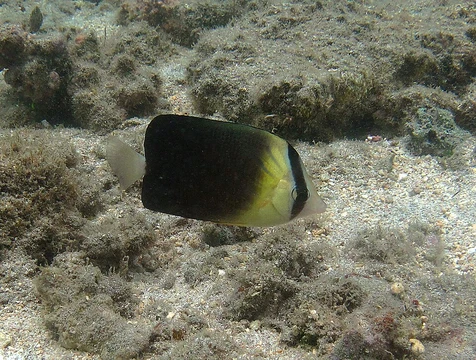
Brownburnie (Chaetodon blackburnii)
Source-cited species reference: taxonomy from WoRMS, biology from FishBase, occurrence map from GBIF, conservation from IUCN Red List, description from Wikipedia.

The brownburnie (Chaetodon blackburnii), also known as Blackburn's butterflyfish or the rayed butterflyfish, is a species of marine ray-finned fish, a butterflyfish belonging to the family Chaetodontidae. It is found in the western Indian Ocean.
- Scientific name
- Chaetodon blackburnii
- Authority
- Desjardins, 1836
- Family
- Chaetodontidae
- Order
- Acanthuriformes
- Maximum length
- 13 cm
- Habitat zone
- reef-associated
- Iucn red list
- Least Concern
- Gbif occurrence records
- 248
Classification (WoRMS)
Full classification as recorded by WoRMS: Kingdom: Animalia · Phylum: Chordata · Class: Teleostei · Order: Acanthuriformes · Family: Chaetodontidae · Genus: Chaetodon.
Accepted name: Chaetodon blackburnii · Authority: Desjardins, 1836 · Taxonomic status: accepted · AphiaID: 218757.
Synonyms and superseded combinations recorded for this taxon: Chaetodon blackburni Desjardins, 1836; Chaetodon blockburnii Desjardins, 1836; Tetragonoptrus blackburni (Desjardins, 1836).
Source: World Register of Marine Species (WoRMS) — https://www.marinespecies.org/aphia.php?p=taxdetails&id=218757 (CC BY 4.0). Accessed 2026-09-23.
Biology and life history (FishBase)
Measured values published by FishBase for Chaetodon blackburnii. Only fields the database actually holds for this species are shown; these are database values, not aquarium guidance.
Maximum length: 13 cm · Habitat zone: reef-associated · Body shape: short and / or deep · Vulnerability index: 10 of 100 · Fishery importance: commercial · Aquarium trade: commercial.
FishBase notes: Inhabit outer reef slopes with moderate coral growth (Ref. 9710). Oviparous (Ref. 205). Form pairs during breeding (Ref. 205).
Source: FishBase species summary (SpecCode 8015) — https://www.fishbase.se/summary/Chaetodon-blackburnii.html (CC BY-NC 3.0 — non-commercial use only). Accessed 2026-09-23.
Distribution and occurrence records (GBIF)
248 georeferenced occurrence records for Chaetodon blackburnii are published through GBIF from 6 countries or marine areas. The map above plots 36 distinct locations from a sample of 248 records, omitting 3 inland records that carry an institution's coordinates rather than a collection site; it shows where the species has been observed and reported, not a modelled range.
Most records by country or area: South Africa (165); Réunion (42); Mozambique (21); Madagascar (13); Mauritius (6); Kenya (1).
Marine regions with a valid WoRMS distribution record: Mozambican Exclusive Economic Zone; Madagascar; Mauritian Exclusive Economic Zone; Réunion Exclusive Economic Zone; Tanzanian Exclusive Economic Zone; Kenyan Exclusive Economic Zone; South Africa (country).
Source: GBIF Occurrence Search (taxonKey 2385386) — https://www.gbif.org/occurrence/search?taxon_key=2385386&has_coordinate=true (records CC0 / CC BY); WoRMS distribution records (MarineRegions) — https://www.marinespecies.org/aphia.php?p=taxdetails&id=218757 (CC BY 4.0); Natural Earth 110m basemap — https://www.naturalearthdata.com/ (public domain). Accessed 2026-09-23.
Conservation status (IUCN Red List)
The IUCN Red List assesses Chaetodon blackburnii Desjardins, 1836 as Least Concern (code LC). No trend, population estimate or threat analysis is given here, because none is available from this source without the Red List API; follow the source link for the full assessment, including its date.
Source: IUCN Red List of Threatened Species (taxon 165709) — https://www.iucnredlist.org/species/165709/0; GBIF IUCN Red List category endpoint (taxonKey 2385386) — https://api.gbif.org/v1/species/2385386/iucnRedListCategory. Accessed 2026-09-23.
Description and natural history (Wikipedia)
The brownburnie is rather drab when compared to many of its congeners. The body of this species is mainly brownish black with the head and front part of the body being bright yellow with a black vertical bar running across the eye. The dark colour extends onto the dorsal fin and the anal fin while the pelvic fins are bright yellow. The dorsal fin contains 16 spines and 21-23 soft rays while the anal fin has 3 spines and 17-18 soft rays. This species attains a maximum total length of 13 cm.
The brownburnie is found in the western Indian Ocean. It is distributed along the East African coast from Kenya in the north to the Mbhashe River in the Eastern Cape Province of South Africa. It has also been recorded from the French Southern and Antarctic Lands in the Mozambique Channel islands, Madagascar, Mauritius, Rodrigues and Réunion in the Indian Ocean.
The brownburnie inhabits shallow rocky reefs and calm bays with limited growth of coral. They are found wither solitarily or in pairs. They are omnivorous and feed on benthic invertebrates such as bivalves, soft coral polyps, crustaceans and worms as well as zooplankton. it is an oviparous species in which the male and females mate as pairs.
The brownburnie was first formally described in 1836 by the French naturalist Julien Desjardins (1799-1840) with the type locality given as Mauritius. The specific name honours the English jurist Edward Berens Blackburn (1786-1839) who was the Chief Justice of Mauritius from 1824 to 1835 and president of the Société d'Histoire Naturelle de l'Ile Maurice (the Natural History Society of the island of Mauritius).
The brownburnie is rarely seen in the aquarium trade because of its comparatively drab colouration.
Source: Wikipedia: Brownburnie — https://en.wikipedia.org/wiki/Brownburnie (CC BY-SA 4.0). Accessed 2026-09-23.
Frequently Asked Questions
What is the Brownburnie (Chaetodon blackburnii)?
The Brownburnie is a small reef-dwelling butterflyfish from the western Indian Ocean, also called Blackburn's butterflyfish or the rayed butterflyfish. It sits within the family Chaetodontidae and the order Acanthuriformes.
Where does the Brownburnie (Chaetodon blackburnii) live?
This species is restricted to the western Indian Ocean and is consistently found in close association with coral reef habitats. It does not appear to range into open-water or non-reef environments.
How big does the Brownburnie (Chaetodon blackburnii) get?
At most, an adult Brownburnie reaches roughly 13 centimeters in length, placing it among the smaller members of the butterflyfish family.
Who named the Brownburnie (Chaetodon blackburnii) and when?
The species was formally described by Desjardins in 1836. Its taxonomic record is maintained in databases such as WoRMS, while biological details are tracked through FishBase.
What makes the Brownburnie (Chaetodon blackburnii) distinct from other butterflyfish?
Its combination of a limited western Indian Ocean range, a modest 13 cm max size, and a reef-tied lifestyle sets it apart from many broader-range Chaetodon relatives. The common name 'rayed butterflyfish' also hints at a distinctive patterning that fans use to spot it in the field.
Spotted an error? Know more?
Reader corrections go straight into our review queue. Suggest an edit · How this site is sourced