
Corky seafinger (Briareum asbestinum)
Source-cited species reference: taxonomy from WoRMS, biology from SeaLifeBase, occurrence map from GBIF, description from Wikipedia.

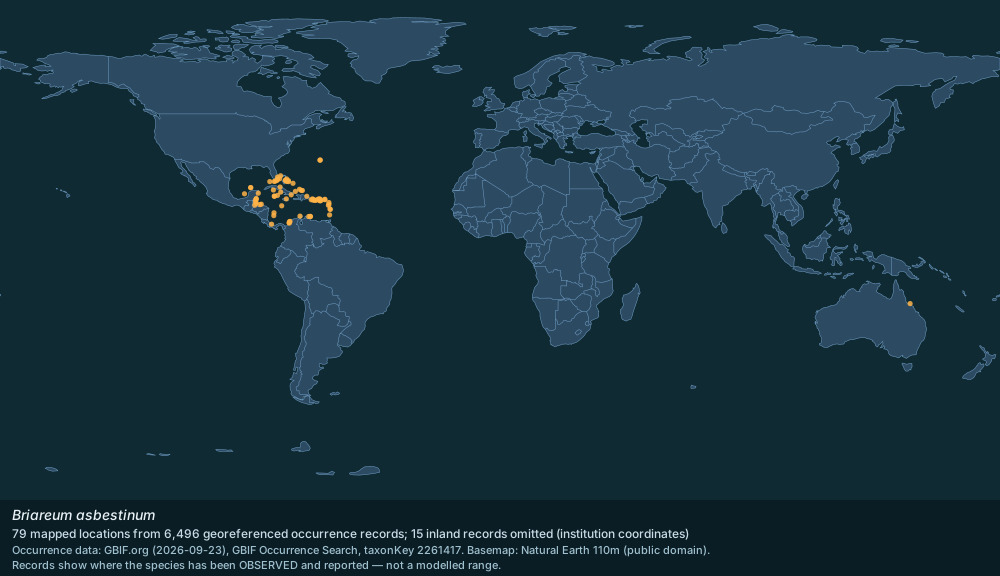
Distribution map plotted from GBIF.org occurrence records; basemap Natural Earth 110m · GBIF records CC0 / CC BY; Natural Earth public domain
Briareum asbestinum, commonly known as the corky sea finger, is a species of a soft coral in the family Briareidae. It inhabits coral reefs and rocky bottoms in the Caribbean, Bahamas, and Florida, often growing to 30 cm at depths of one to 40 metres.
- Scientific name
- Briareum asbestinum
- Authority
- (Pallas, 1766)
- Family
- Briareidae
- Order
- Scleralcyonacea
- Depth range
- 1–55 m
- Habitat zone
- sessile
- Gbif occurrence records
- 6,496
Classification (WoRMS)
Full classification as recorded by WoRMS: Kingdom: Animalia · Phylum: Cnidaria · Class: Octocorallia · Order: Scleralcyonacea · Family: Briareidae · Genus: Briareum.
Accepted name: Briareum asbestinum · Authority: (Pallas, 1766) · Taxonomic status: accepted · AphiaID: 289534.
Synonyms and superseded combinations recorded for this taxon: Alcyonium asbestinum Pallas, 1766; Ammothea polyanthes Duchassaing & Michelotti, 1860; Asbestia asbestinum (Pallas, 1766); Briarea asbestina (Pallas, 1766); Briareum gorgonoideum Blainville, 1830; Briareum marquesarum (Kükenthal, 1916); Briareum polyanthes (Duchassaing & Michelotti, 1860); Erythropodium marquesarum Kükenthal, 1916; Erythropodium polyanthes (Duchassaing & Michelotti, 1860); Gorgonia briareus Ellis & Solander, 1786; Lobularia asbestina (Pallas, 1766); Nephthya polyanthus (Duchassaing & Michelotti, 1860); Solenopodium marquesarum (Kükenthal, 1916); Solenopodium polyanthes (Duchassaing & Michelotti, 1860); Titanideum hartmeyeri Kükenthal, 1908; Vioa asbestina (Pallas, 1766).
Source: World Register of Marine Species (WoRMS) — https://www.marinespecies.org/aphia.php?p=taxdetails&id=289534 (CC BY 4.0). Accessed 2026-09-23.
Biology and life history (SeaLifeBase)
Measured values published by SeaLifeBase for Briareum asbestinum. Only fields the database actually holds for this species are shown; these are database values, not aquarium guidance.
Depth range: 1–55 m · Habitat zone: sessile.
SeaLifeBase notes: Maximum depth from Ref. 109199. This species is found at depths of 0.5 to 12 m, in coral reefs and rocky bottoms (Ref. 83916). Intertidal up to a depth of 55 m (Ref. 91956). In Belize, it was found in a submarine cave near Columbus Cay at a depth of 10 m (Ref. 87209).
Source: SeaLifeBase species summary (SpecCode 42931) — https://www.sealifebase.se/summary/Briareum-asbestinum.html (CC BY-NC 3.0 — non-commercial use only). Accessed 2026-09-23.
Distribution and occurrence records (GBIF)
6,496 georeferenced occurrence records for Briareum asbestinum are published through GBIF from 32 countries or marine areas. The map above plots 79 distinct locations from a sample of 3,000 records, omitting 15 inland records that carry an institution's coordinates rather than a collection site; it shows where the species has been observed and reported, not a modelled range.
Most records by country or area: Virgin Islands (U.S.) (3,443); Puerto Rico (1,948); Colombia (518); Mexico (102); United States of America (92).
The full country table, WoRMS marine regions and the sampling notes are on this species' Distribution page.
Source: GBIF Occurrence Search (taxonKey 2261417) — https://www.gbif.org/occurrence/search?taxon_key=2261417&has_coordinate=true (records CC0 / CC BY); WoRMS distribution records (MarineRegions) — https://www.marinespecies.org/aphia.php?p=taxdetails&id=289534 (CC BY 4.0); Natural Earth 110m basemap — https://www.naturalearthdata.com/ (public domain). Accessed 2026-09-23.
Description and natural history (Wikipedia)
Although different in form, and different enough genetically to be considered as separate populations, the small encrusting polyps of Briareum asbestinum that grow on surfaces are still considered as conspecific with the larger, tall tube-shaped form.
This species grows large vertical cylindrical tubes or "fingers". These fingers are usually un-branched and may reach up to one metre in length. The morphology of the fingers varies as those found in shallow (5m) water depth are shorter and stouter than those found at the deeper (35m) sites. Shallow water morphs also have shorter sclerites than their deepwater counterparts.This phenotypic plasticity results from unknown environmental factors, but may be the result of predation, light density reductions with depth, or increased fragility in shallow waters.
Polyp density and colony thickness is also reduced at deeper depths. The polyps are over 1cm in size, which produce a hairy appearance to the surface of the coral. This surface may be purple, grey, tan, brown or greenish-brown in colour underneath.
Briareum asbestinum is found in shallow tropical waters of the western Atlantic Ocean and Caribbean Sea in depths up to 35m. It can be abundant in back-reef areas, on areas of coral rubble, and is also found in seagrass beds.
Briareum asbestinum can reproduce both sexually, by the annual release of gametes into the water column, and vegetatively by the growth of broken fragments that settle to the ocean floor and can colonize a suitable site.
Briareum asbestinum is threatened by rising ocean temperatures that cause coral bleaching.
Source: Wikipedia: Briareum asbestinum — https://en.wikipedia.org/wiki/Briareum_asbestinum (CC BY-SA 4.0). Accessed 2026-09-23.
Gallery
Related in Corky seafinger
Links follow this subject's own source article.
Elsewhere in Corky seafinger
Spotted an error? Know more?
Reader corrections go straight into our review queue. Suggest an edit · How this site is sourced