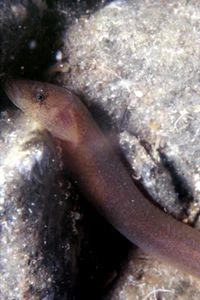
Blunt-snouted clingfish (Gouania willdenowi)
Source-cited species reference: taxonomy from WoRMS, biology from FishBase, occurrence map from GBIF, conservation from IUCN Red List, description from Wikipedia.

The blunt-snouted clingfish (Gouania willdenowi) is a species of clingfish found along the western Mediterranean Sea coasts from Spain to Italy. This species grows to a length of 5 cm TL. The blunt-nosed clingfish is a little known species of shallow water along the littoral of the northern Mediterranean from Alicante to Sicily. Its range was formerly thought to extend to Israel and Syria in the east; however this was actually several closely related cryptic species. It can survive out of the water and occurs only among intertidal pebbles and sand.
- Scientific name
- Gouania willdenowi
- Authority
- (Risso, 1810)
- Family
- Gobiesocidae
- Order
- Gobiesociformes
- Maximum length
- 4.610000133514404 cm
- Depth range
- 0–2 m
- Habitat zone
- demersal
- Iucn red list
- Least Concern
- Gbif occurrence records
- 180
Classification (WoRMS)
Full classification as recorded by WoRMS: Kingdom: Animalia · Phylum: Chordata · Class: Teleostei · Order: Gobiesociformes · Family: Gobiesocidae · Genus: Gouania.
Accepted name: Gouania willdenowi · Authority: (Risso, 1810) · Taxonomic status: accepted · AphiaID: 126516.
Synonyms and superseded combinations recorded for this taxon: Gouania wildenowi (Risso, 1810); Lepadogaster willdenowi Risso, 1810; Leptopterygius coccoi Troschel, 1860; Rupisuga nicensis Swainson, 1839.
Source: World Register of Marine Species (WoRMS) — https://www.marinespecies.org/aphia.php?p=taxdetails&id=126516 (CC BY 4.0). Accessed 2026-09-23.
Biology and life history (FishBase)
Measured values published by FishBase for Gouania willdenowi. Only fields the database actually holds for this species are shown; these are database values, not aquarium guidance.
Maximum length: 4.610000133514404 cm · Depth range: 0–2 m · Habitat zone: demersal · Body shape: elongated · Vulnerability index: 10 of 100 · Aquarium trade: never/rarely.
FishBase notes: Inhabits shallow waters (Ref. 10954). It reaches highest abundances in pebble and boulder beaches of less than 0.5 m depth (24 individuals/m2 in Messina), but reported to be found down to 2 m of water depth. It was also observed to occur with Lepadogaster lepadogaster and that males build and guard nests under boulders during spawning season (Ref.
Source: FishBase species summary (SpecCode 50846) — https://www.fishbase.se/summary/Gouania-willdenowi.html (CC BY-NC 3.0 — non-commercial use only). Accessed 2026-09-23.
Distribution and occurrence records (GBIF)
180 georeferenced occurrence records for Gouania willdenowi are published through GBIF from 8 countries or marine areas. The map above plots 11 distinct locations from a sample of 180 records, omitting 12 inland records that carry an institution's coordinates rather than a collection site; it shows where the species has been observed and reported, not a modelled range.
Most records by country or area: France (89); Italy (70); Spain (12); Croatia (4); Israel (2); Greece (1); Lebanon (1); Monaco (1).
Marine regions with a valid WoRMS distribution record: European waters (ERMS scope); Greek Exclusive Economic Zone.
Source: GBIF Occurrence Search (taxonKey 5214476) — https://www.gbif.org/occurrence/search?taxon_key=5214476&has_coordinate=true (records CC0 / CC BY); WoRMS distribution records (MarineRegions) — https://www.marinespecies.org/aphia.php?p=taxdetails&id=126516 (CC BY 4.0); Natural Earth 110m basemap — https://www.naturalearthdata.com/ (public domain). Accessed 2026-09-23.
Conservation status (IUCN Red List)
The IUCN Red List assesses Gouania willdenowi (Risso, 1810) as Least Concern (code LC). No trend, population estimate or threat analysis is given here, because none is available from this source without the Red List API; follow the source link for the full assessment, including its date.
Source: IUCN Red List of Threatened Species (taxon 274987900) — https://www.iucnredlist.org/species/274987900/0; GBIF IUCN Red List category endpoint (taxonKey 5214476) — https://api.gbif.org/v1/species/5214476/iucnRedListCategory. Accessed 2026-09-23.
Description and natural history (Wikipedia)
This species was formerly the only known member of Gouania; however, a 2020 study described three new species and resurrected a synonym of G. willdenowi (G. pigra) to species status. It was described as Lepadogaster willdenowi by Antoine Risso in 1810 from a type locality of Nice, France, it was subsequently placed in the monotypic genus Covania by Giovanni Domenico Nardo in 1833 and this was corrected to Gouania in 1864 by Giovanni Canestrini. The generic name honours the French botanist Antoine Gouan (1733-1821), Nardo's original name Covania being a latinisation of Gouan, while the specific name honours another botanist, the German Carl Ludwig Willdenow (1765-1812).
Source: Wikipedia: Blunt-snouted clingfish — https://en.wikipedia.org/wiki/Blunt-snouted_clingfish (CC BY-SA 4.0). Accessed 2026-09-23.
Frequently Asked Questions
What is the Blunt-snouted clingfish (Gouania willdenowi)?
It is a small clingfish in the family Gobiesocidae, originally described by Risso back in 1810. The species occupies the shallow littoral zone along the western Mediterranean, spanning the coasts from Spain through to Italy.
Where exactly can you find Gouania willdenowi in the wild?
This fish is restricted to intertidal pebbles and sandy flats along the northern Mediterranean, stretching from the Alicante region to Sicily. It inhabits very shallow water, generally between 0 and 2 metres depth.
How large does the Blunt-snouted clingfish grow?
It is a very small fish, topping out at roughly 4.6 to 5 centimetres in total length. Despite its modest size, it is well suited to life among the rocky intertidal substrate.
Can the Blunt-snouted clingfish survive out of water?
Yes, Gouania willdenowi can tolerate being exposed to air for stretches of time, a notable trait among fish. This ability lets it persist among intertidal pebbles and sand where low tide periodically leaves it above the waterline.
Why was the Blunt-snouted clingfish's range once thought to reach Israel and Syria?
Older records from the eastern Mediterranean were later shown to belong to several closely related cryptic species rather than to G. willdenowi itself. The confirmed distribution of this particular clingfish is therefore limited to the western and central northern Mediterranean.
Spotted an error? Know more?
Reader corrections go straight into our review queue. Suggest an edit · How this site is sourced