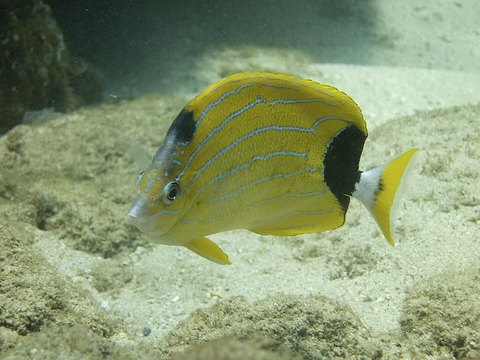
Bluestriped butterflyfish (Chaetodon fremblii)
Source-cited species reference: taxonomy from WoRMS, biology from FishBase, occurrence map from GBIF, conservation from IUCN Red List, description from Wikipedia.

The bluestripe butterflyfish or blue-striped butterflyfish (Chaetodon fremblii) is a species of butterflyfish (family Chaetodontidae) found in the waters surrounding the Hawaiian Islands. The fish is endemic to Hawaii where it is common on shallow water reefs.
- Scientific name
- Chaetodon fremblii
- Authority
- Bennett, 1828
- Family
- Chaetodontidae
- Order
- Acanthuriformes
- Maximum length
- 13 cm
- Depth range
- 4–65 m
- Habitat zone
- reef-associated
- Iucn red list
- Least Concern
- Gbif occurrence records
- 2,876
Classification (WoRMS)
Full classification as recorded by WoRMS: Kingdom: Animalia · Phylum: Chordata · Class: Teleostei · Order: Acanthuriformes · Family: Chaetodontidae · Genus: Chaetodon.
Accepted name: Chaetodon fremblii · Authority: Bennett, 1828 · Taxonomic status: accepted · AphiaID: 273339.
Source: World Register of Marine Species (WoRMS) — https://www.marinespecies.org/aphia.php?p=taxdetails&id=273339 (CC BY 4.0). Accessed 2026-09-23.
Biology and life history (FishBase)
Measured values published by FishBase for Chaetodon fremblii. Only fields the database actually holds for this species are shown; these are database values, not aquarium guidance.
Maximum length: 13 cm · Depth range: 4–65 m · Habitat zone: reef-associated · Body shape: short and / or deep · Vulnerability index: 10 of 100 · Fishery importance: commercial · Aquarium trade: commercial.
FishBase notes: Inhabit areas with rock or coral (Ref. 9710). Benthopelagic (Ref. 58302). Prey on the tentacles of tubeworms and other invertebrates (Ref. 3921). Oviparous (Ref. 205). Form pairs during breeding (Ref. 205).
Source: FishBase species summary (SpecCode 7808) — https://www.fishbase.se/summary/Chaetodon-fremblii.html (CC BY-NC 3.0 — non-commercial use only). Accessed 2026-09-23.
Distribution and occurrence records (GBIF)
2,876 georeferenced occurrence records for Chaetodon fremblii are published through GBIF from 3 countries or marine areas. The map above plots 32 distinct locations from a sample of 2,876 records, omitting 13 inland records that carry an institution's coordinates rather than a collection site; it shows where the species has been observed and reported, not a modelled range.
Most records by country or area: United States of America (2,622); United States Minor Outlying Islands (253); Australia (1).
The full country table, WoRMS marine regions and the sampling notes are on this species' Distribution page.
Source: GBIF Occurrence Search (taxonKey 2385500) — https://www.gbif.org/occurrence/search?taxon_key=2385500&has_coordinate=true (records CC0 / CC BY); WoRMS distribution records (MarineRegions) — https://www.marinespecies.org/aphia.php?p=taxdetails&id=273339 (CC BY 4.0); Natural Earth 110m basemap — https://www.naturalearthdata.com/ (public domain). Accessed 2026-09-23.
Conservation status (IUCN Red List)
The IUCN Red List assesses Chaetodon fremblii Bennett, 1828 as Least Concern (code LC). No trend, population estimate or threat analysis is given here, because none is available from this source without the Red List API; follow the source link for the full assessment, including its date.
Source: IUCN Red List of Threatened Species (taxon 165662) — https://www.iucnredlist.org/species/165662/0; GBIF IUCN Red List category endpoint (taxonKey 2385500) — https://api.gbif.org/v1/species/2385500/iucnRedListCategory. Accessed 2026-09-23.
Description and natural history (Wikipedia)
The bluestripe butterflyfish, like other butterflyfish, are laterally flattened fish up to 15 cm long with pointed snouts and rectangular bodies. The dorsal fin has 12 to 14 spines and 20 to 21 soft rays, while the anal fin has 3 spines and 16 to 18 soft rays. The bluestripe butterflyfish has eight distinctive diagonal blue stripes radiating from the eye region, on a yellow background. There is a black spot at the top of the head and another larger spot of black at the base of the tail. This latter dark patch may serve to distract predators by encouraging them to attack the tail rather than the head end.
The bluestripe butterflyfish is endemic to the Hawaiian Islands where it is described as being abundant on coral and rocky reefs down to depths of about 28 m.
The bluestripe butterflyfish is an omnivore, unlike some butterflyfishes which feed almost exclusively on corals. These specialists usually have mating systems involving a pair bond, but the omnivorous bluestripe butterflyfish lives in a more resource-rich environment, where it is easier to find sufficient food. As a result, males of this species operate a harem system, defending a territory which includes up to four smaller female territories.
The bluestripe butterflyfish was first formally described in 1828 by the English naturalist Edward Turner Bennett (1797-1836). The specific name honours Lieutenant John Frembly R.N., a marine surveyor and geologist, who presented a collection of fish specimens from the Sandwich Islands to the Zoological Society of London.
The bluestripe butterflyfish is sometimes kept in reef aquaria where its generalised diet means that it is easier to maintain than corallivorous types. Specimens are harvested from the wild and it is sometimes difficult to get the fish to eat in captivity. In this respect, juveniles within two or three months of settling are more willing to accept prepared and novel foods. Attempts have been made to breed the fish in captivity, but the lengthy larval period of about two months in the open ocean is difficult to replicate in captivity.
Source: Wikipedia: Bluestripe butterflyfish — https://en.wikipedia.org/wiki/Bluestripe_butterflyfish (CC BY-SA 4.0). Accessed 2026-09-23.
Frequently Asked Questions
What is the Bluestriped butterflyfish (Chaetodon fremblii)?
It is a small reef-dwelling butterflyfish that exists nowhere else on Earth except the waters around the Hawaiian Islands. Described by Bennett back in 1828, it belongs to the family Chaetodontidae and is a familiar sight on shallow coral reefs in that region.
Where does the Bluestriped butterflyfish live and how deep can it be found?
This species is strictly endemic to Hawaii, meaning it is naturally found only in the waters surrounding those islands. It typically inhabits shallow reef habitats, with records spanning depths from about 4 meters down to roughly 65 meters.
How big does a Bluestriped butterflyfish (Chaetodon fremblii) get?
Adults reach a maximum total length of around 13 centimeters, making them a relatively compact member of the butterflyfish family. This modest size suits their niche among the crevices and structures of shallow Hawaiian reefs.
What is the Bluestriped butterflyfish's taxonomic classification?
Chaetodon fremblii sits in the family Chaetodontidae and the order Acanthuriformes. Its original description was published by Bennett in 1828, giving it a long-standing place in the scientific record of Hawaiian marine fauna.
Is the Bluestriped butterflyfish considered rare or threatened?
Because it is described as common across shallow reef habitats throughout the Hawaiian Islands, it does not appear to face the same pressures as many other reef species. Its limited geographic range to Hawaii does, however, make it inherently dependent on the health of those specific ecosystems.
Related in Bluestriped butterflyfish
Links follow this subject's own source article.
Elsewhere in Bluestriped butterflyfish
Spotted an error? Know more?
Reader corrections go straight into our review queue. Suggest an edit · How this site is sourced