
Bluespotted ribbontail ray (Taeniura lymma)
Source-cited species reference: taxonomy from WoRMS, biology from FishBase, occurrence map from GBIF, conservation from IUCN Red List, description from Wikipedia.
The bluespotted ribbontail ray (Taeniura lymma) is a species of stingray in the family Dasyatidae. Found from the intertidal zone to a depth of 30 m, this species is common throughout the tropical Indian and western Pacific Oceans in nearshore, coral reef–associated habitats. It is a fairly small ray, not exceeding 35 cm in width, with a mostly smooth, oval pectoral fin disc, large protruding eyes, and a relatively short and thick tail with a deep fin fold underneath. It can be easily identified by its striking color pattern of many electric blue spots on a yellowish background, with a pair of blue stripes on the tail.
- Scientific name
- Taeniura lymma
- Authority
- (Fabricius, 1775)
- Family
- Dasyatidae
- Order
- Myliobatiformes
- Maximum length
- 35 cm
- Depth range
- 0–20 m
- Habitat zone
- reef-associated
- Iucn red list
- Least Concern
- Gbif occurrence records
- 6,303
Classification (WoRMS)
Full classification as recorded by WoRMS: Kingdom: Animalia · Phylum: Chordata · Class: Elasmobranchii · Order: Myliobatiformes · Family: Dasyatidae · Genus: Taeniura.
Accepted name: Taeniura lymma · Authority: (Fabricius, 1775) · Taxonomic status: accepted · AphiaID: 217422.
Synonyms and superseded combinations recorded for this taxon: Raja lymma Fabricius, 1775; Taeniura lymna (Fabricius, 1775); Trygon ornatus Gray, 1830.
Source: World Register of Marine Species (WoRMS) — https://www.marinespecies.org/aphia.php?p=taxdetails&id=217422 (CC BY 4.0). Accessed 2026-09-23.
Biology and life history (FishBase)
Measured values published by FishBase for Taeniura lymma. Only fields the database actually holds for this species are shown; these are database values, not aquarium guidance.
Maximum length: 35 cm · Depth range: 0–20 m · Habitat zone: reef-associated · Body shape: other · Vulnerability index: 90 of 100 · Fishery importance: commercial · Aquarium trade: commercial.
FishBase notes: Occurs around coral reefs (Ref. 6871, 58534). Migrates in groups into shallow sandy areas during the rising tide to feed on mollusks, worms, shrimps, and crabs; disperses on falling tide to seek shelter in caves and under ledges (Ref. 6871). Rarely found buried under the sand (Ref. 12951). Ovoviviparous (Ref. 50449). Small specimens are popular among marine aquarists (Ref. 5578). Does not do well in aquariums (Ref. 12951). Maximum length about 70 cm TL (Ref. 30573). Reports of specimens reaching 240 cm TL are probably inaccurate (Ref. 6871). Commonly caught by fisheries operating over shallow coral reefs and probably adversely affected by dynamite fishing. Utilized widely for its meat (Ref.58048). Minimum depth reported taken from Ref. 86942.
Source: FishBase species summary (SpecCode 5399) — https://www.fishbase.se/summary/Taeniura-lymma.html (CC BY-NC 3.0 — non-commercial use only). Accessed 2026-09-23.
Distribution and occurrence records (GBIF)
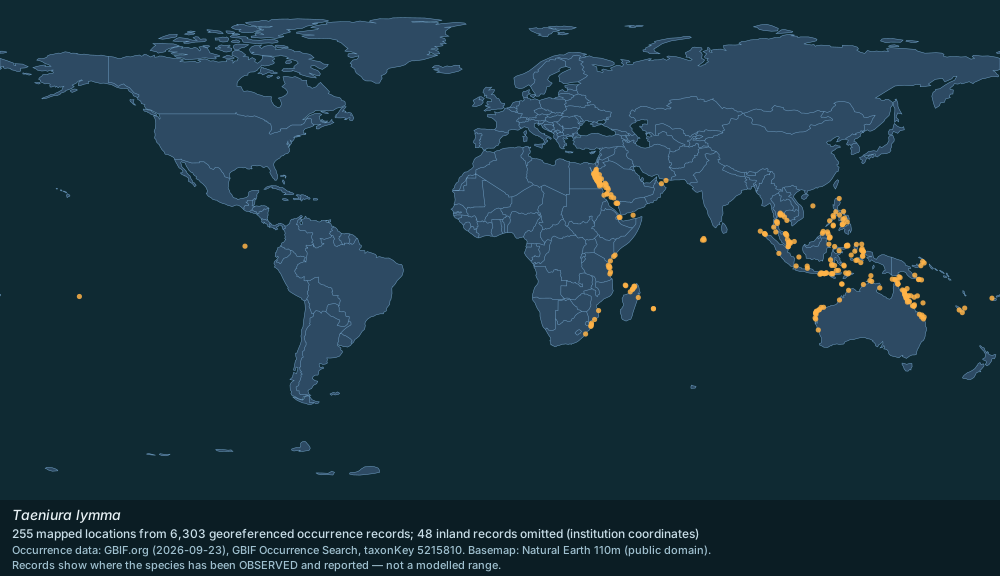
6,303 georeferenced occurrence records for Taeniura lymma are published through GBIF from 44 countries or marine areas. The map above plots 255 distinct locations from a sample of 3,000 records, omitting 48 inland records that carry an institution's coordinates rather than a collection site; it shows where the species has been observed and reported, not a modelled range.
Most records by country or area: Australia (2,785); Egypt (1,768); Indonesia (425); Malaysia (259); South Africa (219).
The full country table, WoRMS marine regions and the sampling notes are on this species' Distribution page.
Source: GBIF Occurrence Search (taxonKey 5215810) — https://www.gbif.org/occurrence/search?taxon_key=5215810&has_coordinate=true (records CC0 / CC BY); WoRMS distribution records (MarineRegions) — https://www.marinespecies.org/aphia.php?p=taxdetails&id=217422 (CC BY 4.0); Natural Earth 110m basemap — https://www.naturalearthdata.com/ (public domain). Accessed 2026-09-23.
Conservation status (IUCN Red List)
The IUCN Red List assesses Taeniura lymma (Forsskål, 1775) as Least Concern (code LC). No trend, population estimate or threat analysis is given here, because none is available from this source without the Red List API; follow the source link for the full assessment, including its date.
Source: IUCN Red List of Threatened Species (taxon 116850766) — https://www.iucnredlist.org/species/116850766/0; GBIF IUCN Red List category endpoint (taxonKey 5215810) — https://api.gbif.org/v1/species/5215810/iucnRedListCategory. Accessed 2026-09-23.
Description and natural history (Wikipedia)
At night, small groups of bluespotted ribbontail rays follow the rising tide onto sandy flats to root for small benthic invertebrates and bony fishes in the sediment. When the tide recedes, the rays separate and withdraw to shelters on the reef. Reproduction is Ovoviviparity. With the females giving birth to litters of up to seven young. This ray is capable of injuring humans with its venomous tail spines, though it prefers to flee if threatened. Because of its beauty and size, the bluespotted ribbontail ray is popular with private aquarists despite being poorly suited to captivity.
The bluespotted ribbontail ray was originally described as Raja lymma by Swedish naturalist Peter Forsskål, in his 1775 Descriptiones Animalium quae in itinere ad maris australis terras per annos 1772, 1773, et 1774 suscepto collegit, observavit, et delineavit Joannes Reinlioldus Forster, etc., curante Henrico Lichtenstein. The specific epithet lymma means "dirt". Forsskål did not designate a type specimen. In 1837, German biologists Johannes Peter Müller and Friedrich Gustav Jakob Henle created the genus Taeniura for Trygon ornatus, now known to be a junior synonym of this species.
Other common names used for this species include bluespotted ray, bluespotted fantail ray, bluespotted lagoon ray, bluespotted stingray, fantail ray, lesser fantail ray, lagoon ray, reef ray, ribbon-tailed stingray, and ribbontail stingray. Morphological examination has suggested that the bluespotted ribbontail ray is more closely related to the amphi-American Himantura (H. pacifica and H. schmardae) and the river stingrays (Potamotrygonidae) than to the congeneric blotched fantail ray (T. meyeni), which is closer to Dasyatis and Indo-Pacific Himantura.
Widespread in the nearshore waters of the tropical Indo-Pacific region, the bluespotted ribbontail ray has a range that extends around the periphery of the Indian Ocean from South Africa to the Arabian Peninsula to Southeast Asia, including Madagascar, Mauritius, Zanzibar, the Seychelles, Sri Lanka, and the Maldives. It is rare in the Persian Gulf and Gulf of Oman. In the Pacific Ocean, this species is found from the Philippines to northern Australia, as well as around numerous Melanesian and Polynesian islands as far east as the Solomon Islands. Rarely found deeper than 30 m, the bluespotted ribbontail ray is a bottom-dwelling species that frequents coral reefs and adjacent sandy flats. It is also commonly encountered in the intertidal zone and tidal pools, and has been sighted near seagrass beds. Every summer, considerable numbers of bluespotted ribbontail rays arrive off South Africa.
The pectoral fin disc of the bluespotted ribbontail ray is oval in shape, around 12-14 inches wide, with a rounded angular snout. The large, protruding eyes are immediately followed by the broad spiracles. There is a narrow flap of skin between the nares with a fringed posterior margin, reaching past the mouth. The lower jaw dips at the middle and deep furrows are present at the mouth corners. There are 15–24 rows of teeth in each jaw, arranged into pavement-like plates, and two large papillae on the floor of the mouth. The pelvic fins are narrow and angular. The thick, depressed tail measures about 1.5 times the disc length and bears one or two (usually two) serrated spines well behind the tail base; there is a deep fin fold on the ventral surface, reaching the tip of the tail, and a low midline ridge on the upper surface.
The skin is generally smooth, save for perhaps a scattering of small thorns on the middle of the back. The dorsal coloration is striking, consisting of numerous circular, neon blue spots on a yellowish brown or green skin; the spots vary in size, becoming smaller and denser towards the disc margin. The tail has two stripes of the same blue running along each side as far as the spines. The eyes are bright yellow and the belly is white. Individuals found off southern Africa may lack the blue tail stripes. The bluespotted ribbontail ray grows to 35 cm across, 80 cm long, and 5 kg.
One of the most abundant stingrays inhabiting Indo-Pacific reefs, the bluespotted ribbontail ray generally spends the day hidden alone inside caves or under coral ledges or other debris (including from shipwrecks), often with only its tail sticking out. At night, small groups assemble and swim onto shallow sandy flats with the rising tide to feed. Unlike many other stingrays, this species seldom buries itself in sand. The bluespotted ribbontail ray excavates sand pits in search of molluscs, polychaete worms, shrimps, crabs, and small benthic bony fishes; when prey is located, it is trapped by the body of the ray and maneuvered into the mouth with the disc. Other fishes, such as goatfish, frequently follow foraging rays, seeking food missed by the ray.
Breeding in the bluespotted ribbontail ray occurs from late spring to summer; the male follows the female and nips at her disc, eventually biting and holding onto her for copulation. There is also a documented instance of a male holding onto the disc of a smaller male bluespotted stingray (Neotrygon kuhlii), in a possible case of mistaken identity. Adult males have been observed gathering in shallow water, which may relate to reproduction. Like other stingrays, this species is aplacental viviparous: the embryos are initially sustained by yolk, which later in development is supplemented by histotroph ("uterine milk", containing mucus, fat, and proteins) produced by the mother. The gestation period is uncertain, but is thought to be between four and twelve months long. Females bear litters of up to seven young, each a miniature version of the adult measuring around 13 - 14 cm across. Males attain sexual maturity at a disc width of 20 - 21 cm; the maturation size of females is unknown.
Known predators of the bluespotted ribbontail ray include hammerhead sharks (Sphyrna) and bottlenose dolphins (Tursiops); it is also potentially preyed upon by other large fishes and marine mammals. When threatened, this ray tends to flee at high speed in a zigzag pattern, to throw off pursuers. Numerous parasites have been identified from this species: the tapeworms Aberrapex manjajiae, Anthobothrium taeniuri, Cephalobothrium taeniurai, Echinobothrium elegans and E. helmymohamedi, Kotorelliella jonesi, Polypocephalus saoudi, and Rhinebothrium ghardaguensis and R. taeniuri, the monogeneans Decacotyle lymmae, Empruthotrema quindecima, Entobdella australis, and Pseudohexabothrium taeniurae, the flatworms Pedunculacetabulum ghardaguensis and Anaporrhutum albidum, the nematode Mawsonascaris australis, the copepod Sheina orri, and the protozoan Trypanosoma taeniurae. This ray has been observed soliciting cleanings from the bluestreak cleaner wrasse (Labroides dimidiatus) by raising the margins of its disc and pelvic fins.
While timid and innocuous towards humans, the bluespotted ribbontail ray is capable of inflicting an excruciating wound with its venomous tail spines. Its attractive appearance and relatively small size has resulted in its being the most common stingray found in the home aquarium trade. It seldom fares well in captivity and few hobbyists are able to maintain one for long. Many specimens refuse to feed in the aquarium, and seemingly healthy individuals often inexplicably die or stop feeding.
Source: Wikipedia: Bluespotted ribbontail ray — https://en.wikipedia.org/wiki/Bluespotted_ribbontail_ray (CC BY-SA 4.0). Accessed 2026-09-23.
Gallery
Related in Bluespotted ribbontail ray
Links follow this subject's own source article.
Elsewhere in Bluespotted ribbontail ray
Spotted an error? Know more?
Reader corrections go straight into our review queue. Suggest an edit · How this site is sourced