Bluelashed butterflyfish (Chaetodon bennetti)
Source-cited species reference: taxonomy from WoRMS, biology from FishBase, occurrence map from GBIF, conservation from IUCN Red List, description from Wikipedia.
Last updated

Bernard E. Picton BernardP · via Wikipedia: Bluelashed butterflyfish · CC BY-SA 4.0
The bluelashed butterflyfish (Chaetodon bennetti), also known as the eclipse butterflyfish, archer butterflyfish or Bennett's butterflyfish, is a species of marine ray-finned fish, a butterflyfish belonging to the family Chaetodontidae, It is found in the Indo-Pacific.
Scientific classification
- KingdomAnimalia
- PhylumChordata
- ClassActinopterygii
- DivisionTeleostei
- OrderAcanthuriformes
- FamilyChaetodontidae
- GenusChaetodon
- GenusChaetodon
- SpeciesChaetodon bennetti
Named by G. Cuvier, 1831
Close relatives
Other species of Chaetodon with a Codexery entry.
- Andaman butterflyfish Chaetodon andamanensis
- Arabian butterflyfish Chaetodon melapterus
- Banded butterflyfish Chaetodon striatus
- Black butterflyfish Chaetodon flavirostris
- Chaetodon melannotus
- Chaetodon austriacus
- Chaetodon falcula
- Chaetodon plebeius
Sources: Wikipedia taxobox: Bluelashed butterflyfish (CC BY-SA 4.0) · order, family and genus agree with WoRMS AphiaID 218735 (CC BY 4.0)
Conservation status
Data Deficient (DD)
Data Deficient: there is not enough information to place this species on the risk scale.
Source: IUCN Red List assessment · GBIF copy of the Red List category
How big is it?
Largest length in the source, 0.2 m, next to a 1.8 m person.
Diagram: drawn by Codexery, schematic shapes to scale (not a likeness). Length: Wikipedia: Bluelashed butterflyfish
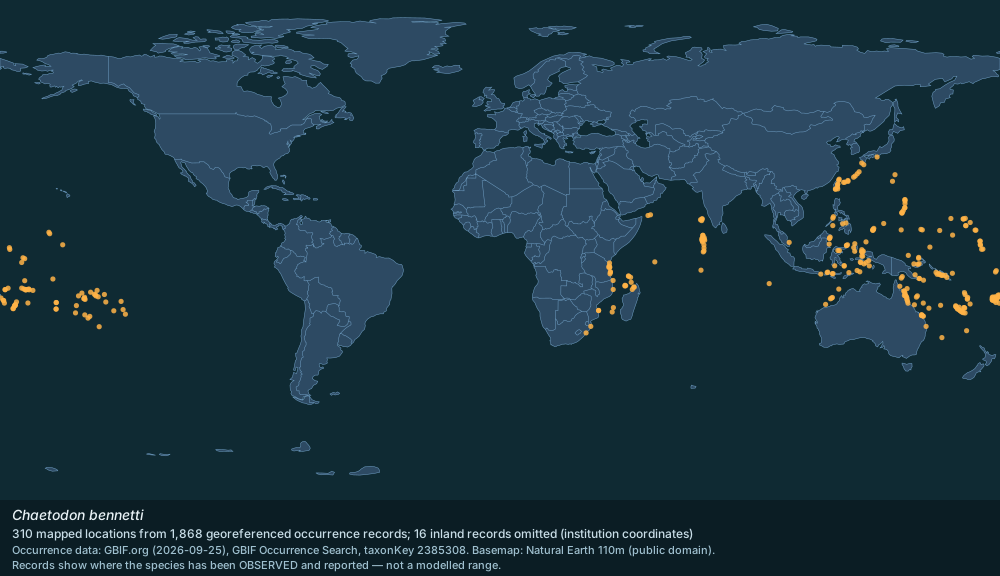
Where the bluelashed butterflyfish (chaetodon bennetti) has been recorded
- Kashiwa
- French Polynesia
- Cocos (Keeling) Islands
- Christmas Island
- Rowley Shoals
- Scott and Seringapatam Reefs
Each dot is a place where the species has been observed and reported (1,868 records, half-degree grid) — not a modelled range. 13 inland records left out (institution coordinates).
Map: drawn by Codexery. Data: GBIF occurrence search (records CC0 / CC BY) · Natural Earth basemap (public domain) · place coordinates: Wikipedia (CC BY-SA 4.0)
Classification (WoRMS)
Full classification as recorded by WoRMS: Kingdom: Animalia · Phylum: Chordata · Class: Teleostei · Order: Acanthuriformes · Family: Chaetodontidae · Genus: Chaetodon.
Accepted name: Chaetodon bennetti · Authority: Cuvier, 1831 · Taxonomic status: accepted · AphiaID: 218735.
Synonyms and superseded combinations recorded for this taxon: Chaetodon benetti Cuvier, 1831; Chaetodon binetti Cuvier, 1831; Chaetodon vinctus Lay & Bennett, 1839.
Source: World Register of Marine Species (WoRMS) — https://www.marinespecies.org/aphia.php?p=taxdetails&id=218735 (CC BY 4.0). Accessed 2026-09-25.
Biology and life history (FishBase)
Measured values published by FishBase for Chaetodon bennetti. Only fields the database actually holds for this species are shown; these are database values, not aquarium guidance.
Maximum length: 20 cm · Depth range: 0–50 m · Habitat zone: reef-associated · Body shape: short and / or deep · Vulnerability index: 10 of 100 · Fishery importance: minor commercial · Aquarium trade: commercial.
FishBase notes: Occur in lagoon and seaward reefs in areas with rich coral growth (Ref. 1602). Juveniles may be found in shallow Acropora thickets (Ref. 1602). Adults occur in pairs (Ref. 1602, 48636).
Omnivorous. Feed on coral polyps (Ref. 37816). Oviparous (Ref. 205). Form pairs during breeding (Ref. 205). This species is extremely difficult to maintain in an aquarium and is very rarely imported.
Source: FishBase species summary (SpecCode 5559) — https://www.fishbase.se/summary/Chaetodon-bennetti.html (CC BY-NC 3.0 — non-commercial use only). Accessed 2026-09-25.
Distribution and occurrence records (GBIF)
1,868 georeferenced occurrence records for Chaetodon bennetti are published through GBIF from 42 countries or marine areas. The map above plots 310 distinct locations from a sample of 1,868 records, omitting 16 inland records that carry an institution's coordinates rather than a collection site; it shows where the species has been observed and reported, not a modelled range.
Most records by country or area: New Caledonia (449); Australia (177); Indonesia (130); French Polynesia (116); Fiji (111).
The full country table, WoRMS marine regions and the sampling notes are on this species' Distribution page.
Source: GBIF Occurrence Search (taxonKey 2385308) — https://www.gbif.org/occurrence/search?taxon_key=2385308&has_coordinate=true (records CC0 / CC BY); WoRMS distribution records (MarineRegions) — https://www.marinespecies.org/aphia.php?p=taxdetails&id=218735 (CC BY 4.0); Natural Earth 110m basemap — https://www.naturalearthdata.com/ (public domain). Accessed 2026-09-25.
Conservation status (IUCN Red List)
The IUCN Red List assesses Chaetodon bennetti Cuvier, 1831 as Data Deficient (code DD). No trend, population estimate or threat analysis is given here, because none is available from this source without the Red List API; follow the source link for the full assessment, including its date.
Source: IUCN Red List of Threatened Species (taxon 165686) — https://www.iucnredlist.org/species/165686/0; GBIF IUCN Red List category endpoint (taxonKey 2385308) — https://api.gbif.org/v1/species/2385308/iucnRedListCategory. Accessed 2026-09-25.
Description and natural history (Wikipedia)
The bluelashed butterflyfish has a body which is yellow with a black patch surrounded by a blue circle below the dorsal fin and two curved blue lines above the belly. Its vertical black eyestripe is flanked by two blue lines. The dorsal fin contains 13–14 spines and 15–17 soft rays while the anal fin has 3 spines and 14–16 soft rays. This species attains a maximum total length of 20 cm.
Distribution
The bluelashed butterflyfish has a wide Indo-Pacific range. In the eastern Indian Ocean they are found along the eastern coast of Africa from Somalia to South Africa and across the Indian Ocean as far north as India and Sri Lanka and into the Pacific Ocean where they extend as far north as Kashiwa-jima in southern Japan, south to Lord Howe Island and east to Mangarava in French Polynesia. In Australia this species occurs on the Indian Ocean territories of the Cocos (Keeling) Islands and Christmas Island. In Western Australia it is found at the Rowley Shoals and Scott Reef.
Habitat and biology
The bluelashed butterflyfish is found in seaward and lagoon reefs in areas with rich coral growth. Juveniles may be found in shallow Acropora thickets. Adults occur in pairs. This species feeds largely on coral polyps.
Systematics
The bluelashed butterflyfish was first formally described in 1831 by the French anatomist Georges Cuvier (1769–1832). The specific name honours the English naturalist Edward Turner Bennett (1797–1836) who had the type specimen of this species shown to Cuvier.
Like the other butterflyfishes with angular yellow bodies with black eyestripes and, except for this species which is regarded as the most basal of them, a single differently-colored patch, it belongs in the subgenus Tetrachaetodon. Among this group it seems to be the most basal living species. If Chaetodon is split up, this subgenus would be placed in Megaprotodon.
Source: Wikipedia: Bluelashed butterflyfish — https://en.wikipedia.org/wiki/Bluelashed_butterflyfish (CC BY-SA 4.0). Accessed 2026-09-25.
Related in Bluelashed butterflyfish
Links follow this subject's own source article.
Elsewhere in Bluelashed butterflyfish
Sources
Compiled from Wikipedia and the sources listed below. Text from Wikipedia is available under CC BY-SA 4.0; this entry is adapted from it.
- Wikipedia: Bluelashed butterflyfish (CC BY-SA 4.0).
- Classification: the source article's taxobox; order, family and genus checked against WoRMS, the World Register of Marine Species (CC BY 4.0).
- Conservation status: IUCN Red List assessment.
- Occurrence records: GBIF (CC0 / CC BY). Basemap: Natural Earth (public domain).
- Biology values: FishBase species summary (CC BY-NC 3.0, non-commercial).
- Word definitions: the , each quoted from its Wikipedia article.
Spotted an error? Know more?
Reader corrections go straight into our review queue. Suggest an edit · How this site is sourced