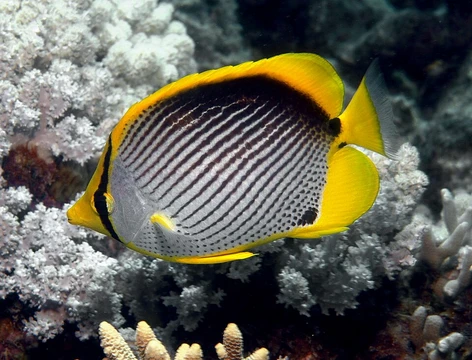
Blackback butterflyfish (Chaetodon melannotus)
Source-cited species reference: taxonomy from WoRMS, biology from FishBase, occurrence map from GBIF, conservation from IUCN Red List, description from Wikipedia.

The black-backed butterflyfish or blackback butterflyfish (Chaetodon melannotus) is a species of ray-finned fish in the butterflyfish family Chaetodontidae. It is widespread through the Indo-Pacific, ranging from the Red Sea and East Africa to southern Japan, Micronesia and Samoa.
- Scientific name
- Chaetodon melannotus
- Authority
- Bloch & Schneider, 1801
- Family
- Chaetodontidae
- Order
- Acanthuriformes
- Maximum length
- 25 cm
- Depth range
- 2–20 m
- Habitat zone
- reef-associated
- Iucn red list
- Least Concern
- Gbif occurrence records
- 5,817
Classification (WoRMS)
Full classification as recorded by WoRMS: Kingdom: Animalia · Phylum: Chordata · Class: Teleostei · Order: Acanthuriformes · Family: Chaetodontidae · Genus: Chaetodon.
Accepted name: Chaetodon melannotus · Authority: Bloch & Schneider, 1801 · Taxonomic status: accepted · AphiaID: 218743.
Synonyms and superseded combinations recorded for this taxon: Chaetodon abhortani Cuvier, 1831; Chaetodon dorsalis Rüppell, 1829; Chaetodon marginatus Cuvier, 1831; Chaetodon melanotus Cuvier, 1831; Chaetodon melanotus Bloch & Schneider, 1801; Chaetodon reinwardti Günther, 1860; Chaetodon reinwardtii Günther, 1860; Mesochaetodon strongylochaetodon melannotus (Bloch & Schneider, 1801); Tetragonoptrus dorsalis (Rüppell, 1829); Tetragonoptrus melanotus (Bloch & Schneider, 1801).
Source: World Register of Marine Species (WoRMS) — https://www.marinespecies.org/aphia.php?p=taxdetails&id=218743 (CC BY 4.0). Accessed 2026-09-23.
Biology and life history (FishBase)
Measured values published by FishBase for Chaetodon melannotus. Only fields the database actually holds for this species are shown; these are database values, not aquarium guidance.
Maximum length: 25 cm · Depth range: 2–20 m · Habitat zone: reef-associated · Body shape: short and / or deep · Vulnerability index: 15 of 100 · Fishery importance: commercial · Aquarium trade: commercial.
FishBase notes: Usually solitary or in pairs in coral-rich areas of reef flats, lagoons, and seaward reefs to a depth of over 15 m. Juveniles inshore. In pairs or traveling in small groups (Ref. 48636). Feed on octocorallian and scleractinian coral polyps. Oviparous (Ref. 205). Form pairs during breeding (Ref. 205). Easy to maintain in the aquarium. Minimum depth reported taken from Ref. 30874.
Source: FishBase species summary (SpecCode 5566) — https://www.fishbase.se/summary/Chaetodon-melannotus.html (CC BY-NC 3.0 — non-commercial use only). Accessed 2026-09-23.
Distribution and occurrence records (GBIF)
5,817 georeferenced occurrence records for Chaetodon melannotus are published through GBIF from 55 countries or marine areas. The map above plots 326 distinct locations from a sample of 3,000 records, omitting 28 inland records that carry an institution's coordinates rather than a collection site; it shows where the species has been observed and reported, not a modelled range.
Most records by country or area: Australia (3,134); New Caledonia (379); Indonesia (368); Egypt (344); Tonga (254).
The full country table, WoRMS marine regions and the sampling notes are on this species' Distribution page.
Source: GBIF Occurrence Search (taxonKey 2385556) — https://www.gbif.org/occurrence/search?taxon_key=2385556&has_coordinate=true (records CC0 / CC BY); WoRMS distribution records (MarineRegions) — https://www.marinespecies.org/aphia.php?p=taxdetails&id=218743 (CC BY 4.0); Natural Earth 110m basemap — https://www.naturalearthdata.com/ (public domain). Accessed 2026-09-23.
Conservation status (IUCN Red List)
The IUCN Red List assesses Chaetodon melannotus Bloch & Schneider, 1801 as Least Concern (code LC). No trend, population estimate or threat analysis is given here, because none is available from this source without the Red List API; follow the source link for the full assessment, including its date.
Source: IUCN Red List of Threatened Species (taxon 165689) — https://www.iucnredlist.org/species/165689/0; GBIF IUCN Red List category endpoint (taxonKey 2385556) — https://api.gbif.org/v1/species/2385556/iucnRedListCategory. Accessed 2026-09-23.
Description and natural history (Wikipedia)
With its genus, the blackback butterflyfish belongs to the large subgenus Rabdophorus, which might warrant recognition as a distinct genus. In this group, it appears to be a close relative of the spot-tailed butterflyfish (C. ocellicaudus), and it is somewhat less close to the yellow-dotted butterflyfish (C. selene). These are all of oval shape, have silvery coloration with yellow fins and snout, and have ascending diagonal stripes and black markings around the eyes, on the caudal peduncle and sometimes on the back. The saddle butterflyfish (C. ephippium) and the dotted butterflyfish (C. semeion) also seem related, but these are already so distant that their ancestors must have diverged soon after the Rabdophorus lineage started to diversify.
The blackback butterflyfish grows up to 18 cm in length, and may live for up to 20 years. Normally, the coloration of this fish is as in the image on the right; however, when observed at night or frightened, it can change color. As a result, the dorsal portion of the body turns black, except for two white patches.
Like most other species of butterflyfish, the blackback butterflyfish inhabits reefs. It is common on staghorn coral thickets, and is less seen on exposed parts of reefs. It is generally found at a depth of 4-20 m, usually solitarily. This changes during the breeding season, when pairs are more common. Juveniles are more commonly found inshore, in pairs or traveling in small groups. This butterflyfish feeds primarily on the polyps of soft and hard corals.
The blackback butterflyfish can be found in the aquarium trade, and is easy to maintain in the aquarium by the standards of its genus.
Source: Wikipedia: Blackback butterflyfish — https://en.wikipedia.org/wiki/Blackback_butterflyfish (CC BY-SA 4.0). Accessed 2026-09-23.
Frequently Asked Questions
Who is Blackback butterflyfish (Chaetodon melannotus)?
It is a ray-finned marine fish in the butterflyfish family (Chaetodontidae), first formally named by Bloch and Schneider in 1801. It belongs to the order Acanthuriformes and is one of the more widely distributed members of its family.
What is Blackback butterflyfish (Chaetodon melannotus)'s role in its habitat?
It inhabits shallow coastal and reef waters, typically between 2 and 20 metres depth, where it forages as part of the local reef community. Its presence across a broad Indo-Pacific range makes it a recurring component of tropical and subtropical marine ecosystems.
How big does Blackback butterflyfish (Chaetodon melannotus) get?
Adults reach a maximum total length of roughly 25 centimetres. That places it in the mid-size tier of the butterflyfish family—large enough to be conspicuous but far from the biggest Chaetodon species.
Where can you find Blackback butterflyfish (Chaetodon melannotus)?
Its range spans the entire Indo-Pacific, stretching from the Red Sea and East African coast eastward to southern Japan, Micronesia, and Samoa. It is essentially a warm-water species tied to tropical and subtropical marine environments across that vast region.
Why is Blackback butterflyfish (Chaetodon melannotus) important?
Its wide Indo-Pacific distribution makes it a useful reference species for tracking the health of coastal and reef ecosystems across multiple countries. Taxonomically it is a well-documented, long-recognized member of Chaetodontidae, with occurrence and conservation data maintained by major biodiversity databases such as WoRMS, FishBase, GBIF, and the IUCN Red List.
Related in Blackback butterflyfish
Links follow this subject's own source article.
Elsewhere in Blackback butterflyfish
Spotted an error? Know more?
Reader corrections go straight into our review queue. Suggest an edit · How this site is sourced