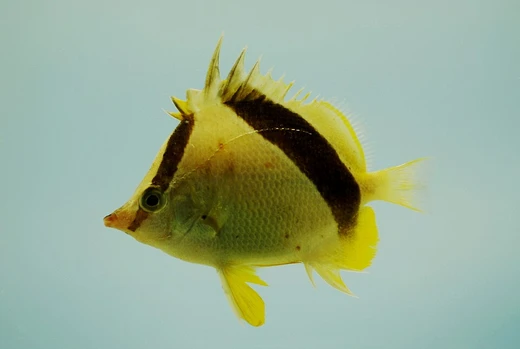
Bank butterflyfish (Prognathodes aya)
Source-cited species reference: taxonomy from WoRMS, biology from FishBase, occurrence map from GBIF, conservation from IUCN Red List, description from Wikipedia.

Jay Brasher · CC BY 4.0
The Bank butterflyfish (Prognathodes aya) is a species of marine ray-finned fish. More specifically, it is a butterflyfish belonging to the family Chaetodontidae. The Bank butterflyfish is found in the tropical and sub-tropical waters of the western Atlantic Ocean.
- Scientific name
- Prognathodes aya
- Authority
- (Jordan, 1886)
- Family
- Chaetodontidae
- Order
- Acanthuriformes
- Maximum length
- 15 cm
- Depth range
- 20–170 m
- Habitat zone
- reef-associated
- Iucn red list
- Least Concern
- Gbif occurrence records
- 2,498
Coloration & Markings
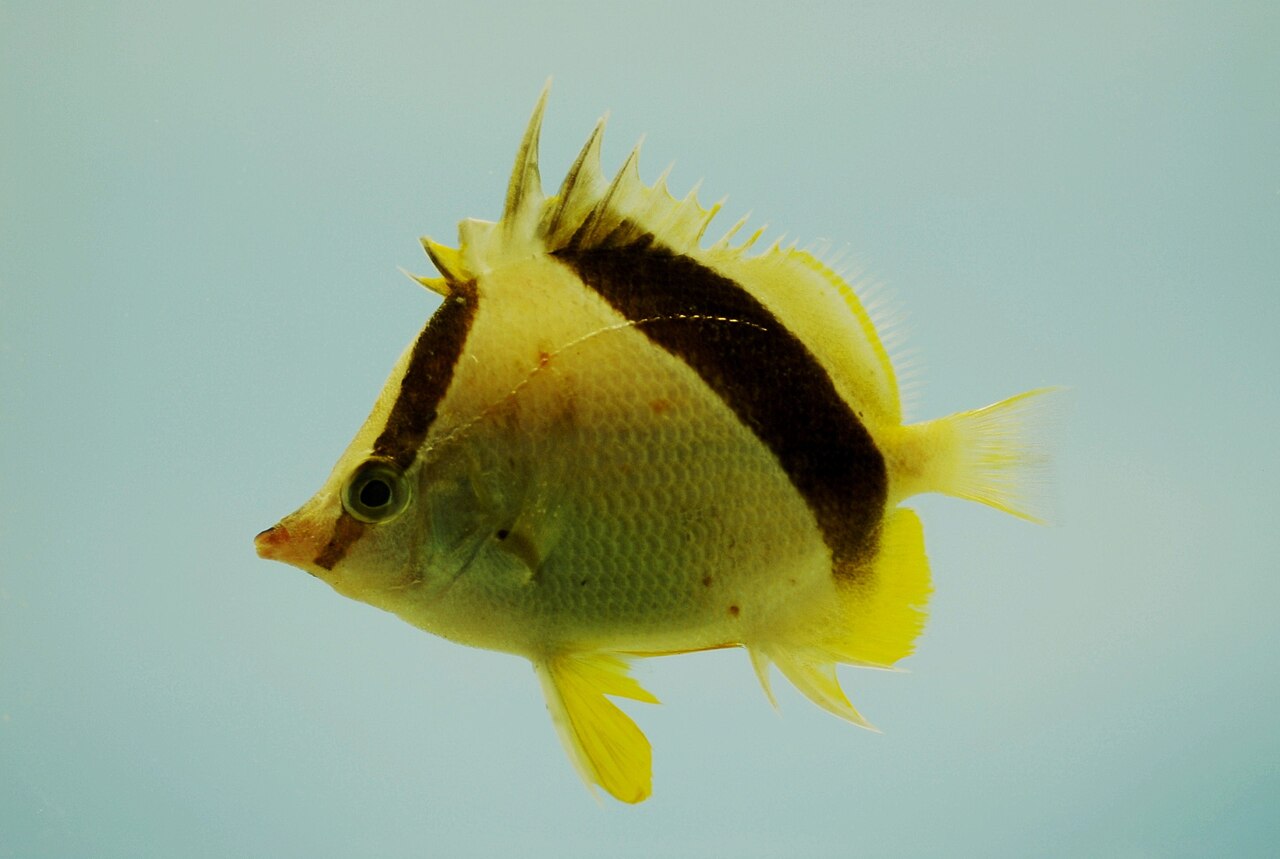
The Bank butterflyfish presents a bold visual profile that sets it apart within the Chaetodontidae family. Its body shifts between silvery white and tan tones, while nearly every fin carries a yellow wash—the pectoral fins being the sole exception to this rule. Two prominent dark, brownish bars run sub-vertically across the body: the first traces a path over the eyes, hugging the contour of the face and snout, while the second originates at the rear of the dorsal fin and descends toward the tail region, stopping just short of the caudal fin. Layered on top of this pattern is a yellow band positioned immediately behind the second dark bar, stretching from the fifth dorsal spine down to the posterior edge of the anal fin. Together, these high-contrast markings create a distinctive silhouette that likely aids in species recognition and provides disruptive camouflage against the dappled light filtering through reef structures in its western Atlantic home.
Geographic Range & Habitat
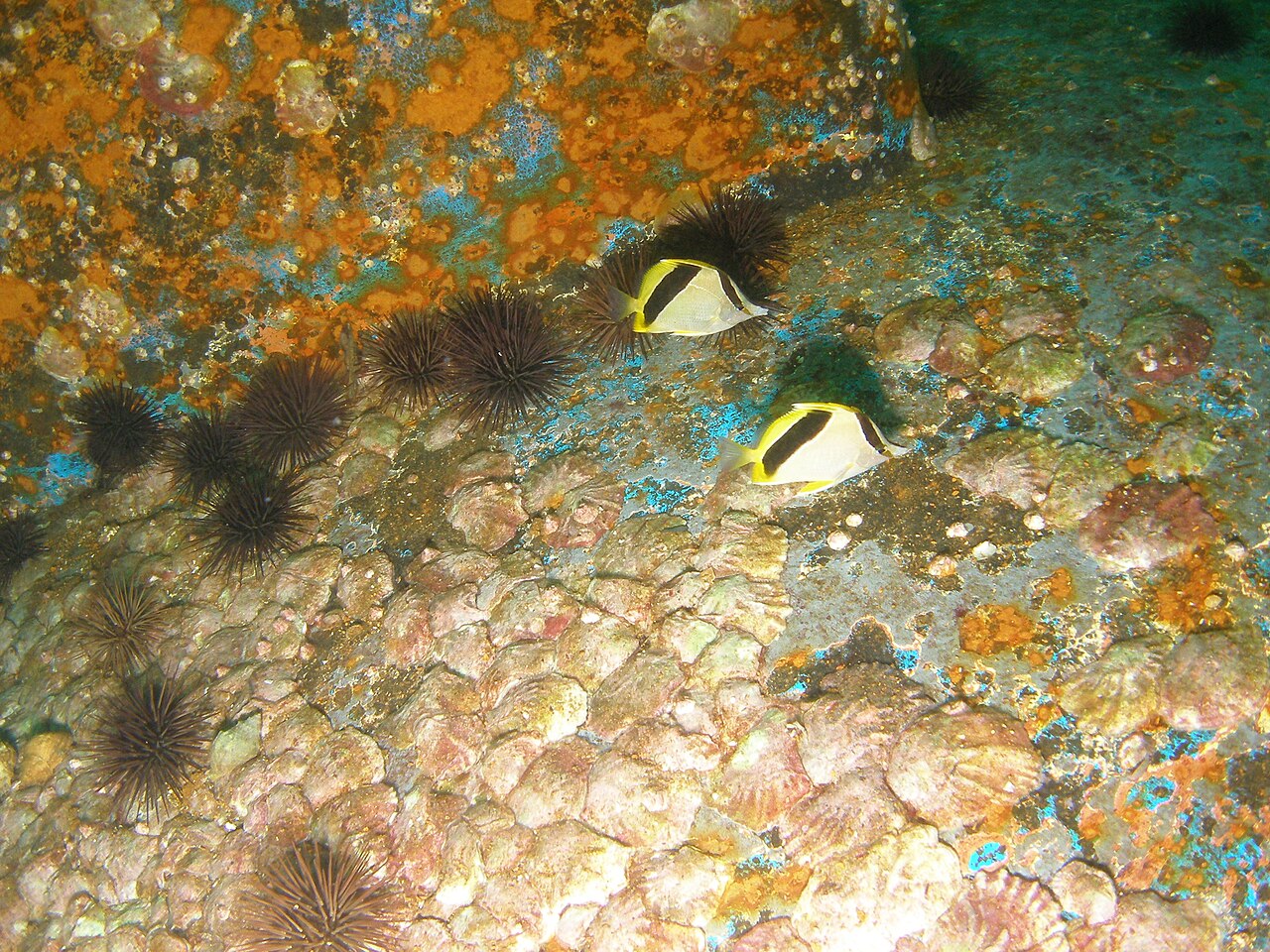
As a marine ray-finned fish of the western Atlantic, the Bank butterflyfish inhabits tropical and sub-tropical waters spanning a broad but specific corridor. Its core distribution covers natural and artificial reef systems in Florida, the Gulf of Mexico, and the waters off the Yucatán Peninsula. On rare occasions the species can be encountered as far north as North Carolina, though such northern sightings remain exceptional rather than routine. Throughout its entire range, the Bank butterflyfish is consistently described as uncommon, indicating it never forms dense schools or abundant local populations even where conditions appear favorable. Its use of both natural and artificial reef structures points to a moderate degree of habitat flexibility, yet it clearly depends on the three-dimensional complexity of reef-like environments for shelter and foraging. This geographically bounded and numerically modest presence paints a picture of a species that is neither widespread nor abundant across the western Atlantic.
Shy Behavior & Diver Encounters
For scuba divers who stumble upon a Bank butterflyfish, the encounter is shaped by a creature of pronounced caution. The species is widely regarded as shy, and its first instinct upon detecting an approaching human is to dart rapidly into the protective architecture of the reef. Yet the interaction does not always conclude with the fish vanishing entirely. Once properly tucked into a crevice or overhang, some individuals will hold position at the entrance of their refuge, apparently watching the diver from a safe vantage point. This behavior reveals a delicate balance between self-preservation and curiosity—a willingness to monitor a potential threat without fully committing to concealment. The fish's dependence on reef complexity for both shelter and this cautious observation highlights how integral structural habitat is to its daily behavioral repertoire. For divers, the result is a fleeting but memorable sighting that rewards patience, quiet movement, and respectful distance.
Conservation Status & Human Interaction
From a conservation perspective, the Bank butterflyfish occupies a comparatively secure position. The IUCN classifies the species as Least Concern, noting no known threats to its survival. While it is collected for the saltwater aquarium trade, this commercial activity does not appear to place meaningful pressure on global populations. The species is not named in any specific protective legislation, yet it benefits indirectly from its presence within a number of designated marine protected areas. This combination—absence of targeted legal safeguards coupled with habitat-level protections—suggests that the fish's conservation is largely incidental rather than the product of active, species-specific management. Its uncommon status across the range, together with the lack of documented population declines, supports the view that current human interactions, including aquarium collection, remain within sustainable limits. The Bank butterflyfish thus exists in a quiet equilibrium with human activity, neither heavily exploited nor formally shielded by dedicated regulatory frameworks.
Gallery
Frequently Asked Questions
What is the Bank butterflyfish (Prognathodes aya)?
It is a small marine ray-finned butterflyfish in the family Chaetodontidae, native to tropical and sub-tropical waters of the western Atlantic Ocean.
Who first described the Bank butterflyfish and when?
The species was formally named by Jordan in 1886, and it is classified within the order Acanthuriformes.
How large does a Bank butterflyfish grow?
Adults reach a maximum total length of roughly 15 cm, placing it among the smaller members of the butterflyfish family.
At what depths can you encounter the Bank butterflyfish?
It lives across a depth span of about 20 to 170 meters in its western Atlantic habitat.
What makes the Bank butterflyfish distinct from other butterflyfish?
Its range is limited to tropical and sub-tropical western Atlantic waters, and its ability to occupy depths well beyond the shallow reef zone sets it apart from many closely related Chaetodontidae species.
Related in Bank butterflyfish
Links follow this subject's own source article.
Elsewhere in Bank butterflyfish
Spotted an error? Know more?
Reader corrections go straight into our review queue. Suggest an edit · How this site is sourced