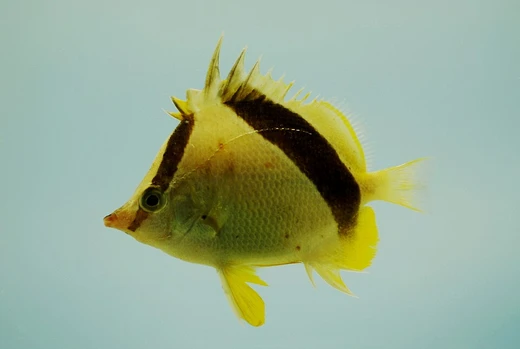
Where Bank butterflyfish has been recorded
GBIF occurrence records for Prognathodes aya, mapped and tabulated by country.

2,498 georeferenced occurrence records with coordinates are published for Prognathodes aya through GBIF, from 7 countries or marine areas. This page maps those records and lists where they come from. Occurrence records reflect where people have looked as well as where the species lives, so well-surveyed coastlines are over-represented.
- Georeferenced records
- 2,498
- Countries / areas
- 7
- Mapped locations
- 70
- Records sampled for the map
- 2,498
- Inland records omitted
- 3
- Gbif taxonkey
- 2385603
Physical Appearance and Morphology
The mailed butterflyfish presents a notably subdued palette compared to many of its reef-dwelling cousins. Its body is predominantly blackish, with each scale bearing a light grey centre that gives the flanks a subtly mottled texture, while the back fades to a paler tone. The most striking facial feature is a broad vertical stripe edged in yellow that passes directly through the eye, immediately followed by a wider white vertical band. The dorsal fin is white, and the caudal peduncle is solid black, creating a sharp contrast with the whitish-blue caudal fin, which carries a yellow marginal band bordered by a thin black submargin. In juveniles, the tail is notably transparent, distinguishing young fish from adults. Structurally, the dorsal fin bears between twelve and thirteen spines alongside twenty-three to twenty-nine soft rays, while the anal fin carries three spines and twenty to twenty-two soft rays. The species reaches a maximum total length of eighteen centimetres, roughly seven inches, making it a mid-sized member of the butterflyfish family.
Geographic Range and Habitat Preferences
The mailed butterflyfish enjoys one of the broadest distributions among Pacific butterflyfishes, stretching across the western and central Pacific Ocean. Its range extends from the waters around Taiwan and the Philippines eastward through Polynesia, reaching as far as Hawaii, the Marquesas Islands, and the remote Pitcairn Islands. To the north, populations are recorded near the Ryukyu Islands, while to the south the species is found off New Caledonia. Within Australian waters, it inhabits the Great Barrier Reef, with juveniles documented as far south as the Solitary Islands. This species is most commonly encountered on exposed seaward reefs, though it also occupies sheltered lagoon areas provided they feature abundant coral growth and clear water. Juveniles show a clear preference for more protected waters compared to adults. The fish occupy depth ranges from just one metre down to thirty metres, placing them firmly within the photic zone where their coral food sources thrive.
Taxonomic Placement and Classification
The mailed butterflyfish received its first formal scientific description in 1831, authored by the French anatomist Georges Cuvier, who designated Tahiti as the type locality. It belongs to the family Chaetodontidae and is classified as a marine ray-finned fish. Taxonomically, it stands as a close relative of both the ornate butterflyfish (Chaetodon ornatissimus) and the scrawled butterflyfish (C. meyeri). These three species have been grouped together under the subgenus name Citharoedus, however this designation is technically invalid because the same name had already been applied to a mollusc genus. The group is considered probably close to the subgenus Corallochaetodon, which includes the Melon Butterflyfish (C. trifasciatus). Should the large genus Chaetodon be split into smaller genera in future taxonomic revisions, these species might be reclassified under the name Megaprotodon. The species is also known by several common names, including reticulated butterflyfish and black butterflyfish, reflecting its dark coloration.
Social Behavior, Diet, and Captive Challenges
In the wild, the mailed butterflyfish is a relatively common sight on exposed reef slopes, typically observed in pairs, though occasional schools have been recorded. The species is an obligate corallivore, feeding mainly on corals belonging to the genus Acropora. This dietary specialization is tightly linked to its reproductive biology: the fish are oviparous and breed in monogamous pairs, a social structure that aligns with their dependence on specific coral habitats. Despite its relative abundance in the wild, the mailed butterflyfish only occasionally appears in the aquarium trade. When it does, the outcome is frequently grim. Its highly specialized coral-based diet proves extremely difficult to replicate in a captive setting, and as a consequence, specimens kept in aquaria often starve to death. This makes the species a striking example of how a fish's narrow ecological niche, even when it appears straightforward, can render it fundamentally unsuitable for life outside its natural reef environment.
Frequently Asked Questions
How many countries or marine areas has Bank butterflyfish been recorded in?
According to the GBIF data, Prognathodes aya occurrence records span 7 countries or marine areas. These are the regions where at least one georeferenced sighting has been logged in the global biodiversity database.
How many georeferenced records exist for Bank butterflyfish?
There are 2,498 georeferenced occurrence records with coordinates currently published for Prognathodes aya. All 2,498 were sampled and plotted on the distribution map, with only 3 inland records omitted from the display.
Why might the Bank butterflyfish distribution map not show its true full range?
The map reflects where researchers and collectors have actually looked, not just where the species lives. Well-surveyed coastlines naturally appear over-represented, while poorly explored regions may harbor unrecorded populations.
How many distinct mapped locations appear on the Bank butterflyfish distribution page?
The page displays 70 mapped locations derived from the full set of 2,498 georeferenced records. These points are aggregated by country or marine area across the 7 recognized regions.
Which database do the Bank butterflyfish distribution records come from?
All occurrence data for Prognathodes aya on this page is sourced from GBIF, identified under taxonKey 2385603. The records are georeferenced, meaning each entry carries specific latitude and longitude coordinates.
Related in Bank butterflyfish
Links follow this subject's own source article.
Elsewhere in Bank butterflyfish
Spotted an error? Know more?
Reader corrections go straight into our review queue. Suggest an edit · How this site is sourced