
Atlantic Bay scallop (Argopecten irradians)
Source-cited species reference: taxonomy from WoRMS, biology from SeaLifeBase, occurrence map from GBIF, description from Wikipedia.
Argopecten irradians, formerly classified as Aequipecten irradians, common names Atlantic bay scallop, bay scallop, and blue-eyed scallop, is a species of scallop in the family Pectinidae. An edible saltwater bivalve, it is native to the northwest Atlantic from Cape Cod to the Gulf of Mexico.
- Scientific name
- Argopecten irradians
- Authority
- (Lamarck, 1819)
- Family
- Pectinidae
- Order
- Pectinida
- Maximum length
- 7.5 cm
- Depth range
- 0–20 m
- Habitat zone
- benthic
- Gbif occurrence records
- 14,506
Classification (WoRMS)
Full classification as recorded by WoRMS: Kingdom: Animalia · Phylum: Mollusca · Class: Bivalvia · Order: Pectinida · Family: Pectinidae · Genus: Argopecten.
Accepted name: Argopecten irradians · Authority: (Lamarck, 1819) · Taxonomic status: accepted · AphiaID: 156817.
Synonyms and superseded combinations recorded for this taxon: Aequipecten irradians (Lamarck, 1819); Pecten nucleus irradians (Lamarck, 1819).
Source: World Register of Marine Species (WoRMS) — https://www.marinespecies.org/aphia.php?p=taxdetails&id=156817 (CC BY 4.0). Accessed 2026-09-23.
Biology and life history (SeaLifeBase)
Measured values published by SeaLifeBase for Argopecten irradians. Only fields the database actually holds for this species are shown; these are database values, not aquarium guidance.
Maximum length: 7.5 cm · Depth range: 0–20 m · Habitat zone: benthic · Vulnerability index: 15 of 100 · Fishery importance: commercial.
SeaLifeBase notes: Average life span of 20 to 26 months. Form beds on sandy, eelgrass or other seagrass bottoms (Ref. 344).
Source: SeaLifeBase species summary (SpecCode 47432) — https://www.sealifebase.se/summary/Argopecten-irradians.html (CC BY-NC 3.0 — non-commercial use only). Accessed 2026-09-23.
Distribution and occurrence records (GBIF)
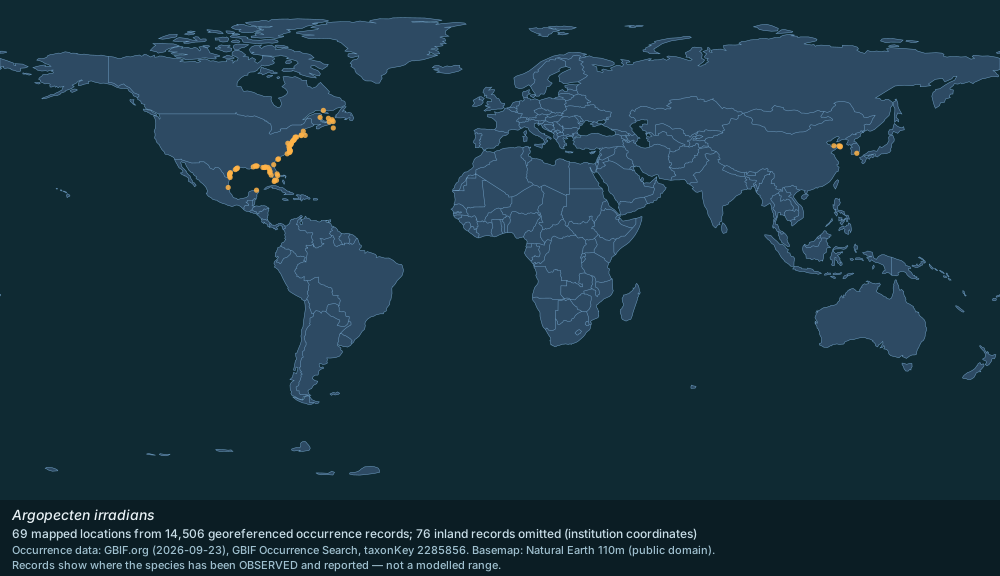
14,506 georeferenced occurrence records for Argopecten irradians are published through GBIF from 26 countries or marine areas. The map above plots 69 distinct locations from a sample of 3,000 records, omitting 76 inland records that carry an institution's coordinates rather than a collection site; it shows where the species has been observed and reported, not a modelled range.
Most records by country or area: United States of America (13,546); Mexico (527); Canada (240); Panama (76); China (40).
The full country table, WoRMS marine regions and the sampling notes are on this species' Distribution page.
Source: GBIF Occurrence Search (taxonKey 2285856) — https://www.gbif.org/occurrence/search?taxon_key=2285856&has_coordinate=true (records CC0 / CC BY); WoRMS distribution records (MarineRegions) — https://www.marinespecies.org/aphia.php?p=taxdetails&id=156817 (CC BY 4.0); Natural Earth 110m basemap — https://www.naturalearthdata.com/ (public domain). Accessed 2026-09-23.
Description and natural history (Wikipedia)
Right and left valve of the same specimens:
At the northern extreme of its range in Massachusetts, germ and gonial cells complete and begin development in winter and early spring. At the southern extreme the timeline is very different, with cytoplasmic growth stages found to occur in July in Tarpon Springs, Florida, when the water approaches its highest temperatures of the year.
is a peptidoglycan recognition protein (PGRP). Its cDNA was cloned by Ni et al. 2007 and is the first bivalve PGRP to be cloned. is a galectin discovered by Song et al. 2010, is a toll-like receptor (TLR) shared with other bivalves. It was first found in this scallop by Song et al. 2006. Song 2006 also found an inhibitor of κB (IκB). is the first big defensin cloned from this scallop. The gene is 531 nucleotides and the polypeptide product is 122 amino acids. Recombinant AiBD is an antimicrobial for Gram-positive bacteria, Gram-negative bacteria, and fungi. Manganese superoxide dismutase (MnSOD) mRNA expression increases in the gill and mantle in response to Vibrio anguillarum.
This species of scallop used to support a large wild fishery on the East Coast of the United States, but since the 1950s it has decreased greatly. This is apparently the result of several negative influences, one of which is a reduction in sea grasses (to which bay scallop spat attach) due to increased coastal development and concomitant nutrient runoff.
By contrast, the Atlantic sea scallop (Placopecten magellanicus) is at historically high levels of abundance because the Magnuson-Stevens Fishery Conservation and Management Reauthorization Act of 2006 put a limit on catch numbers and led to a recovery from overfishing.
Scallop farming is a million-dollar industry in Canada, with British Columbia producing 85% of the country's farmed scallops. Scallop aquaculture is currently being practiced in Florida. They were introduced into China in the 1980s and are the basis of a vibrant aquaculture industry in that country.
This species has five different subspecies:
A. i. sablensis (Clarke, 1965) - a fossil subspecies
A. i. taylorae Petuch, 1987 - the southern bay scallop
Source: Wikipedia: Argopecten irradians — https://en.wikipedia.org/wiki/Argopecten_irradians (CC BY-SA 4.0). Accessed 2026-09-23.
Gallery
Related in Atlantic Bay scallop
Links follow this subject's own source article.
Elsewhere in Atlantic Bay scallop
Spotted an error? Know more?
Reader corrections go straight into our review queue. Suggest an edit · How this site is sourced