
Calico scallop (Argopecten gibbus)
Source-cited species reference: taxonomy from WoRMS, biology from SeaLifeBase, occurrence map from GBIF, description from Wikipedia.
Argopecten gibbus, the Atlantic calico scallop, is a species of medium-sized edible marine bivalve mollusk in the family Pectinidae, the scallops.
- Scientific name
- Argopecten gibbus
- Authority
- (Linnaeus, 1758)
- Family
- Pectinidae
- Order
- Pectinida
- Maximum length
- 6.3 cm
- Depth range
- 0–366 m
- Habitat zone
- benthic
- Gbif occurrence records
- 5,656
Classification (WoRMS)
Full classification as recorded by WoRMS: Kingdom: Animalia · Phylum: Mollusca · Class: Bivalvia · Order: Pectinida · Family: Pectinidae · Genus: Argopecten.
Accepted name: Argopecten gibbus · Authority: (Linnaeus, 1758) · Taxonomic status: accepted · AphiaID: 394271.
Synonyms and superseded combinations recorded for this taxon: Argopecten imitatoides Macsotay & Campos, 2001; Chlamys (Argopecten) gibbus (Linnaeus, 1758); Chlamys liocymatus (Dall, 1925); Ostrea gibba Linnaeus, 1758; Ostrea turgida Gmelin, 1791; Pecten (Chlamys) gibbus (Linnaeus, 1758); Pecten (Chlamys) liocymatus Dall, 1925; Pecten (Plagioctenium) gibbus (Linnaeus, 1758); Pecten (Plagioctenium) gibbus carolinensis Grau, 1952; Pecten (Plagioctenium) gibbus portusregii Grau, 1952; Pecten delessertii Chenu, 1843; Pecten dislocatus Say, 1822; Pecten gibbus (Linnaeus, 1758); Pecten liocymatus Dall, 1925.
Source: World Register of Marine Species (WoRMS) — https://www.marinespecies.org/aphia.php?p=taxdetails&id=394271 (CC BY 4.0). Accessed 2026-09-23.
Biology and life history (SeaLifeBase)
Measured values published by SeaLifeBase for Argopecten gibbus. Only fields the database actually holds for this species are shown; these are database values, not aquarium guidance.
Maximum length: 6.3 cm · Depth range: 0–366 m · Habitat zone: benthic · Vulnerability index: 10 of 100 · Fishery importance: highly commercial.
SeaLifeBase notes: Life span: 18 to 24 months (Ref. 350). Lives in beds in shallow to moderately deep water, usually on (or buried in) sandy bottoms (Ref. 344). Also in seagrass and algae beds (Ref. 106861).
Source: SeaLifeBase species summary (SpecCode 47431) — https://www.sealifebase.se/summary/Argopecten-gibbus.html (CC BY-NC 3.0 — non-commercial use only). Accessed 2026-09-23.
Distribution and occurrence records (GBIF)
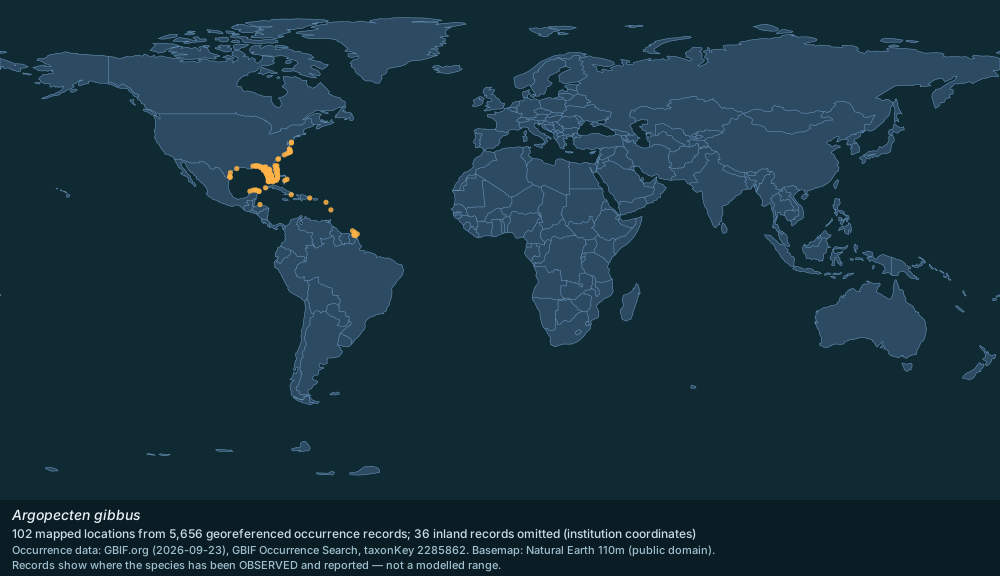
5,656 georeferenced occurrence records for Argopecten gibbus are published through GBIF from 30 countries or marine areas. The map above plots 102 distinct locations from a sample of 3,000 records, omitting 36 inland records that carry an institution's coordinates rather than a collection site; it shows where the species has been observed and reported, not a modelled range.
Most records by country or area: United States of America (5,396); Mexico (62); Guadeloupe (51); Venezuela (Bolivarian Republic of) (26); Saint Kitts and Nevis (22).
The full country table, WoRMS marine regions and the sampling notes are on this species' Distribution page.
Source: GBIF Occurrence Search (taxonKey 2285862) — https://www.gbif.org/occurrence/search?taxon_key=2285862&has_coordinate=true (records CC0 / CC BY); WoRMS distribution records (MarineRegions) — https://www.marinespecies.org/aphia.php?p=taxdetails&id=394271 (CC BY 4.0); Natural Earth 110m basemap — https://www.naturalearthdata.com/ (public domain). Accessed 2026-09-23.
Description and natural history (Wikipedia)
This species was once the basis of an important fishery, but in recent years catches have been low.
This species grows up to three inches in maximum width, and is similar in shape and sculpturing to the Atlantic bay scallop. Both valves of the shell are cupped. The shell near the hinge is extended into "ears", as is the case in all scallops. The shell of the Atlantic calico scallop has about 20 radial ribs, which are sometimes roughened by growth lines.
The exterior coloration of the upper (left) valve of this species is most typically a mottled pattern of purple on a cream background. The lower (right) valve of this scallop is usually whitish with small reddish or purple spotting on the sides. The interior of the shell is white, often with some beige coloration on the "ears" and top edge.
The eye-catching color of the shell of this species gave rise to its popular name; in the US, "calico" was for many years an inexpensive but colorful fabric printed with small flower patterns. The name is no longer in practice within the US.
The Atlantic calico scallop ranges from Delaware to Brazil, and is still sometimes fished commercially. It is not found in bays; instead it lives in open water up to 100-foot depths. The shells are commonly found washed up on ocean beaches.
Valve color and shell morphometry distinguish calico scallops from related species. In the Indian River Lagoon in Florida, two other scallops occur: the bay scallop, (Argopecten irradians), which generally has a uniform gray to gray-brown coloration with distinct convexity of the right (lower) valve. The other is the rough scallop, (Aequipecten muscosus), which has unequal 'ears' and has sharp scales on the lower surface of the ribs. The color of the rough scallop is yellow, orange, red or brownish.
Source: Wikipedia: Argopecten gibbus — https://en.wikipedia.org/wiki/Argopecten_gibbus (CC BY-SA 4.0). Accessed 2026-09-23.
Gallery
Related in Calico scallop
Links follow this subject's own source article.
Elsewhere in Calico scallop
Spotted an error? Know more?
Reader corrections go straight into our review queue. Suggest an edit · How this site is sourced