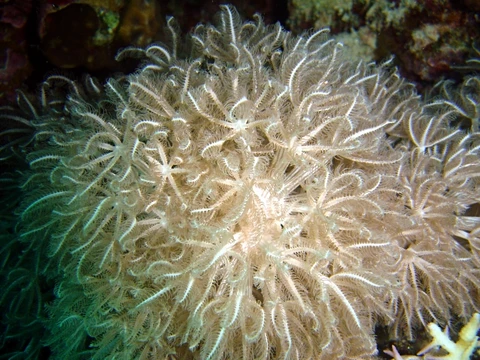
Anthelia glauca
Source-cited species reference: taxonomy from WoRMS, biology from SeaLifeBase, occurrence map from GBIF, description from Wikipedia.

Anthelia glauca, the giant anthelia, is a species of soft coral in the family Xeniidae. It is a colonial species and is found in shallow water in the Indo-Pacific region.
- Scientific name
- Anthelia glauca
- Authority
- Lamarck, 1816
- Family
- Xeniidae
- Order
- Malacalcyonacea
- Habitat zone
- sessile
- Gbif occurrence records
- 135
Classification (WoRMS)
Full classification as recorded by WoRMS: Kingdom: Animalia · Phylum: Cnidaria · Class: Octocorallia · Order: Malacalcyonacea · Family: Xeniidae · Genus: Anthelia.
Accepted name: Anthelia glauca · Authority: Lamarck, 1816 · Taxonomic status: accepted · AphiaID: 209999.
Synonyms and superseded combinations recorded for this taxon: Anthelia fuliginosa (Ehrenberg, 1834); Anthelia purpurascens Ehrenberg, 1834; Anthelia purpurascens Dana, 1846; Anthelia strumosa Ehrenberg, 1834; Clavularia glauca (Lamarck, 1816); Clavularia purpurascens (Dana, 1846); Clavularia strumosa (Ehrenberg, 1834); Sympodium fuliginosum Ehrenberg, 1834; Sympodium purpurascens (Ehrenberg, 1834); Xenia crosslandi Kükenthal, 1914; Xenia rigida Thomson & Henderson, 1906.
Source: World Register of Marine Species (WoRMS) — https://www.marinespecies.org/aphia.php?p=taxdetails&id=209999 (CC BY 4.0). Accessed 2026-09-23.
Biology and life history (SeaLifeBase)
Measured values published by SeaLifeBase for Anthelia glauca. Only fields the database actually holds for this species are shown; these are database values, not aquarium guidance.
Habitat zone: sessile · Aquarium trade: never/rarely.
Source: SeaLifeBase species summary (SpecCode 163287) — https://www.sealifebase.se/summary/Anthelia-glauca.html (CC BY-NC 3.0 — non-commercial use only). Accessed 2026-09-23.
Distribution and occurrence records (GBIF)
135 georeferenced occurrence records for Anthelia glauca are published through GBIF from 15 countries or marine areas. The map above plots 34 distinct locations from a sample of 135 records, omitting 3 inland records that carry an institution's coordinates rather than a collection site; it shows where the species has been observed and reported, not a modelled range.
Most records by country or area: Egypt (82); Australia (22); Madagascar (6); Jordan (4); Papua New Guinea (4); Mayotte (3); Micronesia (Federated States of) (2); Mozambique (2); New Caledonia (2); Saudi Arabia (2); Chinese Taipei (2); Indonesia (1); Malaysia (1); Seychelles (1); Tanzania, United Republic of (1).
Marine regions with a valid WoRMS distribution record: Seychellois Exclusive Economic Zone; Red Sea; South Africa (country); South African Exclusive Economic Zone.
Source: GBIF Occurrence Search (taxonKey 5185290) — https://www.gbif.org/occurrence/search?taxon_key=5185290&has_coordinate=true (records CC0 / CC BY); WoRMS distribution records (MarineRegions) — https://www.marinespecies.org/aphia.php?p=taxdetails&id=209999 (CC BY 4.0); Natural Earth 110m basemap — https://www.naturalearthdata.com/ (public domain). Accessed 2026-09-23.
Description and natural history (Wikipedia)
Anthelia glauca has large tubular polyps growing from a creeping mat that sometimes forms stolon-like fingers. The non-retractable polyps may be 11 to 25 cm tall with a ring of eight slender, plume-like tentacles. The colour is usually white, pale grey, pale brown or bluish-white, and viewed from above, the polyps somewhat resemble snowflakes.
Anthelia glauca is found on reefs in the Indo-Pacific region from the Red Sea to Hawaii, growing at depths between 8 and 22 m. Its range includes the eastern coast of Africa and at Sodwana Bay, this coral grows on reefs formed from fossilised sand-dunes, along with a few stony corals and a diverse population of other soft corals. It is probably the most common species in its genus.
Anthelia glauca is a zooxanthellate soft coral; embedded within its tissues are single-celled symbiotic dinoflagellates which provide their host with the products of photosynthesis such as organic carbon and nitrogen compounds. The polyps supplement this with the planktonic particles caught by the widely-spread tentacles. During the day the polyps sway and contract in a rhythmic fashion.
Colonies of A. glauca are either male or female. Spawning and egg transfer takes place at the full moon over a four to five month period in summer. The larvae are brooded in a unique pharyngeal pouch, an extension of the pharynx constricted on either side of the developing larvae. It has been found that the immature planula larvae acquire their zooxanthellae from symbionts present in the pharyngeal pouch by invasion through their ectodermal surface during the brooding process.
Source: Wikipedia: Anthelia glauca — https://en.wikipedia.org/wiki/Anthelia_glauca (CC BY-SA 4.0). Accessed 2026-09-23.
Spotted an error? Know more?
Reader corrections go straight into our review queue. Suggest an edit · How this site is sourced