Leopard scallop (Annachlamys flabellata)
Source-cited species reference: taxonomy from WoRMS, biology from SeaLifeBase, occurrence map from GBIF, description from Wikipedia.
Last updated

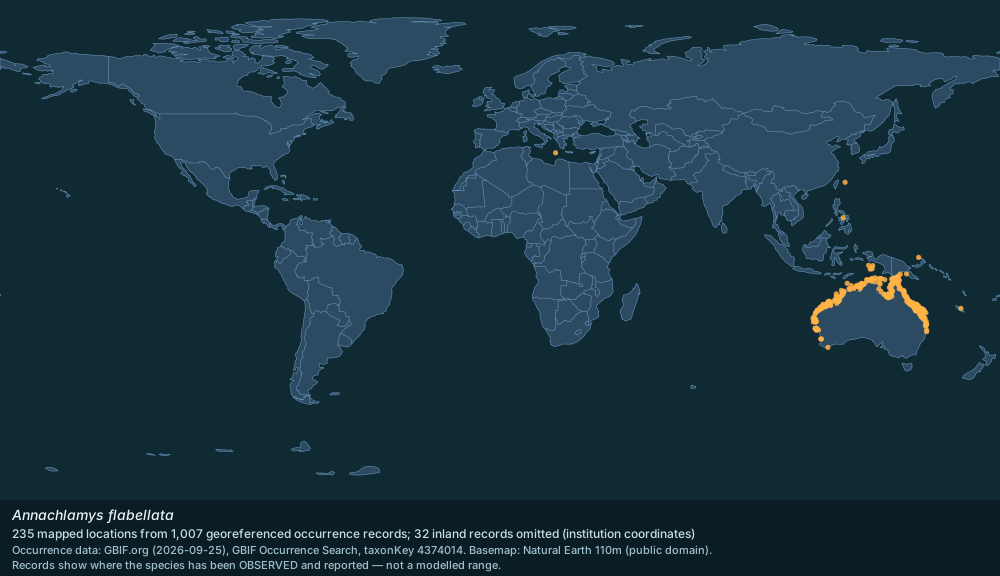
Distribution map plotted from GBIF.org occurrence records; basemap Natural Earth 110m · GBIF records CC0 / CC BY; Natural Earth public domain
Annachlamys flabellata is a species of scallop, a marine bivalve mollusc in the family Pectinidae. It is found in the sublittoral zone of the continental shelf north of Australia.
Scientific classification
- KingdomAnimalia
- PhylumMollusca
- ClassBivalvia
- OrderPectinida
- FamilyPectinidae
- GenusAnnachlamys
- SpeciesAnnachlamys flabellata
Named by (Lamarck, 1819)
Sources: Wikipedia taxobox: Annachlamys flabellata (CC BY-SA 4.0) · order, family and genus agree with WoRMS AphiaID 393954 (CC BY 4.0)
How big is it?
Largest length in the source, 0.1 m, next to a 1.8 m person.
Diagram: drawn by Codexery, schematic shapes to scale (not a likeness). Length: Wikipedia: Annachlamys flabellata
Where the leopard scallop (annachlamys flabellata) has been recorded
Each dot is a place where the species has been observed and reported (1,007 records, half-degree grid) — not a modelled range. 32 inland records left out (institution coordinates). 3 isolated far-off records not drawn.
Map: drawn by Codexery. Data: GBIF occurrence search (records CC0 / CC BY) · Natural Earth basemap (public domain) · place coordinates: Wikipedia (CC BY-SA 4.0)
Classification (WoRMS)
Full classification as recorded by WoRMS: Kingdom: Animalia · Phylum: Mollusca · Class: Bivalvia · Order: Pectinida · Family: Pectinidae · Genus: Annachlamys.
Accepted name: Annachlamys flabellata · Authority: (Lamarck, 1819) · Taxonomic status: accepted · AphiaID: 393954.
Synonyms and superseded combinations recorded for this taxon: Annachlamys leopardus (Reeve, 1853); Annachlamys melica Iredale, 1939; Pecten flabellatus Lamarck, 1819; Pecten leopardus Reeve, 1853.
Source: World Register of Marine Species (WoRMS) — https://www.marinespecies.org/aphia.php?p=taxdetails&id=393954 (CC BY 4.0). Accessed 2026-09-25.
Biology and life history (SeaLifeBase)
Measured values published by SeaLifeBase for Annachlamys flabellata. Only fields the database actually holds for this species are shown; these are database values, not aquarium guidance.
Maximum length: 10 cm · Common length: 8 cm · Depth range: 8–73 m · Habitat zone: benthic · Vulnerability index: 10 of 100 · Fishery importance: of potential interest · Aquarium trade: never/rarely.
SeaLifeBase notes: Sublittoral, from shallow waters to depths of about 125 m (Ref. 348). Living at depths of 10 m to 69 m (Ref. 89006).
Source: SeaLifeBase species summary (SpecCode 84385) — https://www.sealifebase.se/summary/Annachlamys-flabellata.html (CC BY-NC 3.0 — non-commercial use only). Accessed 2026-09-25.
Distribution and occurrence records (GBIF)
1,007 georeferenced occurrence records for Annachlamys flabellata are published through GBIF from 10 countries or marine areas. The map above plots 235 distinct locations from a sample of 1,007 records, omitting 32 inland records that carry an institution's coordinates rather than a collection site; it shows where the species has been observed and reported, not a modelled range.
Most records by country or area: Australia (986); Indonesia (8); Papua New Guinea (5); Malaysia (2); Greece (1).
The full country table, WoRMS marine regions and the sampling notes are on this species' Distribution page.
Source: GBIF Occurrence Search (taxonKey 4374014) — https://www.gbif.org/occurrence/search?taxon_key=4374014&has_coordinate=true (records CC0 / CC BY); WoRMS distribution records (MarineRegions) — https://www.marinespecies.org/aphia.php?p=taxdetails&id=393954 (CC BY 4.0); Natural Earth 110m basemap — https://www.naturalearthdata.com/ (public domain). Accessed 2026-09-25.
Description and natural history (Wikipedia)
Annachlamys flabellata grows to between 6 cm and 10 cm in length. The shell is inequivalve and moderately compressed. The right valve is more inflated and less convex than the left.
The general shape is circular with two broad auricles extending on either side of the umbones. These have a straight hinge line which is exactly in line with the umbones. There are 18 to 20 broad radial ribs which are more prominent and have larger interstices between them on the right valve. There is also sculpturing in the form of concentric growth rings.
Some or all of the ribs on the left valve are pink, orange or mauve, while the colour of the right valve is entirely white. The space between the ribs is narrower than in the otherwise similar, closely related species, Annachlamys reevei. On the inside of the valve there is often a red tinge or a concentric ring of red dots.
Distribution and habitat
Annachlamys flabellata is found on sandy seabeds in the neritic zone at depths of down to 127 m on the coasts of the Australian states of Western Australia, Northern Territory, Queensland and New South Wales, in New Guinea and in Indonesia.
Biology
Annachlamys flabellata is found lying on sandy seabeds covered with a thin layer of substrate. It is a filter feeder, drawing water into its gill chambers through a gap between the valves at the back of the shell. At the same time as oxygen is being absorbed by the gills, food particles, mostly microscopic algae, are sieved out and transported to the mouth and the water is expelled again.
Individuals of Annachlamys flabellata become mature when they reach about 4.5 cm in length. They seem to exhibit partial protandric sex reversal in that smaller individuals are mostly males but females predominate among larger individuals. Nevertheless, some small females do exist as do some large males. In lagoons in New Caledonia with little thermal variation, spawning takes place at intervals throughout the year but the maximum spawning period occurs in the summer from November to March.
Other than this, spawning exhibits no correlation to sea temperature variations, changes in salinity and the phases of the moon. In mature individuals, the male gonads are cream coloured and the female gonads bright red.
When ripe they are enlarged and visible in the live animal where they obscure the view of the animal's digestive tract. The eggs are fertilised externally and the initial trochophore larvae soon develop into veliger larvae which form part of the zooplankton and disperse with the currents. After some weeks, these settle and undergo metamorphosis before becoming juveniles.
Source: Wikipedia: Annachlamys flabellata — https://en.wikipedia.org/wiki/Annachlamys_flabellata (CC BY-SA 4.0). Accessed 2026-09-25.
Related in Leopard scallop
Links follow this subject's own source article.
Elsewhere in Leopard scallop
Sources
Compiled from Wikipedia and the sources listed below. Text from Wikipedia is available under CC BY-SA 4.0; this entry is adapted from it.
- Wikipedia: Annachlamys flabellata (CC BY-SA 4.0).
- Classification: the source article's taxobox; order, family and genus checked against WoRMS, the World Register of Marine Species (CC BY 4.0).
- Occurrence records: GBIF (CC0 / CC BY). Basemap: Natural Earth (public domain).
- Biology values: SeaLifeBase species summary (CC BY-NC 3.0, non-commercial).
- Word definitions: the , each quoted from its Wikipedia article.
Spotted an error? Know more?
Reader corrections go straight into our review queue. Suggest an edit · How this site is sourced