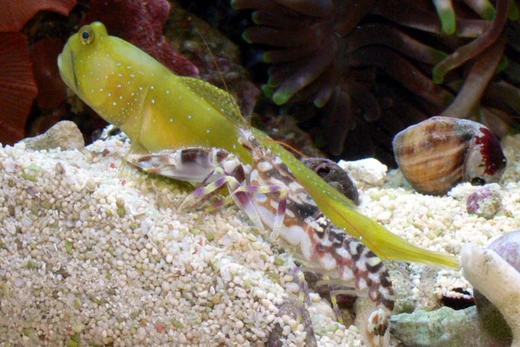
Red pistol shrimp (Alpheus macrocheles)
Source-cited species reference: taxonomy from WoRMS, biology from SeaLifeBase, occurrence map from GBIF, description from Wikipedia.

Alpheus macrocheles, also known as the orange European snapping prawn, is a species of snapping shrimp within the family Alpheidae.
- Scientific name
- Alpheus macrocheles
- Authority
- (Hailstone, 1835)
- Family
- Alpheidae
- Order
- Decapoda
- Habitat zone
- benthic
- Gbif occurrence records
- 412
Place in the Arthropod Tree
The Red pistol shrimp occupies a well-defined position within one of the most ancient and broadly distributed animal groups on Earth. As a member of the subphylum Crustacea, it belongs to the larger phylum of arthropods, a lineage defined by jointed appendages and segmented bodies. This taxonomic placement connects it to an extraordinary range of organisms, from the familiar shrimp and lobsters to the less conspicuous barnacles and the tiny krill that form the base of many marine food webs. The classification system that slots it into this framework is itself a testament to the sheer diversity of the group: crustaceans are organized into multiple classes, each containing numerous orders, which in turn branch into families and species. For the Red pistol shrimp, this means its identity is nested within a hierarchy that encompasses thousands of distinct lineages, each adapted to its own ecological niche while sharing the fundamental arthropod body plan that unites the subphylum.
An Aquatic Lineage
The overwhelming majority of crustaceans have evolved to live in water, and the Red pistol shrimp is squarely part of that aquatic tradition. Among the groups most commonly associated with marine and freshwater environments are shrimp, barnacles, lobsters, crayfish, and krill, all of which share the fundamental requirement for a liquid medium in which to move, feed, and reproduce. This aquatic heritage is not merely a preference but a deep evolutionary commitment; the body structures, respiratory surfaces, and locomotive strategies of these animals are shaped by the physics of water. The Red pistol shrimp, as a shrimp, inherits this aquatic legacy in full. Its existence is tied to the same watery world that sustains the barnacles clinging to harbor walls, the crayfish threading through riverbeds, and the krill swarming through open ocean. In this sense, its story is inseparable from the story of water itself as the medium that shaped an entire subphylum of arthropods.
Among the Spectrum of Crustacean Life
While the Red pistol shrimp is firmly aquatic, the broader crustacean family it belongs to stretches far beyond the waterline. The subphylum Crustacea includes organisms that have successfully adapted to terrestrial existence, such as woodlice and certain crabs, demonstrating that the arthropod body plan is flexible enough to conquer land as well as sea. This spectrum of adaptation, from the fully submerged shrimp and krill to the land-dwelling woodlice, illustrates the remarkable evolutionary range within a single subphylum. The Red pistol shrimp sits at the aquatic end of this spectrum, sharing its fundamental biology with barnacles, lobsters, and crayfish, yet remaining distinct from the terrestrial outliers. Understanding where it falls in this gradient helps clarify both what it shares with its closest relatives and what sets it apart from the crustaceans that have traded water for soil and leaf litter.
A Node in a Vast Taxonomic Web
The sheer scale of crustacean diversity becomes apparent when one considers that Ireland alone has a recorded inventory of 1,774 crustacean species, spanning classes such as Branchiopoda and Malacostraca, and branching through dozens of orders and hundreds of families. Within this enormous catalogue, the Red pistol shrimp represents just one thread in a tapestry that includes water fleas, skeleton shrimps, hooded shrimps, landhoppers, and countless other specialized forms. The taxonomic architecture that organizes these species, from the broad class level down through orders like Amphipoda and families like Caprellidae, reveals a group of staggering complexity. The Red pistol shrimp, as a shrimp within this web, is a single point of reference in a classification system that must account for organisms ranging from the microscopic to the sizeable, from the fully aquatic to the semi-terrestrial, each occupying its own precise coordinate in the tree of life.
Spotted an error? Know more?
Reader corrections go straight into our review queue. Suggest an edit · How this site is sourced