
Brown rib-weed (Alaria esculenta)
Source-cited species reference: taxonomy from WoRMS, biology from SeaLifeBase, occurrence map from GBIF, description from Wikipedia.
Alaria esculenta is an edible seaweed, also known as dabberlocks or badderlocks, or winged kelp, and occasionally as Atlantic Wakame. It is a traditional food along the coasts of the far north Atlantic Ocean. It may be eaten fresh or cooked in Greenland, Iceland, Scotland and Ireland. It is the only one of twelve species of Alaria to occur in both Ireland and in Great Britain.
- Scientific name
- Alaria esculenta
- Authority
- (Linnaeus) Greville, 1830
- Family
- Alariaceae
- Order
- Laminariales
- Habitat zone
- sessile
- Gbif occurrence records
- 8,720
Classification (WoRMS)
Full classification as recorded by WoRMS: Kingdom: Chromista · Phylum: Ochrophyta · Class: Phaeophyceae · Order: Laminariales · Family: Alariaceae · Genus: Alaria.
Accepted name: Alaria esculenta · Authority: (Linnaeus) Greville, 1830 · Taxonomic status: accepted · AphiaID: 145716.
Synonyms and superseded combinations recorded for this taxon: Agarum delisei Bory de Saint-Vincent, 1826; Agarum esculentum (Linnaeus) Bory de Saint-Vincent, 1826; Alaria delisei (Bory) Greville, 1830; Alaria dolichorachis f. longipes Miyabe, 1928; Alaria dolichorhachis Kjellman, 1883; Alaria dolichorhachis f. typica Miyabe & Nagai, 1940; Alaria esculenta f. australis Kjellman, 1883; Alaria esculenta f. fasciculata Strömfelt, 1886; Alaria esculenta f. latifolia Postels & Ruprecht, 1840; Alaria esculenta f. musaefolia (Pylaie) Kjellman, 1883; Alaria esculenta f. pinnata (Gobi) Foslie, 1886; Alaria esculenta f. polyphylla (S.G.Gmelin) Postels & Ruprecht, 1840; Alaria esculenta var. noltei Rabenhorst; Alaria esculenta var. pinnata (Gobi) Kjellman, 1890; Alaria grandifolia J.Agardh, 1872; Alaria linearis Strömfelt, 1886; Alaria macroptera (Ruprecht) Yendo, 1919; Alaria musaefolia (Bachelot de la Pylaie) J.Agardh, 1872; Alaria platyrhiza Kjellman, 1906; Ceramium esculentum (Linnaeus) Stackhouse, 1797; Fucus esculentus Linnaeus, 1767; Fucus esculentus var. ß minor Turner, 1802; Fucus pinnatus Gunnerus, 1766; Fucus teres Goodenough & Woodward, 1797; Laminaria esculenta (Linnaeus) C.Agardh, 1817.
Source: World Register of Marine Species (WoRMS) — https://www.marinespecies.org/aphia.php?p=taxdetails&id=145716 (CC BY 4.0). Accessed 2026-09-23.
Biology and life history (SeaLifeBase)
Measured values published by SeaLifeBase for Alaria esculenta. Only fields the database actually holds for this species are shown; these are database values, not aquarium guidance.
Habitat zone: sessile.
Source: SeaLifeBase species summary (SpecCode 122147) — https://www.sealifebase.se/summary/Alaria-esculenta.html (CC BY-NC 3.0 — non-commercial use only). Accessed 2026-09-23.
Distribution and occurrence records (GBIF)
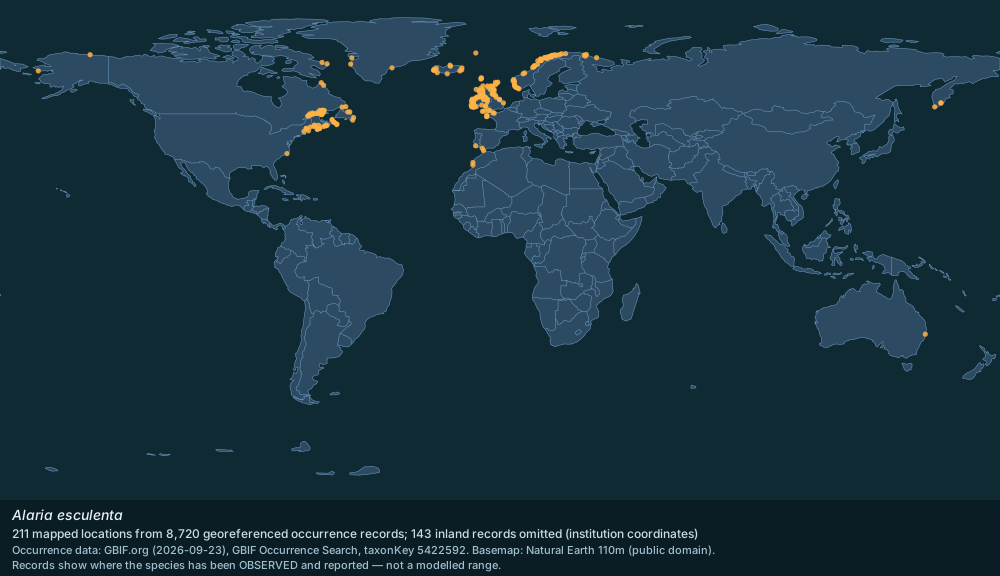
8,720 georeferenced occurrence records for Alaria esculenta are published through GBIF from 23 countries or marine areas. The map above plots 211 distinct locations from a sample of 3,000 records, omitting 143 inland records that carry an institution's coordinates rather than a collection site; it shows where the species has been observed and reported, not a modelled range.
Most records by country or area: United Kingdom of Great Britain and Northern Ireland (4,113); Canada (1,307); United States of America (831); Ireland (654); Norway (594).
The full country table, WoRMS marine regions and the sampling notes are on this species' Distribution page.
Source: GBIF Occurrence Search (taxonKey 5422592) — https://www.gbif.org/occurrence/search?taxon_key=5422592&has_coordinate=true (records CC0 / CC BY); WoRMS distribution records (MarineRegions) — https://www.marinespecies.org/aphia.php?p=taxdetails&id=145716 (CC BY 4.0); Natural Earth 110m basemap — https://www.naturalearthdata.com/ (public domain). Accessed 2026-09-23.
Description and natural history (Wikipedia)
Grows to a maximum length of 2 m. The whole frond is brown and consists of a distinct midrib with wavy membranous lamina up to 7 cm wide on either side. The frond is unbranched and tapers towards the end. The base has a short stipe arising from a rhizoidal holdfast. The stipe may bear several sporophylls which are club-shaped and up to 20 cm long and 5 cm broad which bear the spores.
It grows from a short cylindrical stipe attached to the rocks by a holdfast of branching root-like rhizoids and grows to about 20 cm long. The stipe is continued into the frond forming a long conspicuous midrib, all other large and unbranched brown algae to be found in the British Isles are without a mid-rib. The lamina is thin, membranous with a wavy margin.
Sporangia grow in club shaped narrow leafy outgrowths produced near the base growing from the stipe. These grow to 20 cm long and 5 cm broad.
Alaria esculenta is well known in Ireland, where it is known as Láir or Láracha, and in the rest of the British Isles save the south and east of England. It is perennial.
It is a common large algae on shores where there is severe wave exposure attached to rocks just below low-watermark in the "Laminaria belt", and is common on rocky shores in exposed places. It has a fairly high intrinsic growth rate compared to other algae, 5.5% per day and a carrying capacity of about 2 kg wet weight per square meter. It may reach lengths of about 2.5 m. It overlaps to a small degree (+) in distribution with Fucus serratus and somewhat more with Laminaria digitata. It has low and high light limitation values of about 5 and 70 W per square meter respectively. Its distribution is also limited by salinity, wave exposure, temperature, desiccation and general stress. These, and other attributes of the algae are summarized in Lewis (1964) and Seip 1980.
Leaf-like sporophylls develop from the stipe and produce zoospores.
A. esculenta may produce phlorotannins and oxidized lipids as protective functions against high photosynthetically active and UV radiations.
It is host to the pathogenic fungus Phycomelaina laminariae.
Europe: Atlantic France, Channel Islands, Britain, Ireland, Netherlands, Heligoland, Baltic, Iceland, Faroes, Norway and Svalbard; North America: New York, New England, Maritime Provinces, Newfoundland, Quebec, Labrador, Alaska, Canadian Arctic and Greenland; Asia: Japan, Korea, Kuriles, Sakhalin and Kamchatka.
Source: Wikipedia: Alaria esculenta — https://en.wikipedia.org/wiki/Alaria_esculenta (CC BY-SA 4.0). Accessed 2026-09-23.
Gallery
Related in Brown rib-weed
Links follow this subject's own source article.
Elsewhere in Brown rib-weed
Spotted an error? Know more?
Reader corrections go straight into our review queue. Suggest an edit · How this site is sourced