
Wakame (Undaria pinnatifida)
Source-cited species reference: taxonomy from WoRMS, biology from SeaLifeBase, occurrence map from GBIF, description from Wikipedia.
Wakame (Undaria pinnatifida) is a species of kelp native to cold, temperate coasts of the northwest Pacific Ocean. As an edible seaweed, it has a subtly sweet, but distinctive and strong flavour and satiny texture. It is most often served in soups and salads.
- Scientific name
- Undaria pinnatifida
- Authority
- (Harvey) Suringar, 1873
- Family
- Alariaceae
- Order
- Laminariales
- Habitat zone
- sessile
- Gbif occurrence records
- 285,141
Classification (WoRMS)
Full classification as recorded by WoRMS: Kingdom: Chromista · Phylum: Ochrophyta · Class: Phaeophyceae · Order: Laminariales · Family: Alariaceae · Genus: Undaria.
Accepted name: Undaria pinnatifida · Authority: (Harvey) Suringar, 1873 · Taxonomic status: accepted · AphiaID: 145721.
Synonyms and superseded combinations recorded for this taxon: Alaria amplexicaulis Martens, 1866; Alaria pinnatifida Harvey, 1860; Hirome undarioides Yendo, 1903; Laminaria peterseniana Kjellman, 1885; Ulopteryx pinnatifida (Harvey) Kjellman, 1885; Undaria peterseniana (Kjellmann) Okamura, 1915; Undaria pinnatifida f. distans (Miyabe & Okamura) Yendo, 1911; Undaria pinnatifida f. narutensis Yendo; Undaria pinnatifida f. subflabellata Suringar; Undaria pinnatifida f. typica Yendo; Undaria pinnatifida var. distans Miyabe & Okamura; Undaria pinnatifida var. elongata Suringar, 1872; Undaria pinnatifida var. vulgaris Suringar, 1872; Undaria undarioides (Yendo) Okamura, 1915; Undariella peterseniana (Kjellman) Y.-P.Lee, 1998; Undariopsis peterseniana (Kjellmann) Miyabe & Okamura, 1902.
Source: World Register of Marine Species (WoRMS) — https://www.marinespecies.org/aphia.php?p=taxdetails&id=145721 (CC BY 4.0). Accessed 2026-09-23.
Biology and life history (SeaLifeBase)
Measured values published by SeaLifeBase for Undaria pinnatifida. Only fields the database actually holds for this species are shown; these are database values, not aquarium guidance.
Habitat zone: sessile · Fishery importance: commercial.
Source: SeaLifeBase species summary (SpecCode 129650) — https://www.sealifebase.se/summary/Undaria-pinnatifida.html (CC BY-NC 3.0 — non-commercial use only). Accessed 2026-09-23.
Distribution and occurrence records (GBIF)
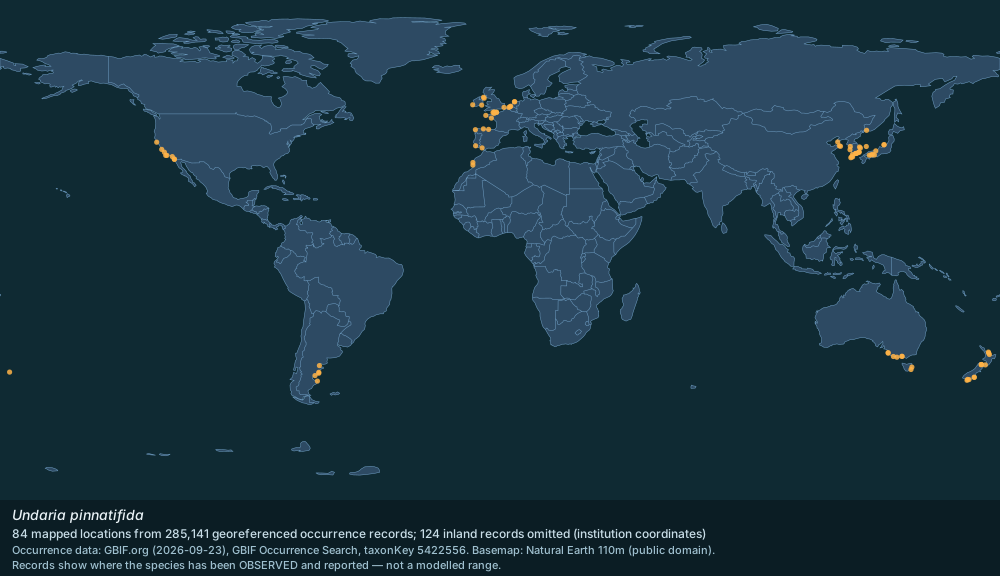
285,141 georeferenced occurrence records for Undaria pinnatifida are published through GBIF from 22 countries or marine areas. The map above plots 84 distinct locations from a sample of 3,000 records, omitting 124 inland records that carry an institution's coordinates rather than a collection site; it shows where the species has been observed and reported, not a modelled range.
Most records by country or area: United States of America (253,551); New Zealand (17,145); Australia (7,438); Japan (2,189); France (1,514).
The full country table, WoRMS marine regions and the sampling notes are on this species' Distribution page.
Source: GBIF Occurrence Search (taxonKey 5422556) — https://www.gbif.org/occurrence/search?taxon_key=5422556&has_coordinate=true (records CC0 / CC BY); WoRMS distribution records (MarineRegions) — https://www.marinespecies.org/aphia.php?p=taxdetails&id=145721 (CC BY 4.0); Natural Earth 110m basemap — https://www.naturalearthdata.com/ (public domain). Accessed 2026-09-23.
Description and natural history (Wikipedia)
Wakame has long been collected for food in East Asia, and sea farmers in Japan have cultivated wakame since the eighth century (Nara period).
Although native to cold, temperate coastal areas of Japan, Korea, China, and Russia, it has established itself in temperate regions around the world, including New Zealand, the United States, Belgium, France, Great Britain, Spain, Italy, Argentina, Australia and Mexico., the Invasive Species Specialist Group has listed the species on its list of 100 worst globally invasive species.
Wakame, as with all other kelps and brown algae, is plant-like in appearance, but is unrelated to true plants, being, instead, a photosynthetic, multicellular stramenopile protist of the SAR supergroup.
The primary common name is derived from the Japanese name (,,,).
In English, it can also be called sea mustard.
In Chinese, it is called (裙带菜) or (海帶芽).
In French, it is called or ('sea fern').
In Korean, it is called (미역).
In Old Japanese, stood for edible seaweeds in general as opposed to standing for algae. In kanji, such as, and were applied to transcribe the word. Among seaweeds, wakame was likely most often eaten, therefore especially meant wakame. It expanded later to other seaweeds like kajime, hirome (kombu), arame, etc. Wakame is derived from + (, lit. 'young seaweed'). If this is a eulogistic prefix, the same as the of tamagushi, wakame likely stood for seaweeds widely in ancient times. In the Man'yōshū, in addition to and (both are read as), (, soft wakame) can be seen. Besides, (, lit. 'beautiful algae'), which often appeared in the, may be wakame depending on poems.
The earliest appearance in Western documents is probably in the Portuguese Nippo Jisho (1603), as Vacame.
In 1867 the word wakame appeared in an English-language publication, A Japanese and English Dictionary, by James C. Hepburn.
Starting in the 1960s, the word wakame started to be used widely in the United States, and the product (imported in dried form from Japan) became widely available at natural food stores and Asian-American grocery stores, due to the influence of the macrobiotic movement, and in the 1970s with the growing number of Japanese restaurants and sushi bars.
Japanese and Korean sea-farmers have grown wakame for centuries, and are still both the leading producers and consumers. Wakame has also been cultivated in France since 1983, in sea fields established near the shores of Brittany.
Source: Wikipedia: Wakame — https://en.wikipedia.org/wiki/Wakame (CC BY-SA 4.0). Accessed 2026-09-23.
Gallery
Elsewhere in Wakame
Spotted an error? Know more?
Reader corrections go straight into our review queue. Suggest an edit · How this site is sourced