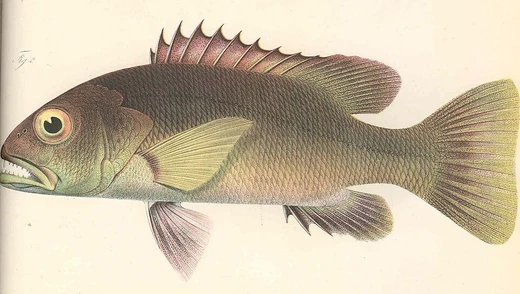
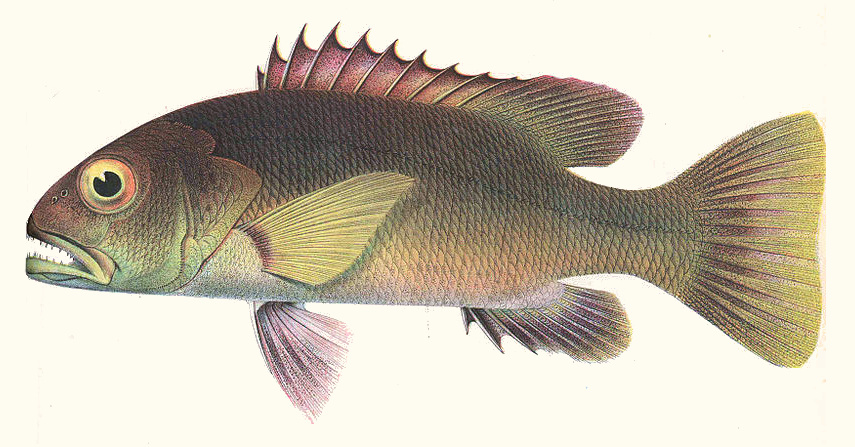
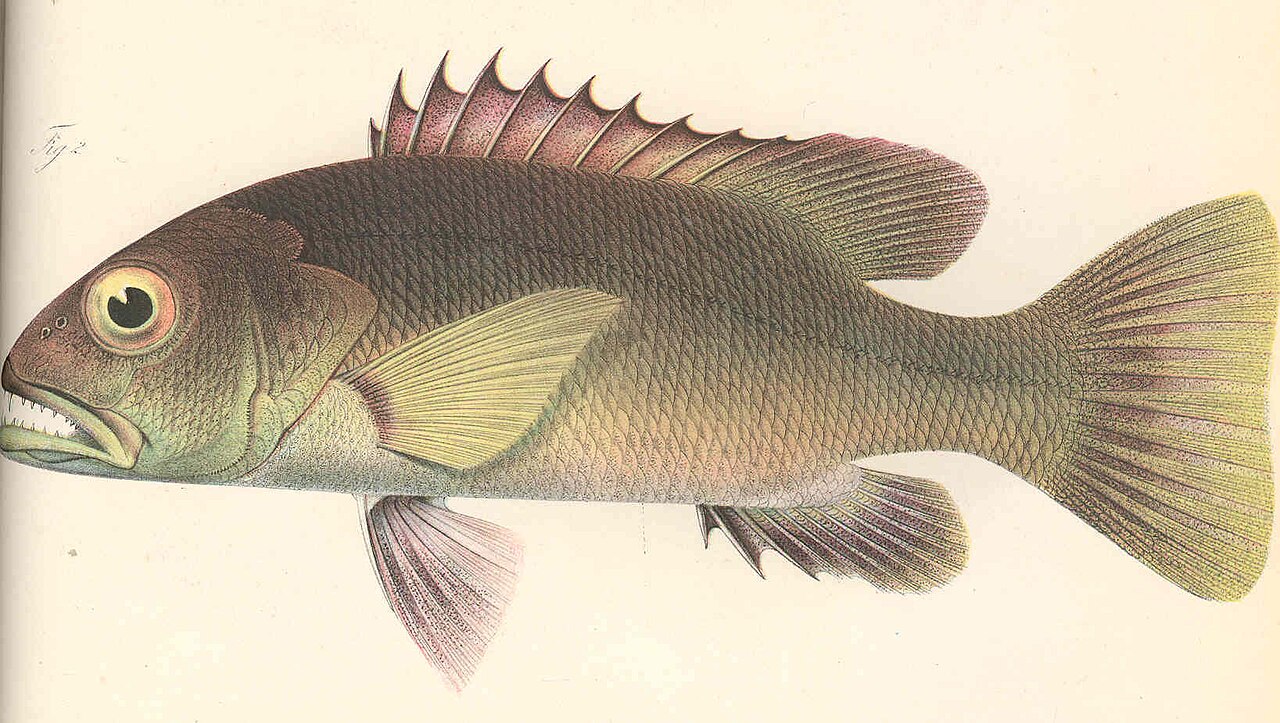
African brown snapper (Lutjanus dentatus)
Source-cited species reference: taxonomy from WoRMS, biology from FishBase, occurrence map from GBIF, conservation from IUCN Red List, description from Wikipedia.

Pieter Bleeker · Public domain
The African brown snapper (Lutjanus dentatus) is a species of marine ray-finned fish, a snapper belonging to the family Lutjanidae. It is native to the eastern Atlantic Ocean off the coast of West Africa.
- Scientific name
- Lutjanus dentatus
- Authority
- (Duméril, 1861)
- Family
- Lutjanidae
- Order
- Eupercaria incertae sedis
- Maximum length
- 150 cm
- Habitat zone
- reef-associated
- Iucn red list
- Data Deficient
- Gbif occurrence records
- 678
Taxonomic Identity and Naming History
The African brown snapper entered the scientific record in 1861, when French zoologist Auguste Duméril formally described it under the name Mesoprion dentatus, based on a specimen collected at Gorée, Senegal. The species epithet "dentatus" is Latin for "toothed," a nod to the notably large teeth this fish carries. Despite its established name, the taxonomic identity of L. dentatus has never been entirely settled. Researchers examining a vagrant cubera snapper (Lutjanus cyanopterus) washed up on Flores Island in the Azores alongside a stray individual of this species from Gran Canaria raised the possibility that the two might actually be the same species. If that hypothesis holds, L. dentatus would be demoted to a junior synonym of L. cyanopterus. Adding further confusion, the poorly documented Guinea snapper (Lutjanus endecacanthus) is regarded by some authorities as simply another name for L. dentatus, leaving the precise boundaries of this species somewhat uncertain within the broader Lutjanus complex.
Morphology and Colouration Across Life Stages
Adults of this snapper present a deep-bodied silhouette with a gently rounded head, thick-set lips, and a mouth that reaches back to the vertical midline of the eye. The preopercular notch and knob are only faintly developed. One of the most distinctive features is the arrangement of vomerine teeth: in juveniles they form a chevron pattern, while in adults they cluster into a triangular patch, occasionally with a small rearward extension. The dorsal fin carries ten spines backed by thirteen or fourteen soft rays, and the anal fin has three spines with eight soft rays. In mature fish the pectoral fins, which bear seventeen rays, fall short of the anus. Size varies considerably; the species can reach a maximum total length of 150 cm and a published maximum weight of 50 kg, though 50 cm is a far more common adult size. Colouration shifts dramatically with age: juveniles display alternating light and dark vertical bars of roughly equal width along their flanks, while adults fade from a dusky grey back and upper sides to a pale pinkish-white belly.
Geographic Range and Habitat Flexibility
The African brown snapper is a resident of the eastern Atlantic, ranging along the western African coastline from Senegal in the north down to Angola in the south. Its distribution also encompasses the islands of Bioko and São Tomé and Príncipe, and the species has been recorded in the Canary Islands, suggesting occasional dispersal beyond its core range. In terms of depth, this snapper occupies relatively shallow waters, typically between 2 and 50 metres. Its preferred substrate is rocky or coral reef, but it is by no means restricted to hard-bottom environments. Individuals are also found in brackish lagoons and mangrove channels, and on occasion they venture into rivers. This flexibility in habitat use—from open reef to sheltered estuarine systems—distinguishes it from many of its reef-bound congeners and likely contributes to its overlap with artisanal fishing grounds in coastal West African communities.
Commercial Exploitation and Conservation Outlook
The African brown snapper is harvested by both commercial trawlers and small-scale artisanal fishers across West Africa, often alongside other snapper species in mixed catches. Although it fetches high market prices, it does not enjoy the same level of demand as the more popular African red snapper (Lutjanus agennes). A portion of the landed catch is exported to European markets. A significant concern is that spawning aggregations of snappers are likely being directly targeted by fishing operations, which could disproportionately impact recruitment. Because fisheries do not collect species-specific catch data for L. dentatus, its population status remains poorly quantified. The IUCN currently lists the species as Data Deficient for this reason. However, the organization acknowledges that given the intense fishing pressure across the region and documented declines in all West African snapper stocks, the true conservation status of this species may be Near Threatened or even Vulnerable.
Gallery
Frequently Asked Questions
Who is African brown snapper (Lutjanus dentatus)?
It is a marine ray-finned fish in the snapper family Lutjanidae, first formally named by Duméril in 1861. Think of it as a reef-dwelling member of the snapper 'franchise,' restricted to the eastern Atlantic off West Africa.
What are African brown snapper (Lutjanus dentatus)'s powers/role?
As a reef-associated forager it sits in the mid-to-upper trophic tier, linking small reef prey to larger predators and coastal food webs. Its 'power set' is essentially that of a structured reef predator: ambush, pursuit, and sustained foraging around coral and rocky outcrops.
Why is African brown snapper (Lutjanus dentatus) important?
It is a commercially harvested snapper that supplies protein to coastal communities along the West African shelf. Ecologically, its abundance tracks the health of the reef systems it depends on, making it a useful barometer for eastern Atlantic marine conservation.
Where does African brown snapper (Lutjanus dentatus) live?
Its range is confined to the eastern Atlantic along the West African coastline, from roughly Senegal southward. Being reef-associated, it hangs around coral heads, rocky ledges, and structured nearshore habitats rather than the open pelagic zone.
Spotted an error? Know more?
Reader corrections go straight into our review queue. Suggest an edit · How this site is sourced