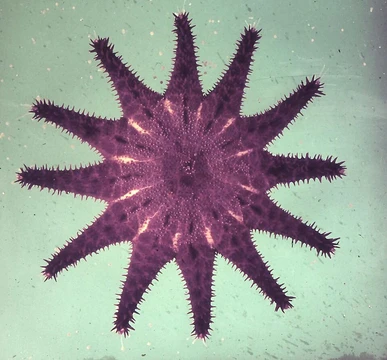
Acanthaster brevispinus
Source-cited species reference: taxonomy from WoRMS, biology from SeaLifeBase, occurrence map from GBIF, description from Wikipedia.

Acanthaster brevispinus, the short-spined crown-of-thorns starfish, is one of the two members of the starfish genus Acanthaster, along with the much better-known A. planci, the common crown-of-thorns starfish.
- Scientific name
- Acanthaster brevispinus
- Authority
- Fisher, 1917
- Family
- Acanthasteridae
- Order
- Valvatida
- Habitat zone
- benthic
- Gbif occurrence records
- 44
Classification (WoRMS)
Full classification as recorded by WoRMS: Kingdom: Animalia · Phylum: Echinodermata · Class: Asteroidea · Order: Valvatida · Family: Acanthasteridae · Genus: Acanthaster.
Accepted name: Acanthaster brevispinus · Authority: Fisher, 1917 · Taxonomic status: accepted · AphiaID: 213291.
Source: World Register of Marine Species (WoRMS) — https://www.marinespecies.org/aphia.php?p=taxdetails&id=213291 (CC BY 4.0). Accessed 2026-09-23.
Biology and life history (SeaLifeBase)
Measured values published by SeaLifeBase for Acanthaster brevispinus. Only fields the database actually holds for this species are shown; these are database values, not aquarium guidance.
Habitat zone: benthic · Aquarium trade: never/rarely.
Source: SeaLifeBase species summary (SpecCode 167032) — https://www.sealifebase.se/summary/Acanthaster-brevispinus.html (CC BY-NC 3.0 — non-commercial use only). Accessed 2026-09-23.
Distribution and occurrence records (GBIF)
44 georeferenced occurrence records for Acanthaster brevispinus are published through GBIF from 9 countries or marine areas. The map above plots 22 distinct locations from a sample of 44 records, omitting 4 inland records that carry an institution's coordinates rather than a collection site; it shows where the species has been observed and reported, not a modelled range.
Most records by country or area: Australia (23); Philippines (9); Réunion (3); French Polynesia (2); Seychelles (2); Somalia (2); Madagascar (1); Oman (1); Tanzania, United Republic of (1).
Source: GBIF Occurrence Search (taxonKey 2271220) — https://www.gbif.org/occurrence/search?taxon_key=2271220&has_coordinate=true (records CC0 / CC BY); WoRMS distribution records (MarineRegions) — https://www.marinespecies.org/aphia.php?p=taxdetails&id=213291 (CC BY 4.0); Natural Earth 110m basemap — https://www.naturalearthdata.com/ (public domain). Accessed 2026-09-23.
Description and natural history (Wikipedia)
The body form of A. brevispinus is fundamentally the same as that of a typical starfish or seastar. Like A. planci, however, its distinctive traits include being disc-shaped, multiple-armed with multiple madreporites, flexible, prehensile, and densely spined, and having a large ratio of stomach surface to body mass. Its prehensile ability arises from the two rows of numerous tube feet that extend to the tip of each arm. In being multiple-armed, it has lost the five-fold symmetry (pentamerism) typical of starfish, although it begins with this symmetry in its life cycle.
Acanthaster brevispinus is readily distinguished from A.
dense blunt spines over the upper (aboral) surface of its disc
short pedicellaria on its aboral surface
purple-brown aboral surface becoming more intense along the arms
blotches of darker colour around the perimeter of the disc and along the arms, including a large blotch at the base of each arm
pale marks on the disc between each arm
spines along it arms which are not as long as in A.
A. brevispinus was described by the American zoologist Walter Kenrick Fisher from a specimen collected at 18 m deep off Sirun Island, Sulu Archipelago, Philippines. The holotype is lodged in the U.S. National Museum, Washington, registration number USNM37027.
Madsen (1955) reviewed the taxonomy of the genus Acanthaster and concluded that there were three species: the Indo-Pacific A. planci(L.); the short-armed, blunt spined eastern Pacific A. ellisii (Gray) and A. brevispinus Fisher. Madsen suspected that A. brevispinus was part of the variability of A. planci over its wide geographical range. See Acanthaster planci for a treatment of the status of Acanthaster ellisii.
Subsequently, A. brevispinus was reported from the Great Barrier Reef region.
Jangoux and Aziz reported a specimen from the Seychelles. They considered it sufficiently different from the holotype in some features to describe it as A. brevispinus seyshellesensis nov. subsp.
The genus name Acanthaster comes from Ancient Greek ἄκανθα (ákantha), meaning "spine, thorn", and ἀστήρ (astḗr), meaning "star". The specific epithet brevispinus comes from Latin brevis, meaning "short", and spinus, meaning "spine".
Source: Wikipedia: Acanthaster brevispinus — https://en.wikipedia.org/wiki/Acanthaster_brevispinus (CC BY-SA 4.0). Accessed 2026-09-23.
Spotted an error? Know more?
Reader corrections go straight into our review queue. Suggest an edit · How this site is sourced