
Crown-of-thorns starfish (Acanthaster planci)
Source-cited species reference: taxonomy from WoRMS, biology from SeaLifeBase, occurrence map from GBIF, description from Wikipedia.
The crown-of-thorns starfish (Acanthaster planci) is a large starfish that preys upon hard coral polyps. The crown-of-thorns starfish, frequently abbreviated to COTS, receives its name from venomous, thornlike spines that cover its upper surface, resembling the biblical crown of thorns. It is one of the largest starfish in the world.
- Scientific name
- Acanthaster planci
- Authority
- (Linnaeus, 1758)
- Family
- Acanthasteridae
- Order
- Valvatida
- Maximum length
- 80 cm
- Depth range
- 0–65 m
- Habitat zone
- reef-associated
- Gbif occurrence records
- 7,696
Classification (WoRMS)
Full classification as recorded by WoRMS: Kingdom: Animalia · Phylum: Echinodermata · Class: Asteroidea · Order: Valvatida · Family: Acanthasteridae · Genus: Acanthaster.
Accepted name: Acanthaster planci · Authority: (Linnaeus, 1758) · Taxonomic status: accepted · AphiaID: 213289.
Synonyms and superseded combinations recorded for this taxon: Acanthaster echinites (Ellis & Solander, 1786); Acanthaster echinus Gervais, 1841; Acanthaster ellisi (Gray, 1840); Acanthaster ellisi pseudoplanci Caso, 1962; Acanthaster pseudoplanci Caso, 1962; Acanthaster solaris (Schreber, 1793); Asterias echinites Ellis & Solander, 1786; Asterias echinus Gervais, 1841; Asterias planci Linnaeus, 1758; Asterias solaris Schreber, 1793; Echinaster ellisi Gray, 1840; Echinaster solaris (Schreber, 1793); Echinities solaris (Schreber, 1793); Stellonia echinites L. Agassiz, 1836.
Source: World Register of Marine Species (WoRMS) — https://www.marinespecies.org/aphia.php?p=taxdetails&id=213289 (CC BY 4.0). Accessed 2026-09-23.
Biology and life history (SeaLifeBase)
Measured values published by SeaLifeBase for Acanthaster planci. Only fields the database actually holds for this species are shown; these are database values, not aquarium guidance.
Maximum length: 80 cm · Depth range: 0–65 m · Habitat zone: reef-associated · Vulnerability index: 29.6 of 100.
SeaLifeBase notes: Minimum depth from Ref. 81548. Cryptic on coral areas (Also Ref. 129602) and reef patches (Ref. 78188). On a reef slope (Ref. 97449). Feeds on hard corals, soft corals, encrusting organisms, algae, gorgonians and cannibalistic on other Acanthaster planci (Ref. 78188). Nocturnal (Ref. 130720).
Source: SeaLifeBase species summary (SpecCode 48649) — https://www.sealifebase.se/summary/Acanthaster-planci.html (CC BY-NC 3.0 — non-commercial use only). Accessed 2026-09-23.
Distribution and occurrence records (GBIF)
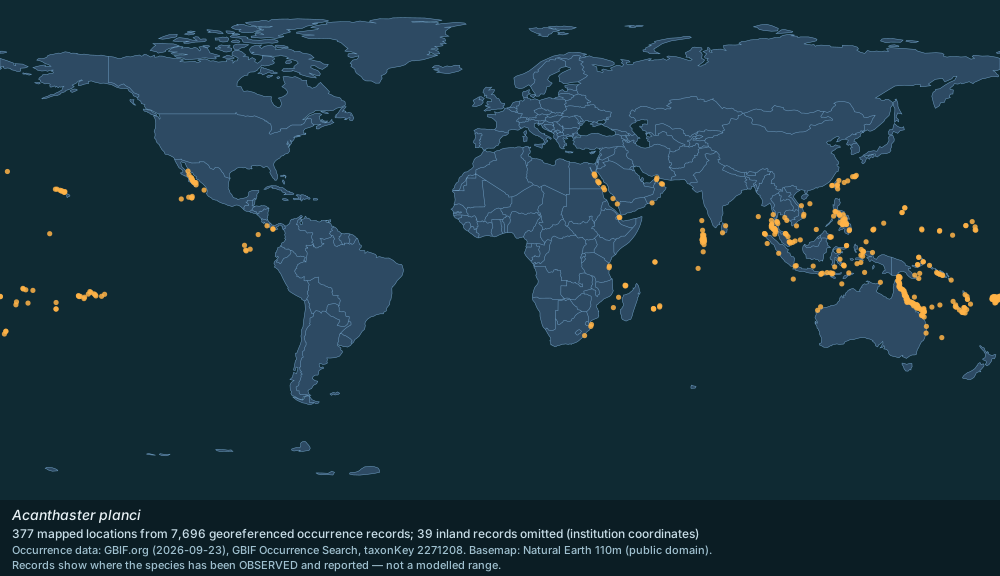
7,696 georeferenced occurrence records for Acanthaster planci are published through GBIF from 69 countries or marine areas. The map above plots 377 distinct locations from a sample of 3,000 records, omitting 39 inland records that carry an institution's coordinates rather than a collection site; it shows where the species has been observed and reported, not a modelled range.
Most records by country or area: Australia (3,788); French Polynesia (830); Mexico (337); United States of America (279); New Caledonia (252).
The full country table, WoRMS marine regions and the sampling notes are on this species' Distribution page.
Source: GBIF Occurrence Search (taxonKey 2271208) — https://www.gbif.org/occurrence/search?taxon_key=2271208&has_coordinate=true (records CC0 / CC BY); WoRMS distribution records (MarineRegions) — https://www.marinespecies.org/aphia.php?p=taxdetails&id=213289 (CC BY 4.0); Natural Earth 110m basemap — https://www.naturalearthdata.com/ (public domain). Accessed 2026-09-23.
Description and natural history (Wikipedia)
A. planci has a very wide Indo-Pacific distribution, perhaps most common around Australia, but can occur at tropical and subtropical latitudes from the Red Sea and the East African coast across the Indian Ocean, and across the Pacific Ocean to the west coast of Central America. It occurs where coral reefs or hard coral communities occur in the region.
The body form of the crown-of-thorns starfish is fundamentally the same as that of a typical starfish, with a central disc and radiating arms. Its special traits, however, include being disc-shaped, multiple-armed, flexible, prehensile, and heavily spined, and having a large ratio of stomach surface to body mass. Its prehensile ability arises from the two rows of numerous tube feet that extend to the tip of each arm. In being multiple-armed, it has lost the five-fold symmetry (pentamerism) typical of starfish, although it begins its lifecycle with this symmetry. The animal has true image-forming vision.
Adult crown-of-thorns starfish normally range in size from 25 to 35 cm. They have up to 21 arms. Although the body of the crown of thorns has a stiff appearance, it is able to bend and twist to fit around the contours of the corals on which it feeds. The underside of each arm has a series of closely fitting plates, which form a groove and extend in rows to the mouth. Depending on diet or geographic region, individuals can be purple, purple-blue, reddish grey or brown with red spine tips, or green with yellow spine tips.
The long, sharp spines on the sides of the starfish's arms and upper (aboral) surface resemble thorns and create a crown-like shape, giving the creature its name. The spines can range from 4 to 5 cm long and are stiff, very sharp, and readily pierce through soft surfaces. Despite the battery of sharp spines on the aboral surface and blunt spines on the oral surface, the crown-of-thorns starfish's general body surface is membranous and soft. When the starfish is removed from the water, the body surface ruptures and the body fluid leaks out, so the body collapses and flattens. The spines bend over and flatten, as well. They recover their shape when reimmersed, if they are still alive.
Echinobase is the model organism database for A. planci and a number of other echinoderms.
The family Acanthasteridae is monogeneric; its position within the Asteroides is unsettled. It is generally recognized as a distinctly isolated taxon. Recently, paleontologist Daniel Blake concluded from comparative morphology studies of A. planci that it has strong similarities with various members of the Oreasteridae. He transferred the Acanthasteridae from the Spinulosida to the Valvatida and assigned it a position near to the Oreasteridae, from which it appears to be derived. He attributed Acanthaster morphology as possibly evolving in association with its locomotion over irregular coral surfaces in high-energy environments. A complication exists, however, in that Acanthaster is not a monospecific genus and any consideration of the genus must also take into account another species, Acanthaster brevispinus, which lives in a completely different environment. A. brevispinus lives on soft substrates, perhaps buried in the substrate at times like other soft substrate-inhabiting starfish, at moderate depths, where presumably the surface is regular and little wave action occurs.
A. planci has a long history in the scientific literature with great confusion in the generic and specific names from the outset, with a long list of complex synonyms. Georg Eberhard Rhumphius first described it in 1705, naming it Stella marina quindecium radiotorum. Later, Carl Linnaeus described it as Asterias planci based on an illustration by Plancus and Gualtieri (1743), when he introduced his system of binomial nomenclature. No type specimens are known; the specimen described by Plancus and Gualtieri (1743) no longer exists.
Subsequent generic names used for the crown-of-thorns starfish included Stellonia, Echinaster, and Echinites, before settling on Acanthaster (Gervais 1841). Specific names included echintes, solaris, mauritensis, ellisii, and ellisii pseudoplanci (with subspecies). Most of these names arose from confusion in the historical literature, but Acanthaster ellisii came to be used for the distinctive starfish in the eastern Pacific Gulf of California.
The eastern Pacific Acanthaster is very distinctive (see image to the right) with its rather "plump" body, large disc-to-total diameter ratio, and short, blunt spines.
Nishida and Lucas examined genetic variation at 14 allozyme loci of 10 population samples of A. planci using starch-gel electrophoresis. The samples were from localities across the Pacific: Ryukyu Archipelago (four locations), Micronesia (two locations), and samples from one location each of the Great Barrier Reef, Fiji, Hawaii, and the Gulf of California. A sample of 10 specimens of A. brevispinus from the Great Barrier Reef region was included for comparison. Considerable genetic differentiation was seen between the A. brevispinus and A. planci populations (D= 0.20 +/− 0.02)(D is genetic distance). The genetic differences between geographic populations of A. planci were, however, small (D = 0.03 +/− 0.00; Fsr = 0.07 + 0.02) (Fsr is standardized genetic variance for each polymorphic locus) despite the great distances separating them. A positive correlation was observed between degree of genetic differentiation and geographic distance, suggesting the genetic homogeneity among A. planci populations is due to gene flow by planktonic larval dispersion. The distance effect on genetic differentiation most probably reflects decreasing levels of successful larval dispersal over long distances. In view of the level of macrogeographic homogeneity, significant allele frequency differences were observed between adjacent populations separated by about 10 km. The Hawaiian population was most differentiated from other populations. Treating the morphologically distinctive, eastern Pacific Acanthaster as a separate species, A. ellisii, is not supported by these data. The lack of unique alleles in the central (Hawaii) and eastern Pacific (Gulf of California) populations suggests they were derived from those in the western Pacific.
Further details of the genetic relationship between A. planci and A. brevispinus are presented in the entry for the latter species. These are clearly sibling species, and A. planci, the specialized, coral-feeding species, is suggested to have arisen from A. brevispinus, the less-specialized, soft-bottom inhabitant.
In a very comprehensive geographic study, Benzie examined allozyme loci variation in 20 populations of A. planci, throughout the Pacific and Indian Oceans. The most striking result was a very marked discontinuity between the Indian and Pacific Ocean populations. Those, however, off northern Western Australia had a strong Pacific affinity. With the exception of the very strong connection of southern Japanese populations to the Great Barrier Reef populations, the patterns of variation within regions were consistent with isolation by distance. Again, the pattern of decreasing levels of successful larval dispersal over long distances is apparent. Benzie suggests that the divergence between Indian Ocean and Pacific Ocean populations began at least 1.6 million years ago and is likely to reflect responses to changes in climate and sea level.
A more recent comprehensive geographic study of A. planci by Vogler et al., using DNA analyses (one mitochondrial gene), suggests it is actually a species complex consisting of four species or clades. The four cryptic species/clades are defined geographically: Northern Indian Ocean, southern Indian Ocean, Red Sea, and Pacific Ocean. These molecular data suggest the species/clades diverged 1.95 and 3.65 million years ago. (The divergence of A. planci and A. brevispinus is not included in this time scale.) The authors suggest the differences between the four putative species in behavior, diet, or habitat may be important for the design of appropriate reef-conservation strategies.
Source: Wikipedia: Crown-of-thorns starfish — https://en.wikipedia.org/wiki/Crown-of-thorns_starfish (CC BY-SA 4.0). Accessed 2026-09-23.
Gallery
Related in Crown-of-thorns starfish
Links follow this subject's own source article.
Elsewhere in Crown-of-thorns starfish
Spotted an error? Know more?
Reader corrections go straight into our review queue. Suggest an edit · How this site is sourced