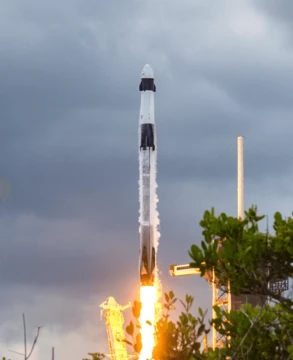
SpaceX CRS-4
Fourth operational SpaceX resupply mission under NASA contract.
Last updated
SpaceX CRS-4 (SpX-4) was a Commercial Resupply Service mission to the International Space Station, contracted to NASA. Launched on 21 September 2014, it arrived at the station on 23 September 2014. The mission carried the first 3D printer to be tested in space, a wind-speed measurement device, and small satellites for deployment from the ISS.
Primary payload
NASA contracted for the CRS-4 mission and determined the primary payload, launch date and time, and target orbital parameters. The cargo included the ISS-RapidScat, a scatterometer that measures ocean wind speed by bouncing microwaves off the surface, to be attached to the Columbus laboratory.
Also carried was the Space Station Integrated Kinetic Launcher for Orbital Payload Systems (SSIKLOPS) for releasing small satellites. A Bone Densitometer payload, developed by Techshot, provides bone density scanning capability on the ISS using Dual-Energy X-ray Absorptiometry (DEXA). The Rodent Research Hardware System was also part of the payload.
Secondary payloads
SpaceX had primary control over manifesting, scheduling and loading secondary payloads, subject to contract restrictions on hazards and safety margins. The mission carried the 3D Printing in Zero-G Experiment, which tested a 3D printer designed for microgravity by Made In Space, Inc., to validate additive manufacturing in zero gravity.
It also carried SPINSAT, a 56 cm-diameter sphere built by the Naval Research Laboratory to study atmospheric density and demonstrate electric solid propellant (ESP) thrusters from Digital Solid State Propulsion (DSSP). The satellite uses 12 thruster-clusters that burn an inert solid fuel only when an electric charge is applied; NASA safety experts approved the mission because the satellite starts inside the habitable volume of the ISS. The mission also brought 20 mice for long-term physiological research using the Rodent Research Hardware System.
First stage landing attempt
A piece of the Falcon 9 first stage from the CRS-4 mission was discovered floating near the Isles of Scilly in November 2015, as SpaceX later verified. The stage had previously re-entered over the Atlantic off the U.S. East Coast, with NASA’s WB-57 aircraft filming the event to study high-speed Mars atmospheric entry.
More in SpaceX Payloads Contracted by NASA
Sources
Compiled from Wikipedia and the sources listed below. Text from Wikipedia is available under CC BY-SA 4.0; this entry is adapted from it.
- Wikipedia: SpaceX CRS-4 (CC BY-SA 4.0).
Spotted an error? Know more?
Reader corrections go straight into our review queue. Suggest an edit · How this site is sourced