Chandra X-ray Observatory
Flagship X-ray telescope launched in 1999, still operating.

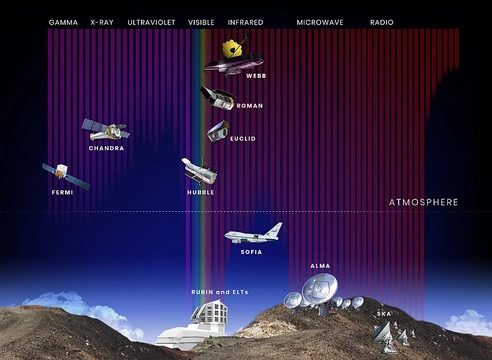
The Chandra X-ray Observatory, originally called the Advanced X-ray Astrophysics Facility, is a Flagship-class space telescope that launched on July 23, 1999, aboard the Space Shuttle Columbia during mission STS-93. It is one of NASA’s Great Observatories, a group that also includes the Hubble Space Telescope, the Compton Gamma Ray Observatory (active 1991–2000), and the Spitzer Space Telescope (active 2003–2020). Because Earth’s atmosphere blocks most X-rays, Chandra must operate from space. Its mirrors give it an angular resolution that lets it detect X-ray sources 100 times fainter than any earlier X-ray telescope could. The observatory orbits Earth every 64 hours, and its mission continues as of 2025. It is named after Subrahmanyan Chandrasekhar, the Nobel Prize–winning Indian-American astrophysicist. Chandra’s work is similar to that of the European Space Agency’s XMM-Newton, also launched in 1999, but the two telescopes have different strengths: Chandra has much higher angular resolution, while XMM-Newton has higher spectroscopy throughput.
In 2024, the U.S. Congress reduced NASA funding, threatening Chandra with early cancellation even though it has more than a decade of operational life left. Some astronomers have called this potential shutdown an “extinction-level” event for X-ray astronomy in the United States. A group of astronomers launched a public outreach campaign to persuade enough American citizens to urge Congress to provide the funding needed to avoid ending the mission early.
**History**
The observatory was first proposed to NASA in 1976 by Riccardo Giacconi and Harvey Tananbaum, under the name AXAF. Preliminary work began the next year at the Marshall Space Flight Center and the Smithsonian Astrophysical Observatory, which now operates the telescope for NASA at the Chandra X-ray Center, part of the Center for Astrophysics | Harvard & Smithsonian. In 1978, NASA launched the first imaging X-ray telescope, Einstein (HEAO-2). Work on AXAF continued through the 1980s and 1990s. To cut costs in 1992, the spacecraft was redesigned: four of the twelve planned mirrors were removed, along with two of the six scientific instruments.
Quick Facts
- Names List
- Advanced X-ray Astrophysics Facility (AXAF)
- Mission Type
- X-ray astronomy
- Operator
- NASASAOCXC
- Satcat
- 25867
- Manufacturer
- TRW Inc.
- Launch Mass
- 12930 lb
- Dry Mass
- 10560 lb
- Dimensions
- Deployed: 13.8 xx / Stowed: 38.7 xx
- Power
- 2,350 W
- Launch Date
- July 23, 1999, 04:30:59.984 UTC
- Launch Rocket
- Columbia (STS-93)
Facts from the source article.
Lore & Background
In 1976, the Chandra X-ray Observatory (called AXAF at the time) was proposed to NASA by Riccardo Giacconi and Harvey Tananbaum. Preliminary work began the following year at Marshall Space Flight Center and the Smithsonian Astrophysical Observatory. In 1992, to reduce costs, the spacecraft was redesigned: four of the twelve planned mirrors were eliminated, as were two of the six scientific instruments, and its orbit was changed to an elliptical one reaching one third of the way to the Moon. AXAF was assembled and tested by TRW (now Northrop Grumman Aerospace Systems) in Redondo Beach, California. AXAF was renamed Chandra in 1998 following a contest that drew more than 6,000 submissions; the winners, Jatila van der Veen and a high school student, suggested the name. In 2024, professional astronomers used Chandra to discover a neutron star in supernova remnant IC 443.
Reader's Guide
Chandra has greatly advanced the field of X-ray astronomy since its launch. Its first light image, of supernova remnant Cassiopeia A, gave astronomers their first glimpse of the compact object at the center of the remnant. It showed a never-before-seen ring around the central pulsar in the Crab Nebula, detected the first X-ray emission from the supermassive black hole Sagittarius A* at the center of the Milky Way, and provided strong evidence that dark matter exists by observing a supercluster collision. Chandra's high angular resolution has enabled observations of pressure fronts in merging galaxy clusters, sound waves from a supermassive black hole in the Perseus Cluster, and the X-ray shadow of Titan transiting the Crab Nebula. Despite an initial expected lifetime of 5 years, NASA extended its lifetime to 10 years in 2001, and a 2004 study indicated it could last at least 15 years. As of 2025, its mission is ongoing, though threatened by a decrease in NASA funding in 2024 by the US Congress, with a group of astronomers organizing a public outreach project to persuade Congress to avoid early termination.
Did You Know?
- Chandra was the heaviest payload ever launched by the Space Shuttle, at 22,753 kilograms (50,162 lb).
- The telescope is named after Nobel Prize-winning Indian-American astrophysicist Subrahmanyan Chandrasekhar; the name Chandra means 'moon' in Sanskrit.
- High school students, using Chandra data, discovered a neutron star in supernova remnant IC 443.
- In 2024, a decrease in NASA funding threatened Chandra with early cancellation, sardonically referred to as a potential 'extinction-level' event for X-ray astronomy in the US.
More in Space telescopes 1-24
Spotted an error? Know more?
Reader corrections go straight into our review queue. Suggest an edit · How this site is sourced