Space telescope
Telescopes in space avoiding atmospheric interference for astronomical observation.

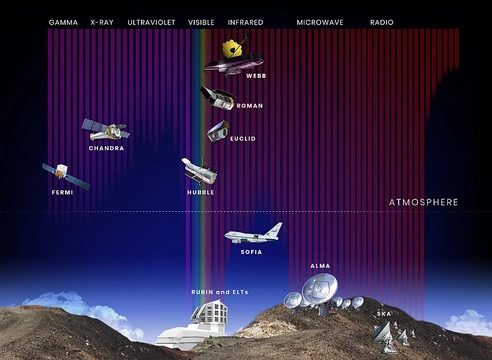
A space telescope (or space observatory) is a telescope positioned in outer space for observing astronomical objects. The idea was first proposed by Lyman Spitzer in 1946. The first functioning space telescopes were the American OAO-2, launched in 1968, and the Soviet Union's Orion 1 ultraviolet telescope, which operated aboard the Salyut 1 space station in 1971. By operating above Earth's atmosphere, these telescopes avoid several issues that plague ground-based observatories: the atmosphere absorbs or scatters certain light wavelengths, clouds block views, and atmospheric refraction causes distortions like twinkling. Space telescopes also face no light pollution from artificial sources and can observe faint objects even during daytime.
There are two main types of space telescopes: survey satellites that map the entire sky, and those that focus on specific astronomical objects or regions. They are different from Earth imaging satellites, which point toward our planet for tasks like weather monitoring, espionage, and other data collection.
**History** In 1946, American astrophysicist Lyman Spitzer—later called the "father of Hubble"—proposed placing a large telescope in space, free from atmospheric interference. After decades of advocacy in the 1960s and 1970s, his vision became the Hubble Space Telescope, launched on April 24, 1990, aboard Space Shuttle Discovery (STS-31). This achievement was driven significantly by Nancy Grace Roman, known as the "mother of Hubble." As NASA's first Chief of Astronomy and its first female executive, she worked as a program scientist to persuade NASA, the U.S. Congress, and others that Hubble was "very well worth doing." The first operational space telescopes were the American OAO-2 (1968) and the Soviet Orion 1 (1971).
**Advantages** Ground-based astronomy is limited by the atmosphere, which filters and distorts electromagnetic radiation (causing scintillation, or twinkling). An orbiting telescope avoids both twinkling and light pollution from Earth, giving it much higher angular resolution than a ground-based telescope of similar size—though many large terrestrial telescopes now use adaptive optics to reduce atmospheric effects. Space-based astronomy is especially crucial for wavelengths outside the optical and radio windows, which the atmosphere blocks almost entirely.
- First suggested
- 1946
- First operational
- 1968 (OAO-2) and 1971 (Orion 1)
- Key proposer
- Lyman Spitzer
- Key advocate
- Nancy Grace Roman
- Notable example
- Hubble Space Telescope (launched 1990)
- Types
- astronomical survey satellites and focused observation satellites
Lore & Background
In 1946, American theoretical astrophysicist Lyman Spitzer proposed placing a telescope in space to avoid Earth's atmospheric hindrances. After lobbying in the 1960s and 1970s, his vision materialized as the Hubble Space Telescope, launched on April 24, 1990, by Space Shuttle Discovery (STS-31). Nancy Grace Roman, the first Chief of Astronomy and first female executive at NASA, worked to convince NASA and the U.S. Congress that Hubble was 'very well worth doing'.
Reader's Guide
Space telescopes are significant because they overcome limitations of ground-based observatories caused by Earth's atmosphere, including filtering and distortion of electromagnetic radiation, light pollution, and cloud obstruction. They achieve higher angular resolution than ground-based telescopes of similar aperture, though larger terrestrial telescopes use adaptive optics to reduce atmospheric effects. Space-based astronomy is crucial for wavelength ranges outside the optical and radio windows, such as X-rays, infrared, and ultraviolet, which are blocked or largely attenuated by the atmosphere. Notable space telescopes include the Chandra X-ray Observatory, James Webb Space Telescope, XMM-Newton, and the International Ultraviolet Explorer. However, space telescopes are much more expensive to build and extremely difficult to maintain; most cannot be serviced at all, unlike Hubble which was serviced by the Space Shuttle. As of 2022, many observatories have completed missions while others continue on extended time, but future availability depends on timely and sufficient funding. In January 2023, NASA announced preliminary considerations for future programs including the Great Observatory Technology Maturation Program, Habitable Worlds Observatory, and New Great Observatories.
Did You Know?
- The concept of a space telescope was suggested by Lyman Spitzer in 1946.
- Space telescopes avoid atmospheric refraction distortions such as twinkling.
Instruments & Optical Technology
Roman carries two scientific instruments, both installed into the telescope in December 2024. The Wide-Field Instrument serves as the primary science tool: a 300.8-megapixel camera delivering multiband imaging and spectroscopy across visible to near-infrared wavelengths from 0.48 to 2.30 micrometers. Its focal-plane array, assembled from 18 H4RG-10 detectors supplied by Teledyne, captures a 0.28-square-degree field of view at 0.11-arcsecond resolution—roughly 100 times wider than Hubble's imaging cameras while matching Hubble's sharpness. An Element Wheel Assembly rotates eight science filters, two spectroscopy elements, and a spectralon dark element into the active position as mission needs dictate. The detector rests on hexapod actuators that let ground teams fine-tune focus throughout the mission's lifetime. The Coronagraph Instrument, operating between 575 and 825 nanometers, employs dual deformable mirror starlight suppression to reach part-per-billion contrast, enabling detection of planets as close as 0.15 arcseconds from their host stars. CGI is explicitly designed as a technology demonstrator for a future large observatory such as the Habitable Worlds Observatory.
Cosmology, Exoplanets & the Dark Energy Quest
Roman's science program tackles some of the deepest open questions in modern astronomy. A central goal is deciphering dark energy: determining whether cosmic acceleration arises from a new energy component or from a breakdown of general relativity on cosmological scales. If a new component is confirmed, Roman will test whether its density stays constant or has evolved across the universe's history. Three independent techniques will be deployed—baryon acoustic oscillations, distant supernova observations, and weak gravitational lensing—complementing ESA's Euclid mission. Beyond cosmology, the telescope will conduct a census of exoplanets via gravitational microlensing, sensitive enough to detect worlds with masses only a few times that of the Moon, including free-floating planets potentially as light as Mars. The coronagraph will deliver the first direct images and spectra of giant planets orbiting the Sun's nearest stellar neighbors. Additional objectives span probing the chronology of the universe, the growth of cosmic structure, the curvature of spacetime, and the detection of primordial black holes.
From WFIRST to Roman: Origins & Development
The telescope's lineage stretches back to the Joint Dark Energy Mission concept jointly explored by NASA and the Department of Energy. The initial design, called WFIRST Design Reference Mission 1, was studied between 2011 and 2012 and featured a 1.3-meter three-mirror anastigmat telescope paired with a single imager-spectrometer instrument. A pivotal shift arrived in 2012 when the National Reconnaissance Office offered to donate two existing 2.4-meter telescopes built by Harris Corporation—optics the same diameter as Hubble's primary mirror but with a shorter focal length that yields a wider field of view. This gift provided crucial political momentum, even though the donated optics represented only a modest fraction of total mission cost. The United States National Research Council Decadal Survey committee had already recommended the mission as the top-priority astronomy project for the following decade in 2010. NASA formally approved development and launch on 17 February 2016. The Wide-Field Instrument was completed and shipped to NASA in August 2024, and both instruments were installed into the telescope by December of that year.
Launch, Legacy & the Road Ahead
On 30 August 2026, a Falcon Heavy rocket sent the Nancy Grace Roman Space Telescope on a trajectory toward a Sun–Earth L2 orbit. The observatory carries the name of Nancy Grace Roman, who served as NASA's first chief of astronomy—a distinction that underscores the agency's commitment to honoring the pioneers who shaped its scientific direction. NASA expects to release Roman's first images by early 2027, marking the opening of a new era in infrared astronomy. The 2.4-meter primary mirror, donated by the NRO, provides a wide field of view unmatched by any previous space-based infrared instrument at this scale. The mission also establishes a guest investigator mode, opening its survey data to diverse investigations about the Milky Way and the broader cosmos. As a technology demonstrator, the coronagraph paves the way for the Habitable Worlds Observatory, while the dark energy measurements will inform the next generation of cosmological models. Roman represents the culmination of more than a decade of design evolution from the original WFIRST concept into a mission poised to reshape our understanding of the universe.
Frequently Asked Questions
Who first proposed the idea of a space telescope?
Lyman Spitzer put forward the concept in 1946, imagining an optical instrument placed above Earth's atmosphere. Nancy Grace Roman later became one of the idea's most determined advocates and helped steer it toward actual construction.
When did the first space telescopes actually operate?
The American OAO-2, launched in 1968, and the Soviet Orion 1 ultraviolet telescope, which worked aboard the Salyut 1 station in 1971, marked the first truly functional space-based observatories.
Why put a telescope in space instead of on the ground?
Being above the atmosphere removes cloud cover, eliminates the scattering and absorption of certain wavelengths, and avoids the blurring caused by atmospheric refraction. The result is a far clearer, more complete view of the cosmos than any ground-based dish can achieve.
What are the main categories of space telescopes?
They generally split into two groups: wide-field survey satellites that sweep large swaths of sky, and dedicated observation satellites that lock onto specific targets for detailed study.
What is the most famous space telescope?
The Hubble Space Telescope, deployed in 1990, is the most widely recognized example and has delivered some of the most iconic deep-space imagery ever captured. It stands as a defining milestone in the history of astronomical observation.
More in Space telescopes 1-24
Spotted an error? Know more?
Reader corrections go straight into our review queue. Suggest an edit · How this site is sourced