BeppoSAX
Italian–Dutch satellite that resolved the origin of gamma-ray bursts.

BeppoSAX was an Italian–Dutch X-ray astronomy satellite that helped solve the mystery of gamma-ray bursts (GRBs), the universe's most powerful known events. It was the first X-ray mission able to observe targets across more than three orders of magnitude in energy simultaneously, covering 0.1 to 300 kiloelectronvolts (keV) with a large collecting area, decent energy resolution for its era, and imaging capabilities (spatial resolution of 1 arcminute between 0.1 and 10 keV). The mission was a major project of the Italian Space Agency (ASI), with the Netherlands Agency for Aerospace Programmes (NIVR) as a partner. Alenia served as the prime contractor for the space segment, while Nuova Telespazio led ground segment development. Most scientific instruments came from the Italian National Research Council (CNR); the Wide Field Cameras were built by the Netherlands Institute for Space Research (SRON), and the LECS was developed by the astrophysics division of ESA's ESTEC facility. The satellite was named after Italian physicist Giuseppe "Beppo" Occhialini; SAX stands for "Satellite per Astronomia a raggi X" (Satellite for X-ray Astronomy).
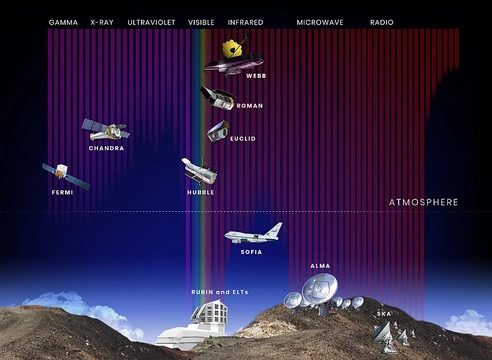
Because Earth's atmosphere blocks most X-rays, these observations cannot be done from the ground. One of BeppoSAX's key achievements was identifying many gamma-ray bursts as originating from extragalactic objects. Launched by an Atlas-Centaur on 30 April 1996 into a low-inclination (less than 4 degrees) low-Earth orbit, its planned two-year mission was extended well beyond its original design life due to strong scientific interest and the spacecraft's good condition. After that, the orbit decayed quickly and subsystems began failing, making further observations impractical. On 29 April 2003, the satellite re-entered the atmosphere and its debris fell into the Pacific Ocean.
The spacecraft was three-axis stabilized with a pointing accuracy of 1 arcminute. A main attitude constraint was keeping the solar arrays' normal within 30 degrees of the Sun, with occasional excursions to 45 degrees for some WFC observations. Because of its low orbit, the satellite was only in view of the Malindi ground station for limited periods. Data was stored onboard on a 450 Mbit tape unit and transmitted to ground each orbit during station passes.
Quick Facts
- Auto
- all
- Names List
- Satellite per Astronomia X
- Mission Type
- X-ray astronomy
- Operator
- ASINIVR
- Satcat
- 23857
- Mission Duration
- 7 years
- Manufacturer
- Alenia / CNR
- Launch Mass
- 1400 kg
- Payload Mass
- 480 kg
- Dimensions
- 3.6 x
- Power
- 800 W
- Launch Date
- 1996-04-30
Facts from the source article.
Lore & Background
BeppoSAX was a major programme of the Italian Space Agency (ASI) with the participation of the Netherlands Agency for Aerospace Programmes (NIVR). The prime contractor for the space segment was Alenia while Nuova Telespazio led the development of the ground segment. Most of the scientific instruments were developed by the Italian National Research Council (CNR) while the Wide Field Cameras were developed by the Netherlands Institute for Space Research (SRON) and the LECS was developed by the astrophysics division of the European Space Agency's ESTEC facility. Launched by an Atlas-Centaur on 30 April 1996 into a low inclination low-Earth orbit, the expected operating life of two years was extended until the mission ended on 29 April 2003, due to high scientific interest and continued good technical status.
Reader's Guide
BeppoSAX's significance lies in its identification of numerous gamma-ray bursts with extra-galactic objects, a key achievement that helped resolve the origin of these most energetic events. It was the first X-ray mission to simultaneously observe targets over more than 3 orders-of-magnitude of energy, from 0.1 to 300 keV, with imaging capabilities. The satellite's Wide Field Camera and Phoswich Detector System allowed detection and localization of gamma-ray bursts, with positions sent out as International Astronomical Union and Gamma-ray Burst Coordinate Network Circulars, enabling immediate follow-up observations with narrow-field instruments and optical observatories worldwide. Its legacy includes detailed observations of X-ray, optical and radio afterglows, and it remains a milestone in multi-wavelength astrophysics.
Did You Know?
- The satellite ended its life on April 29, 2003, falling into the Pacific Ocean.
- One of its three identical MECS units was lost on 6 May 1997 due to a fault in the High Voltage power supply.
Frequently Asked Questions
What is BeppoSAX?
BeppoSAX is an X-ray astronomy satellite jointly built by Italy and the Netherlands, led by the Italian Space Agency. It was engineered to capture high-energy photons from cosmic sources with both broad energy coverage and imaging capability.
What made BeppoSAX's instruments unique?
It was the first X-ray mission able to observe a single target simultaneously across more than three orders of magnitude in energy, spanning 0.1 to 300 keV. That wide bandwidth, paired with a large collecting area and arcminute-level imaging, let it track fast-evolving events that narrower-band telescopes simply missed.
What is BeppoSAX most famous for discovering?
BeppoSAX caught the X-ray afterglow of gamma-ray bursts and tied them to distant, extra-galactic sources, proving these events happen billions of light-years away. That single breakthrough settled a decades-long debate about whether GRBs originated inside the Milky Way or far beyond it.
When did BeppoSAX operate in orbit?
The satellite launched on 30 April 1996 and was decommissioned on 29 April 2003. During those roughly seven years it continuously scanned the high-energy sky and logged numerous transient explosions.
Why is BeppoSAX considered a landmark in space astronomy?
By demonstrating that gamma-ray bursts are cosmological in origin, it redirected an entire research field toward the most violent explosions known in the universe. Its simultaneous multi-energy design also set a new benchmark for how future X-ray missions could be built to catch unpredictable, rapidly changing sources.
More in Space telescopes 1-24
Spotted an error? Know more?
Reader corrections go straight into our review queue. Suggest an edit · How this site is sourced