Rogers Commission Report
Presidential inquiry into the Challenger disaster and its causes.
Last updated

via Wikipedia: Rogers Commission Report · see source
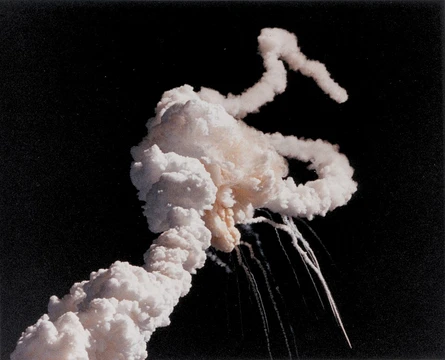
After the Challenger disaster on its tenth flight, a presidential commission investigated and produced the Rogers Commission Report. Delivered to President Reagan on June 9, 1986, it pinpointed the failure 73 seconds after launch and called for NASA to improve shuttle safety and management.
Quick Facts
- Report submitted to
- President Ronald Reagan
- Date of submission
- June 9, 1986
- Mission investigated
- STS-51-L
- Commission name
- Rogers Commission
- Immediate cause identified
- O-ring failure in right solid rocket booster
- Contractor involved
- Morton Thiokol, Inc.
Facts from the source article.
Findings
The commission determined that the immediate cause was a failure of the O-rings sealing the aft field joint on the right solid rocket booster, which allowed pressurized hot gases and flame to blow by and contact the external tank, causing structural failure. This O-ring failure was attributed to a design flaw that could be compromised by factors including the low launch temperature. The report also identified contributing causes, notably the failure of NASA and Morton Thiokol to adequately respond to the known design flaw, which NASA managers had been aware of since 1977 and recognized as potentially catastrophic.
The commission concluded the disaster was 'an accident rooted in history'. The decision-making process leading to launch was strongly criticized. The night before launch, Morton Thiokol engineers recommended not launching below 53°F, the previous lowest launch temperature. NASA managers challenged this, and after a 30-minute offline caucus, Morton Thiokol senior management overruled their engineers and approved the launch.
Concerns were not communicated beyond the Level III Flight Readiness Review, and higher-level FRR members who could have stopped the launch did not, due to NASA's management structure and lack of checks and balances.
Results
The Rogers Commission put forward nine safety improvements for the space shuttle program, addressing areas like design oversight, management structure, astronaut involvement, hazard analysis, safety organization, communication, landing safety, crew escape, flight rates, and maintenance. In response, NASA completely redesigned the solid rocket boosters, with an independent group monitoring the work. NASA’s contract with Morton Thiokol, the booster contractor, included a clause that if a failure caused loss of life or mission, Thiokol would lose $10 million in incentive fees and accept legal liability.
After the Challenger accident, Thiokol agreed to take the financial penalty without being forced to accept liability. NASA also set up a new Office of Safety, Reliability and Quality Assurance, led by an associate administrator who reported directly to the NASA administrator. George Rodney, formerly of Martin Marietta, was appointed to that role, and former Challenger flight director Jay Greene became chief of the Safety Division. The commission had criticized NASA’s overly optimistic launch schedule as a possible factor in the accident.
Afterwards, NASA aimed for a more realistic flight rate, added the orbiter Endeavour to replace Challenger, and worked with the Department of Defense to use expendable rockets for satellites. In August 1986, President Reagan announced the shuttle would stop carrying commercial satellite payloads.
Did You Know?
- Physicist Richard Feynman demonstrated O-ring failure by compressing a sample in a clamp and immersing it in a glass of ice water during a televised hearing.
- NASA management claimed the risk of catastrophic malfunction was 1 in 105 (1 in 100,000), but Feynman's rough estimate put the true likelihood closer to 1 in 100.
More in Space Shuttle Challenger Disaster
Sources
Compiled from Wikipedia and the sources listed below. Text from Wikipedia is available under CC BY-SA 4.0; this entry is adapted from it.
- Wikipedia: Rogers Commission Report (CC BY-SA 4.0).
Spotted an error? Know more?
Reader corrections go straight into our review queue. Suggest an edit · How this site is sourced