Teacher in Space Project
NASA program to send teachers as payload specialists into space.
Last updated
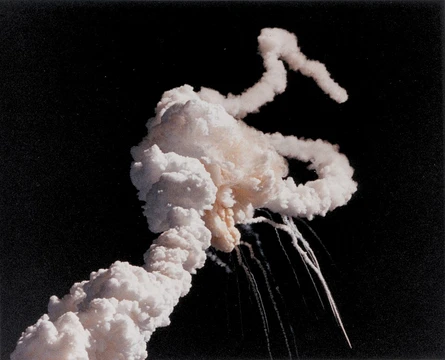
The Teacher in Space Project (TISP) was a NASA program announced by President Ronald Reagan in 1984 to send teachers into space as payload specialists, aiming to inspire students and promote interest in science and space exploration. Its first participant, Christa McAuliffe, died in the Space Shuttle Challenger disaster on January 28, 1986, leading to the program's cancellation in 1990.
Quick Facts
- Announced
- August 27, 1984
- Announced by
- President Ronald Reagan
- First participant
- Christa McAuliffe
- Disaster date
- January 28, 1986
- Program cancelled
- 1990
- Applications received
- 11,000
- Finalists selected
- 10
Facts from the source article.
NASA programs
The Teacher in Space Project was introduced by President Ronald Reagan on August 27, 1984, during a Washington, D.C., speech about education. Selected teachers would serve as Payload Specialists rather than joining the Astronaut Corps, and they were expected to return to teaching after their flight. This marked the first time NASA included "citizen passengers" on a Space Shuttle, a concept the program had aimed for since its start. The initiative was part of the Reagan administration's response to the education reform movement and the 1983 report A Nation at Risk, which declared U.S. public education insufficient.
While many teachers welcomed the announcement, the National Education Association, the largest teachers' union, dismissed it as a publicity stunt. Its president, Mary Hatwood Futrell, argued that teachers needed well-equipped classrooms, not a trip to space. Over 40,000 application forms were mailed to interested teachers, and 11,000 completed applications reached NASA, each including an essay and a proposed in-flight lesson. Applications were sent to each teacher's state Department of Education.
By May 1, 1985, state education agencies from all 50 states, the District of Columbia, Guam, Puerto Rico, the U.S. Virgin Islands, and three federal agencies had each selected two nominees. The resulting 114 candidates gathered in Washington, D.C., from June 22 to 27, 1985, for evaluation by a 20-judge panel that included university president Richard Berendzen, actress Pam Dawber, athlete Wes Unseld, and artificial heart inventor Dr. Robert Jarvik.
Panel chair William Pierce stated that judges assessed essays, medical fitness, and whether they would "like to see this person on the cover of Time and on the Today Show." NASA administrator James M. Beggs announced ten finalists on July 1, 1985.
Teacher in Space Education Foundation
On January 26, 1986, the 114 teacher nominees founded the Teacher in Space Education Foundation to boost public education, focusing on space science. Christa McAuliffe served as honorary president, Barbara Morgan as vice president, and the other eight finalists formed the board. Following the Challenger disaster, this foundation combined with a group started by the astronauts' families, creating the Challenger Center for Space Science Education. That center now runs many Challenger Learning Centers nationwide and backs educational initiatives.
Private program
In the early 21st century, the Teacher in Space project was revived in the private sector. The development of reusable suborbital launch vehicles by commercial companies made it possible for nonprofit groups to contemplate sending large numbers of teachers into space. The new Teachers in Space program began in 2005. In March 2005, candidate Pam Leestma, a second-grade teacher and cousin of astronaut David Leestma, completed a training flight aboard a MiG-21 operated by X-Rocket, LLC.
Armadillo Aerospace, Masten Space Systems, PlanetSpace, Rocketplane Limited, Inc., and XCOR Aerospace pledged flights to the project. Advisors include SpaceShipOne builder Burt Rutan, X-Prize founder Peter Diamandis, Apollo astronaut Buzz Aldrin, and private astronaut Anousheh Ansari. The United States Rocket Academy partnered with the SFF in 2006 and drafted rules for a "pathfinder" competition, announced at the Wirefly X PRIZE Cup in October 2007.
Applications were accepted until November 4, 2008. On July 20, 2009, Teachers in Space announced its first group of "Pathfinders." On June 11, 2013, Embry–Riddle Aeronautical University's new Commercial Space Operations degree program announced it would sponsor Teachers in Space summer workshops for the next five years.
More in Space Shuttle Challenger Disaster
Sources
Compiled from Wikipedia and the sources listed below. Text from Wikipedia is available under CC BY-SA 4.0; this entry is adapted from it.
- Wikipedia: Teacher in Space Project (CC BY-SA 4.0).
Spotted an error? Know more?
Reader corrections go straight into our review queue. Suggest an edit · How this site is sourced