Thiokol
From synthetic rubber to solid rocket boosters.
Last updated
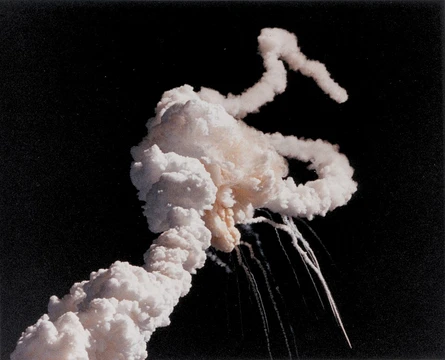
Thiokol was an American corporation that began with rubber and chemical products and later became a major supplier of rocket and missile propulsion systems. It is best known for manufacturing the solid rocket boosters for the Space Shuttle, and for its involvement in the Challenger disaster of 1986, which was caused by failed O-ring seals in a booster it had built.
Company history
In 1926, chemists Joseph C. Patrick and Nathan Mnookin were searching for a cheap antifreeze when a reaction between ethylene dichloride and sodium polysulfide produced a foul-smelling gum that plugged a sink. No solvent could remove it, leading them to realize the material’s solvent resistance was valuable. They had created a synthetic rubber, which they named Thiokol. Three years later, in 1929, Morton Salt executive Bevis Longstreth established the Thiokol Corporation in Trenton, New Jersey, and became its president and general manager.
Longstreth died in 1944, and William Crosby took over as general manager. The following year, Charles Bartley at the Jet Propulsion Laboratory found that thiokol could stabilize solid-fuel rockets. A plant in Elkton, Maryland began producing solid rocket motors in 1948, and in 1949 Thiokol built the TX-18 Falcon missile, the first solid-fueled missile system. In 1957, anticipating the Minuteman contract, the company constructed a facility west of Brigham City, Utah, near Promontory, while Thiokol Huntsville started building XM33 Pollux missiles.
In 1958, Thiokol merged with Reaction Motors Inc., a liquid propellant rocket motor maker, and won a contract to produce the TU-122 rocket motor for the first stage of the LGM-30 Minuteman ICBM. The next year, Thiokol Huntsville began making the CASTOR strap-on booster for the Atlas rocket. The Woodbine, Georgia plant, built in 1964 to produce solid propellant motors for NASA, was never used for that purpose because the agency switched to liquid fuel.
In 1969, Thiokol received a U.S. Army contract for 750,000 Tripflares for the Vietnam War. A 1971 explosion at the Woodbine magnesium flare assembly facility killed 29 and injured 50. In 1974, Thiokol won the contract for the Space Shuttle’s solid rocket booster. The following year, it took over operation of the Louisiana Army Ammunition Plant near Minden from Sperry Rand.
In 1978, the company sold its ski lift division to CTEC and its snow equipment division to Logan Manufacturing Company, owned by John DeLorean.
Products
Thiokol's aerospace divisions produced motors for numerous military missiles, including Subroc, the Pershing missile, the Peacekeeper missile, Poseidon missile, Minuteman missile, and the Trident I and Trident II missiles. It also supplied powerplants for the AIM-9 Sidewinder, AGM-88 HARM, AGM-65 Maverick, AGM-69 SRAM, and AIR-2 Genie. For the US space program, Thiokol manufactured deorbit motors for the Mercury and Gemini programs, rocket stages and separation motors for Apollo, motors for the Pioneer, Surveyor, Viking, Voyager, and Magellan missions, updated CASTOR boosters for the Delta rocket, and the Space Shuttle Solid Rocket Booster.
Reaction Motors powerplants propelled the X-1 and X-15 aircraft, and Thiokol technologies were later used in the private Tier One crewed spaceplane. In 2006, NASA announced Thiokol as the prime contractor for the Ares I Crew Launch Vehicle and the five-segment SRBs for the Ares V heavy-lift Cargo Launch Vehicle. Beyond rocketry, Thiokol produced ski lifts, snowcats, and snow grooming vehicles for ski resorts. These businesses were spun off in 1978 when the company restructured to focus on rocket products.
John Z. DeLorean purchased the snowcat operation and renamed it DMC, which manufactured snowcats until 1988; the company then became LMC and continued until 2000. Thiokol's snow vehicles ranged from utility vehicles based on tracked snowcats to larger grooming machines for steep slopes, and were used in ski resorts, by the USAF in Alaska, and by private owners.
More in Space Shuttle Challenger Disaster
Sources
Compiled from Wikipedia and the sources listed below. Text from Wikipedia is available under CC BY-SA 4.0; this entry is adapted from it.
- Wikipedia: Thiokol (CC BY-SA 4.0).
Spotted an error? Know more?
Reader corrections go straight into our review queue. Suggest an edit · How this site is sourced