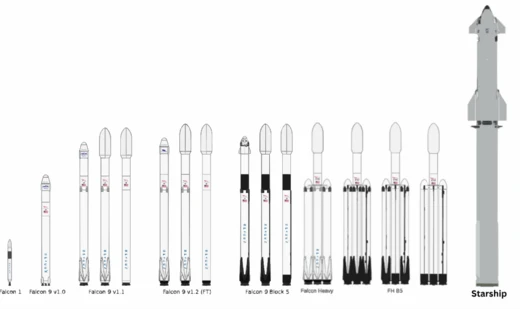
SpaceX launch vehicles
SpaceX builds and flies Falcon rockets and develops Starship.
Last updated
SpaceX manufactures and operates the Falcon 9 Block 5 and Falcon Heavy launch vehicles, both powered by Merlin engines and featuring vertical-takeoff-vertical-landing first-stage reuse. The company is also developing the fully reusable Starship system to replace its current rockets and Dragon spacecraft. SpaceX's first rocket, the Falcon 1, was the first privately developed liquid-fueled launch vehicle to reach orbit.
Quick Facts
- First launch vehicle
- Falcon 1
- Falcon heavy introduced
- 2018
- Launch sites
- Cape Canaveral Space Force Station, Kennedy Space Center, Vandenberg Space Force Base
Facts from the source article.
Retired
The Falcon 1 was a small rocket designed for partial reusability, capable of lifting several hundred kilograms to low Earth orbit. It served as a testbed for concepts later used in the Falcon 9. Initial launches occurred from the Reagan Test Site on Kwajalein Atoll in the Pacific Ocean, marking the first ground-launched orbital attempts from that site. The maiden flight on March 26, 2006, failed seconds after liftoff due to a fuel line rupture.
The second flight on March 22, 2007, also failed when a spin stabilization problem caused sensors to shut down the Kestrel second-stage engine. The third flight, delayed nearly 17 months for engine development, introduced a regenerative cooling system for the first-stage Merlin engine; the mission failed because residual propellant from the higher-capacity cooling system caused the first stage to strike the second-stage engine bell at staging. On September 28, 2008, the fourth flight reached orbit, making the Falcon 1 the first privately funded, liquid-fueled rocket to do so.
The fifth and final launch on July 13, 2009, carried the rocket's only successful commercial payload. No further Falcon 1 launches have occurred, and SpaceX stopped taking reservations to focus on the Falcon 9.
The Falcon 9 v1.0, developed from 2005 to 2010, first flew in 2010 and made five flights before retirement in 2013. Announced on September 8, 2005, the Falcon 9 featured nine Merlin engines on its first stage and was designed as an EELV-class vehicle to compete with the Delta IV and Atlas V. Both stages were intended for reuse. A planned Falcon 5 variant was dropped to concentrate on the Falcon 9.
Cancelled
The Falcon 1e was a proposed upgrade of the Falcon 1, featuring a larger first stage with a higher-thrust engine, an upgraded second-stage engine, and a larger payload fairing, with partial reusability intended. Its first launch was planned for mid-2011, but SpaceX withdrew the Falcon 1 and Falcon 1e from the market, citing limited demand, before the Falcon 1e debuted. Payloads booked for the Falcon 1 were instead to fly on the Falcon 9 using excess capacity.
The Falcon 1e would have been 6.1 m longer than the Falcon 1, with an overall length of 27.4 m and the same 1.68 m diameter. Its first stage had a dry mass of 5680 lb and was powered by an upgraded pump-fed Merlin 1C engine burning 87000 lb of RP-1 and liquid oxygen, with a burn time of about 169 seconds. The second stage had a dry mass of 1200 lb and used a pressure-fed Kestrel 2 engine burning 8900 lb of propellant, restartable for up to 418 seconds total burn time.
The second stage planned to use Aluminum Lithium alloy 2195 instead of the 2014 Aluminum used on Falcon 1 second stages. Launches were intended from Omelek Island and Cape Canaveral, with SpaceX open to other locations if a business case existed. After a demonstration flight, the Falcon 1e was to launch multiple Orbcomm O2G satellites, with eighteen total satellites carried several per rocket. EADS Astrium was responsible for marketing the Falcon 1e in Europe.
Falcon 5
The Falcon 5 was a proposed two-stage-to-orbit partially reusable rocket with five Merlin engines on the first stage and one Merlin on the upper stage, both burning RP-1 and liquid oxygen. Along with the Falcon 9, it would have been the world's only launch vehicle with a reusable first stage. The Falcon 5 would have been the first American rocket since the Saturn V with full engine-out capability, able to meet mission requirements by burning the remaining four engines longer if one failed. The Space Shuttle had only partial engine-out capability.
Competitive position
SpaceX offers its Falcon rockets at highly competitive prices, building a manifest of over 50 launches by late 2013, two-thirds of which were for commercial customers excluding US government flights. In the US launch industry, SpaceX prices its products well below its competition. Its primary US competitor, United Launch Alliance, maintained in early 2013 that it required a large annual subsidy, which neither SpaceX nor Orbital Sciences received, to remain financially viable, citing a lack of market opportunity—a stance that seemed to conflict with the market itself.
SpaceX launched its first satellite to geostationary orbit in December 2013 (SES-8) and its second, Thaicom 6, a month later, beginning to compete with European and Russian launch providers in the commercial communications satellite market. SpaceX prices undercut major competitors Ariane 5 and Proton in this market. Moreover, SpaceX prices for Falcon 9 and Falcon Heavy are much lower than projected prices for Ariane 6, expected to be available in 2024.
US government missions are priced somewhat higher than similar commercial missions due to additional requirements, but even with added services and special security charges for some missions, Falcon 9 government contracts are still priced well below ULA prices for payloads of the same size, which are nearly $400 million. On January 10, 2023, SpaceX had four rockets on all four of its orbital launch pads and two Dragon 2 spacecraft on orbit. On December 28–29, 2023, SpaceX ignited all of its rockets within 24 hours, with Falcon family rockets launching and both Starship stages performing static fires.
More in Space Launch Vehicles of the United States
Sources
Compiled from Wikipedia and the sources listed below. Text from Wikipedia is available under CC BY-SA 4.0; this entry is adapted from it.
- Wikipedia: SpaceX launch vehicles (CC BY-SA 4.0).
Spotted an error? Know more?
Reader corrections go straight into our review queue. Suggest an edit · How this site is sourced