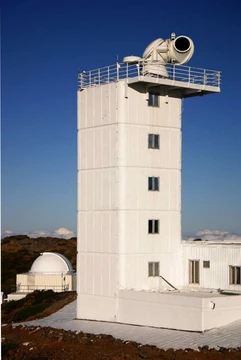
CERN Axion Solar Telescope
Searching for solar axions at CERN since 2003.
The CAST experiment at CERN hunts for axions produced in the Sun. It began operations in 2002, with its first data collection starting in May 2003. Finding these particles would be a huge breakthrough in physics and let scientists study the solar core in a completely new way. CAST is the most sensitive axion helioscope currently operating.
Quick Facts
- Headquarters
- Geneva, Switzerland
- Leader
- Konstantin Zioutas
- Formation
- Approved on 13 April 2000
- Purpose
- Search for dark matter and energy
- Fields
- Astroparticle physics
- Successor
- International Axion Observatory
Facts from the source article.
Theory and operation
The CAST experiment hunts for hypothetical axions that might be created deep inside the Sun. The idea is that X-rays, when they scatter off protons and electrons in the solar core under strong electric fields, could produce these particles. To catch them, the setup uses a 9.26-meter-long magnet, originally built to test the Large Hadron Collider, which can generate a powerful magnetic field. This field is meant to convert any incoming solar axions back into X-rays, which are then picked up by detectors. The telescope only points at the Sun for about 1.5 hours at sunrise and another 1.5 hours at sunset each day. For the other 21 hours, it faces away to measure background noise. CAST started in 2003, looking for axions up to a certain mass. In 2005, helium-4 was pumped into the magnet, boosting sensitivity to masses up to 0.39 eV. From 2008 to 2011, helium-3 extended that range to 1.15 eV. After that, the team switched back to a vacuum to search for axions lighter than 0.02 eV. As of 2014, CAST had not found clear proof of solar axions, but it did shrink the possible parameters where they might hide. A 2017 analysis of data from 2013–2015 set a new best limit on how strongly axions couple to photons, at 0.66×10 per GeV. The lessons learned from CAST are now guiding the development of a much larger successor, the International Axion Observatory (IAXO), which is currently in preparation.
Detectors
The CAST experiment hunts for solar axions with a helioscope built from a 9.2-meter superconducting dipole magnet originally made for the LHC. This magnet is kept at 1.8 Kelvin using superfluid helium. It has two bores, each 43 millimeters wide and 9.26 meters long, with X-ray detectors at both ends. These detectors pick up photons created when solar axions convert via the inverse Primakoff effect. The experiment’s two X-ray telescopes measure signal and background at the same time with the same detector, cutting down systematic errors. Between 2003 and 2013, three detectors were used on the magnet’s ends, all relying on the inverse Primakoff effect: a conventional time projection chamber (TPC), MICROMEGAS detectors, and an X-ray telescope with a CCD. After 2013, new detectors like RADES, GridPix, and KWISP were added, with updated goals and better technology. The TPC is a gas-filled drift chamber for low-energy X-rays, operating from 2002 to 2004. The X-ray telescope uses a pn-CCD chip at the focus of a Wolter-I mirror system. Its mirrors are 27 gold-coated nickel shells, arranged confocally, with the largest shell 163 millimeters across and the smallest 76 millimeters, giving a focal length of 1.6 meters.
Results
The CAST experiment was built to develop new techniques and technologies for detecting solar axions. Over nearly two decades of operation, it has not directly observed axions but has placed significant constraints on their properties. In its early phase, three detectors set an upper limit on the axion-photon coupling parameter with 95% confidence for a given axion mass. For a specific mass range, the RADES detector constrained this coupling constant to within about 5% error. The most recent results from 2017 established an upper limit on the coupling at 95% confidence for all axions with masses below 0.02 electronvolts. These findings improved upon earlier astrophysical limits and tested many axion models with sub-electronvolt masses. CAST has constrained the axion-photon coupling from very low values up to the hot dark matter sector. In late 2017, the CAST helioscope, originally designed to search for solar axions and axion-like particles, was repurposed as a haloscope to hunt for dark matter wind in the Milky Way’s galactic halo as it passes through Earth.
More in Solar Telescopes
Spotted an error? Know more?
Reader corrections go straight into our review queue. Suggest an edit · How this site is sourced