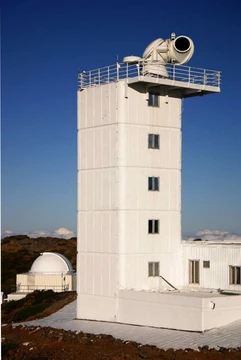
CCOR-1
Space-based coronograph for real-time solar corona monitoring.
CCOR-1, short for Compact CORonograph-1, is a space telescope on NOAA's GOES-19 satellite. It blocks the Sun's bright surface to study the much fainter corona, providing real-time data for space weather forecasts. This is the first of three planned coronographs in the Compact Coronograph series.
Quick Facts
- Launched
- 25 June 2024 5:26 PM EDT
- Launch vehicle
- Falcon Heavy
- Launch site
- John F. Kennedy Space Center
- First light image
- 19 September 2024
- Operational handover to noaa
- 29 January 2025
- Declared operational on goes-east
- 7 April 2025
- Orbit longitude
- 75.2°W
Facts from the source article.
Did You Know?
- The first comet discovered by CCOR-1 was a Kreutz sungrazer found by citizen scientist Robert Pickard on 11 February 2025, accompanied by two fragments.
- By 30 August 2025, 101 comets had been discovered via NASA's Sungrazer Project program using CCOR-1 data.
Mission
The instrument obtains white light images of the solar corona and downlinks the data within 30 minutes for space weather forecasting. It is designed to replace aging research coronographs such as SOHO/LASCO and STEREO/COR. Launched on 25 June 2024 aboard a Falcon Heavy rocket from Kennedy Space Center, it achieved first light on 19 September 2024, with the image released publicly on 22 October. NOAA took ownership on 29 January 2025, and it became an operational satellite on GOES-East at 75.2°W on 7 April 2025. Its geostationary orbit keeps it fixed above a specific equatorial point at 35,786 km altitude.
Technicals
CCOR-1 was developed and tested by the US Naval Research Laboratory (NRL) and is mounted on a Sun Pointing Platform alongside EXIS and SUVI. In geocentric orbit, it experiences daily eclipses; around 20 days before and after each equinox, Earth eclipses half of the images. A 180-degree roll maneuver called a yawflip reduces stray light from the solar arrays. The instrument meets requirements including a field of view of 3.7 to 17 solar radii, signal-to-noise ratio of 10 for 5.1 to 21.0 MSB, spatial resolution of 50 arcseconds, visible light bandpass, 15-minute cadence for full resolution images and 5 minutes for 2×2 binned, 30-minute latency, and capability during S4 solar storms and X50 flares. CME velocity is estimated with 5% error for 200–3,400 km/s, and CME mass with 50% error. A reclosable door allows up to 5 years of on-orbit storage. CMEs are detected by PyCat, open-source software from NOAA/SWPC and the UK Met Office, which analyzes morphology from L1 files and multi-satellite comparisons to compute speed, mass, and direction.
Ground Processing Algorithm
Raw images are compressed into FITS format and processed through six levels. L0 is the raw detector readout with metadata; two L0A files (inner and outer FOV) are assembled, then combined and rotated to produce L0B with solar north upward. L0B undergoes bias reconstruction, linearity correction, exposure division, time normalization, calibration factor storage, conversion to Mean Solar Brightness (MSB), and vignetting correction to create L1A. L1A is used to compute earthshine and median background models; earthshine subtraction yields L1B, the only real-time level. L1A also generates a Daily Median background; a 14-day Monthly Minimal Background and a 7-day Minimal Background are derived. L1 products are processed by subtracting these backgrounds to produce L2, and L2 binned 2×2 becomes L3.
More in Solar Telescopes
Spotted an error? Know more?
Reader corrections go straight into our review queue. Suggest an edit · How this site is sourced