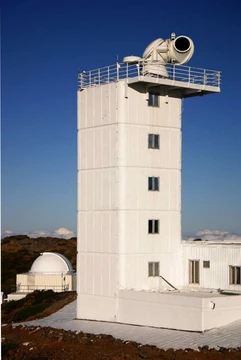
Big Bear Solar Observatory
University-based solar observatory in California with a 1.6 m unobstructed telescope.
Big Bear Solar Observatory (BBSO) is a university-based solar observatory in the United States operated by New Jersey Institute of Technology (NJIT). It is located on the north side of Big Bear Lake in the San Bernardino Mountains of California, approximately 120 km east of downtown Los Angeles. The observatory is notable for its 1.6 meter clear-aperture Goode Solar Telescope (GST), which has no obscuration in the optical train and is designed specifically for studying solar activities and phenomena.
Quick Facts
- Location
- North side of Big Bear Lake, San Bernardino Mountains, San Bernardino County, California
- Operator
- New Jersey Institute of Technology (NJIT)
- Primary telescope
- Goode Solar Telescope (GST), 1.6 m clear-aperture off-axis telescope
- Altitude of lake surface
- Approximately 2055 m above sea level
- First light of gst
- January 2009
- First ao-corrected imaging (near-infrare
- Summer 2010
- First mcao observations
- Summer 2016
Facts from the source article.
Establishment
Perched on Big Bear Lake in the San Bernardino Mountains, the observatory benefits from a rare combination of high elevation and the lake’s daytime calming effect, making it ideal for studying the sun. The lake sits at roughly 2055 meters above sea level, placing it above much of the atmosphere. Over a mile of open water stretches to the west, where the prevailing winds originate. This cool water creates a natural inversion that cuts down ground-level turbulence, sharpening the telescope’s images by preventing heat waves from distorting the view. The main building stands in the lake itself, linked to the north shore by a causeway about 200 meters long.
Instruments
The Big Bear Solar Observatory started with four telescopes: two 10-inch refractors, a 9-inch reflecting coronagraph, and a 16-inch Cassegrain reflector. By 1997, its main telescope was in the 50 cm range, similar to other high-resolution solar observatories worldwide. To study the Sun’s atmosphere at its fundamental scale—where photons travel about 100 km before scattering—a telescope with an aperture of at least 1.5 meters was needed. That led to the Goode Solar Telescope (GST), a 1.6-meter off-axis design with an unobstructed light path feeding visible and near-infrared spectro-polarimeters. The GST uses three generations of adaptive optics, including a multi-conjugate system (MCAO) with three deformable mirrors—the only operational MCAO setup of its kind. Corrected light goes to the VIS or NIRIS instruments, while uncorrected light can reach the CYRA cryogenic spectrograph, which works out to 5 microns. Construction began in 2005, first light came in January 2009, and initial adaptive-optics imaging followed in summer 2010 in the near-infrared. Visible-light correction arrived in summer 2012, and the first MCAO observations in summer 2016 roughly tripled the corrected field of view, crucial for wide-field studies at high speed. Until the 4-meter Daniel K. Inouye Solar Telescope saw first light in 2019, the GST was the world’s largest clear-aperture solar telescope, resolving features under 50 km across. It was renamed the Goode Solar Telescope in July 2017. BBSO also runs full-disk patrol telescopes.
Transfer of operations
In 1995, Caltech learned that professor Zirin planned to step down as director and began looking for a replacement. The university later chose to shift the focus of that solar-physics position and find a new operator for the observatory. By the spring of 1996, Caltech announced that the New Jersey Institute of Technology (NJIT) would take over BBSO. A lease for the land and buildings, running until 2048, was signed in early 1997. On July 1, 1997, the instruments and grants—then worth about $1.6 million each year—were handed over to NJIT. After that, NJIT professor Philip R. Goode became director, and now NJIT professor Wenda Cao holds that role. Funding comes from NASA, the National Science Foundation, the United States Air Force, and other sources.
More in Solar Telescopes
Spotted an error? Know more?
Reader corrections go straight into our review queue. Suggest an edit · How this site is sourced