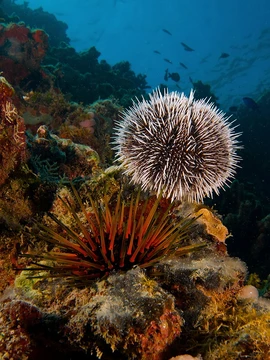
Evechinus chloroticus
Endemic New Zealand sea urchin, overabundant due to overfishing and climate change.
Last updated

Baker, A N · CC BY 4.0
New Zealand is the exclusive home range of the sea urchin species Evechinus chloroticus, which is also referred to as kina or the common sea urchin.[1] Across New Zealand, no sea urchin species is encountered more frequently than Evechinus chloroticus.[2]
Scientific classification
- KingdomAnimalia
- PhylumEchinodermata
- ClassEchinoidea
- OrderCamarodonta
- FamilyEchinometridae
- GenusEvechinus
- SpeciesEvechinus chloroticus
Named by Valenciennes, 1846
Sources: Wikipedia taxobox: Evechinus chloroticus (CC BY-SA 4.0) · order, family and genus agree with WoRMS AphiaID 414225 (CC BY 4.0)
Where the evechinus chloroticus has been recorded
Each dot is a place where the species has been observed and reported (2,500 records, half-degree grid) — not a modelled range. 37 inland records left out (institution coordinates).
Map: drawn by Codexery. Data: GBIF occurrence search (records CC0 / CC BY) · Natural Earth basemap (public domain) · place coordinates: Wikipedia (CC BY-SA 4.0)
Quick Facts
- Species
- chloroticus
Facts from the source article.
Key facts and history
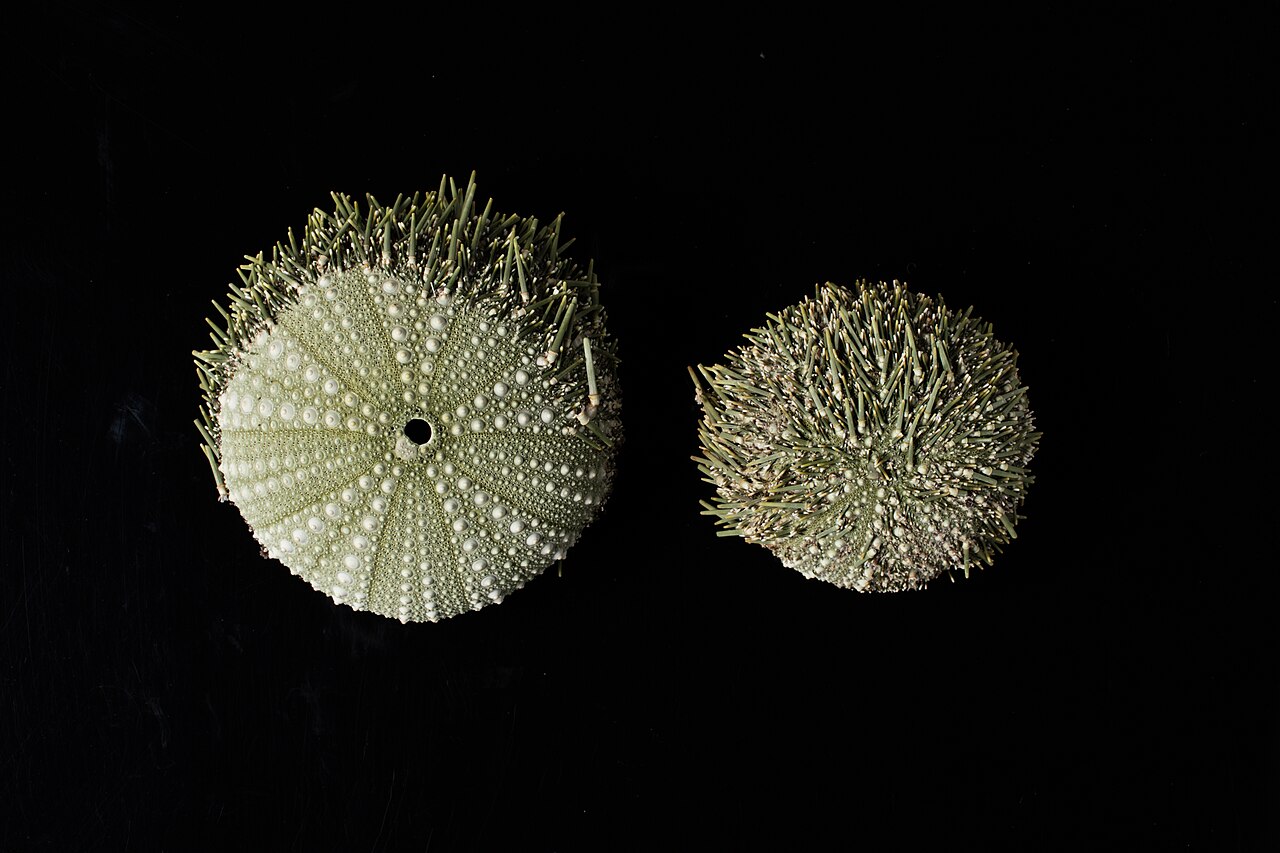
Kina have been a traditional component of Māori diet since pre-European times.[3] Commercial fishing of kina began in 1986 under the quota management system in restricted coastal areas.[3] The urchin is oval in shape and covered with spines used for protection.[4] Evechinus chloroticus is found in shallow waters up to 12–14 metres deep around New Zealand.[5]
It prefers areas with moderate wave action and is found on rocky and sandy seafloor areas.[6] The Māori term for this urchin is kina, while its roe is called ateate.[7] Kina use their tube feet, located between the spines, to move across the seafloor.[4] Large brown algae, red algae, and encrusting substrate make up the primarily herbivorous diet of this species.[8]
An annual breeding cycle is observed in kina, with gonads reaching ripeness in October and spawning occurring from November through February.[9] Overfishing and climate change have caused a dramatic increase in kina populations, leading to the destruction of kelp forest ecosystems.[10]
What the cited sources add
A 2005 NIWA article notes that kina roe can fetch $70 per kg on the domestic market.[11] The same NIWA source states that increasing the yield per animal is important to the fishery and environmentally beneficial.[11] A 2020 Guardian article reports that kina barrens have proliferated with the decimation of their natural predators.[12] The Guardian article also describes the Hauraki Gulf Marine Park as overfished and overrun with sea urchins.[12]
References
- Wikipedia, "Evechinus chloroticus" (CC BY-SA 4.0), which cites: F Barker, "Developments in Aquaculture and Fisheries Science", Elsevier, 2007, p. 319–338 (original not read by us) en.wikipedia.org
- Wikipedia, "Evechinus chloroticus" (CC BY-SA 4.0), which cites: F Barker, "Developments in Aquaculture and Fisheries Science", Elsevier, 2007, p. 319–338; Dix, "Biology ofevechinus chloroticus(echinoidea: Echinometridae) from different localities", New Zealand Journal of Marine and Freshwater Research, June 1970, p. 91–116; (original not read by us) en.wikipedia.org
- Wikipedia, "Evechinus chloroticus" (CC BY-SA 4.0), which cites: F Barker, "Developments in Aquaculture and Fisheries Science", Elsevier, 2007, p. 319–338; James, "The effects of season, temperature and initial gonad condition on roe enhancement of the sea urchin Evechinus chloroticus", Aquaculture, September 2007, p. 115–131; James, "Enhancing urchin roe value"; James P. 2010. Sea urchins: opportunities and lessons. New Zealand Aquaculture 36 (July/August): 12–13. (original not read by us) en.wikipedia.org
- Wikipedia, "Evechinus chloroticus" (CC BY-SA 4.0) en.wikipedia.org
- Wikipedia, "Evechinus chloroticus" (CC BY-SA 4.0), which cites: F Barker, "Developments in Aquaculture and Fisheries Science", Elsevier, 2007, p. 319–338; Dix, "Biology ofevechinus chloroticus(echinoidea: Echinometridae) from different localities", New Zealand Journal of Marine and Freshwater Research, June 1970, p. 91–116 (original not read by us) en.wikipedia.org
- Wikipedia, "Evechinus chloroticus" (CC BY-SA 4.0), which cites: F Barker, "Developments in Aquaculture and Fisheries Science", Elsevier, 2007, p. 319–338; Dix, "Biology ofevechinus chloroticus(echinoidea: Echinometridae) from different localities", New Zealand Journal of Marine and Freshwater Research, June 1970, p. 91–116; Choat, "Patterns of distribution and abundance of large brown algae and invertebrate herbivores in subtidal regions of northern New Zealand", Journal of Experimental Marine Biology and Ecology, April 1982, p. 129–162; Villouta, "Effects of sea urchin(Evechinus chloroticus)g en.wikipedia.org
- Wikipedia, "Evechinus chloroticus" (CC BY-SA 4.0), which cites: ; ; ; (original not read by us) en.wikipedia.org
- Wikipedia, "Evechinus chloroticus" (CC BY-SA 4.0), which cites: F Barker, "Developments in Aquaculture and Fisheries Science", Elsevier, 2007, p. 319–338; Dix, "Biology ofevechinus chloroticus(echinoidea: Echinometridae) from different localities", New Zealand Journal of Marine and Freshwater Research, June 1970, p. 91–116; R McEdward, "Developments in Aquaculture and Fisheries Science", Elsevier, 2007, p. 71–93 (we also read that source) en.wikipedia.org
- Wikipedia, "Evechinus chloroticus" (CC BY-SA 4.0), which cites: Dix, "Biology ofEvechinus chloroticus(echinoidea: Echinometridae) from different localities", New Zealand Journal of Marine and Freshwater Research, December 1970, p. 385–405; Dix, "Biology ofEvechinus chloroticus(echinoidea: Echinometridae) from different localities", New Zealand Journal of Marine and Freshwater Research, December 1970, p. 385–405; F Barker, "Developments in Aquaculture and Fisheries Science", Elsevier, 2007, p. 319–338 (original not read by us) en.wikipedia.org
- Wikipedia, "Evechinus chloroticus" (CC BY-SA 4.0), which cites: Miller, "The efficiency and effectiveness of different sea urchin removal methods for kelp forest restoration", Restoration Ecology, January 2023 (original not read by us) en.wikipedia.org
- "Award-winning kina research – Wetland construction at Lake Okaro – Ecological engineers – French Polynesia at Bream Bay", NIWA, 1 September 2005. facts only, no text reused. niwa.co.nz
- Evans, "'We used to be leaders': the collapse of New Zealand's landmark ocean park", The Guardian, 2020-03-11. facts only, no text reused. theguardian.com
Each numbered sentence above was checked against the source it cites before publication. Sentences citing Wikipedia adapt text from the English Wikipedia article Evechinus chloroticus (contributors), used under CC BY-SA 4.0; this entry is available under the same licence. Other sources were used for facts only; no text or images are copied from them.
More in Sea Urchins
Sources
Compiled from Wikipedia and the sources listed below. Text from Wikipedia is available under CC BY-SA 4.0; this entry is adapted from it.
- Wikipedia: Evechinus chloroticus (CC BY-SA 4.0).
- Classification: the source article's taxobox; order, family and genus checked against WoRMS, the World Register of Marine Species (CC BY 4.0).
- Occurrence records: GBIF (CC0 / CC BY). Basemap: Natural Earth (public domain).
- Word definitions: the Codexery glossary, each quoted from its Wikipedia article.
Spotted an error? Know more?
Reader corrections go straight into our review queue. Suggest an edit · How this site is sourced