Fossil echinoids
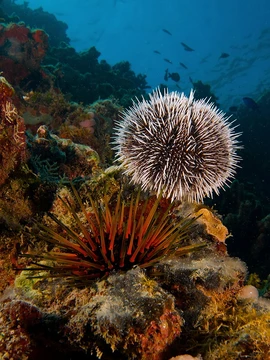
Fossilised sea urchins with a rich cultural and geological history.
Last updated
Their hard tests, made of calcite plates, and spines are the parts normally found as fossils.[1] The main feature of echinoid fossils is a distinctive five-petalled pattern formed by five ambulacra radiating from a central point.[2] Sea urchins, which are spiny marine invertebrates dwelling on the seabed, leave behind fossilised remains known as echinoid fossils.[3]
Quick Facts
- Earliest fossil date
- late Ordovician period, some 450 Mya
- Common rock ages
- Jurassic and Cretaceous
- Notable location
- White Cliffs of Dover, southern England
Facts from the source article.
Key facts and history
Echinoids have lived in the seas since the Late Ordovician, about 450 million years ago.[1] Spines usually became detached and fossilised separately, but occasionally test and spines are preserved together.[1] In the Mesozoic, echinoids evolved into a variety of shapes adapted to burrowing beneath the seabed.[1] Around 450 million years ago, during the late Ordovician, the oldest echinoid fossils appear.[2]
Fossils from the Paleozoic era are frequently fragmentary, composed of isolated spines or plate clusters, because those echinoids possessed thin tests.[2] Rocks from the Jurassic and Cretaceous periods, particularly late Cretaceous chalk, frequently contain echinoid fossils.[4] In southern England, the research of geologists A W Rowe and R M Brydone demonstrated that distinct echinoid types could split the Chalk into biozones and sub-biozones representing different ages.[1] For thousands of years, people have regarded these fossils as lucky objects, associating them with deities and magical properties.[3]
Thunderstones, fairy loaves, and shepherds' crowns are folk names for these fossils.[5]
What the cited sources add
The BGS account notes that echinoids are marine animals belonging to the phylum Echinodermata and the class Echinoidea.[1] It explains that calcite also forms the powerful downward-pointing teeth found in some types of living and fossil echinoids.[1] The BGS source states that some fossil echinoids made themselves less palatable as prey by having large, solid spines.[1] It adds that echinoids have been used in traditional remedies for stomach disorders and, in Roman times, were considered an antidote to snake bites.[1]
In Kent, an Acheulean hand axe from the Middle Pleistocene represents the earliest documented human use of such a fossil in England.[6]
References
- "Echinoids", BGS fossils and geological time. facts only, no text reused. bgs.ac.uk
- Wikipedia, "Fossil echinoids" (CC BY-SA 4.0), which cites: "Echinoids", BGS fossils and geological time; "Echinoids", British Geological Survey, 2017; "The Echinoid Directory: Introduction", Natural History Museum (we also read that source) en.wikipedia.org
- Wikipedia, "Fossil echinoids" (CC BY-SA 4.0), which cites: "Echinoids", BGS fossils and geological time (we also read that source) en.wikipedia.org
- Wikipedia, "Fossil echinoids" (CC BY-SA 4.0), which cites: Kirkaldy, "Fossils in Colour", Blandford Press, 1967, p. 161–163 (original not read by us) en.wikipedia.org
- Wikipedia, "Fossil echinoids" (CC BY-SA 4.0), which cites: McNamara, "Shepherds' crowns, fairy loaves and thunderstones: the mythology of fossil echinoids in England", Geological Society, London, Special Publications, 2007, p. 279–294; "Echinoids", BGS fossils and geological time (we also read that source) en.wikipedia.org
- Wikipedia, "Fossil echinoids" (CC BY-SA 4.0), which cites: McNamara, "Shepherds' crowns, fairy loaves and thunderstones: the mythology of fossil echinoids in England", Geological Society, London, Special Publications, 2007, p. 279–294 (original not read by us) en.wikipedia.org
Each numbered sentence above was checked against the source it cites before publication. Sentences citing Wikipedia adapt text from the English Wikipedia article Fossil echinoids (contributors), used under CC BY-SA 4.0; this entry is available under the same licence. Other sources were used for facts only; no text or images are copied from them.
More in Sea Urchins
Sources
Compiled from Wikipedia and the sources listed below. Text from Wikipedia is available under CC BY-SA 4.0; this entry is adapted from it.
- Wikipedia: Fossil echinoids (CC BY-SA 4.0).
- Word definitions: the Codexery glossary, each quoted from its Wikipedia article.
Spotted an error? Know more?
Reader corrections go straight into our review queue. Suggest an edit · How this site is sourced