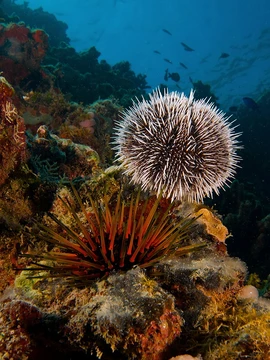
Cidaroida
Primitive sea urchins with widely separated primary spines.

Cidaroida, commonly known as pencil urchins, is an order of primitive sea urchins. It is notable as the only living order of the subclass Perischoechinoidea, all other orders of which became extinct during the Mesozoic.
Quick Facts
- Taxon
- Cidaroida
Facts from the source article.
Lore & Background
Cidaroida, also called pencil urchins, are an order of primitive sea urchins. They are the only living representatives of the subclass Perischoechinoidea, as all other orders of this subclass, which were even more primitive than the living forms, became extinct during the Mesozoic. Their primary spines are much more widely separated than in other sea urchins, and they have no buccal slits. Other primitive features include relatively simple plates in the test, and the ambulacral plates continuing as a series across the membrane that surrounds the mouth.
Reader's Guide
The significance of Cidaroida lies in their status as the only surviving order of the subclass Perischoechinoidea, making them a living link to a more ancient lineage of sea urchins. All other orders of this subclass, which were even more primitive, became extinct during the Mesozoic. Their anatomy retains several primitive features: primary spines that are much more widely separated than in other sea urchins, absence of buccal slits, relatively simple test plates, and ambulacral plates that continue as a series across the membrane surrounding the mouth. These characteristics distinguish them from more derived sea urchins and provide insight into the early evolution of echinoids. The order includes both living and extinct families, as listed by the World Register of Marine Species, with extinct families such as Anisocidaridae, Diplocidaridae, Heterocidaridae, Miocidaridae, Polycidaridae, Rhabdocidaridae, Serpianotiaridae, and Triadocidaridae, alongside extant families like Cidaridae, Ctenocidaridae, Histocidaridae, and Psychocidaridae.
Did You Know?
- Cidaroida are also known as pencil urchins.
- All other orders of Perischoechinoidea became extinct during the Mesozoic.
More in Sea Urchins 1-24
Spotted an error? Know more?
Reader corrections go straight into our review queue. Suggest an edit · How this site is sourced