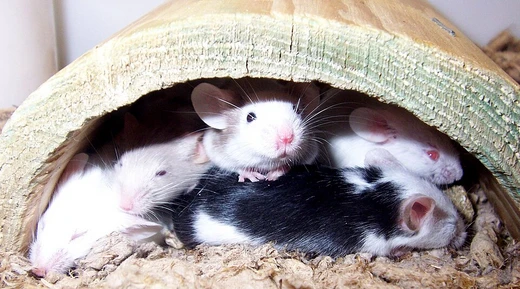
House mouse
Last updated

Unknown authorUnknown author (original) / Ilmari Karonen (editing) · via Wikipedia: House mouse · Public domain
The year 2002 saw the sequencing of the complete mouse reference genome.[1]
Scientific classification
- KingdomAnimalia
- PhylumChordata
- InfraclassPlacentalia
- OrderRodentia
- FamilyMuridae
- GenusMus
- GenusMus
- SpeciesMus musculus
Named by Linnaeus, 1758
Sources: Wikipedia taxobox: House mouse (CC BY-SA 4.0) · order, family and genus agree with WoRMS AphiaID 993616 (CC BY 4.0)
Conservation status
Least Concern (LC)
- LC▲ this species
- NT
- VU
- EN
- CR
- EW
- EX
Source: IUCN Red List assessment · GBIF copy of the Red List category
How big is it?
Largest length in the source, 0.1 m, next to a 1.8 m person.
Diagram: drawn by Codexery, schematic shapes to scale (not a likeness). Length: Wikipedia: House mouse
Where the house mouse has been recorded
Each dot is a place where the species has been observed and reported (213,605 records, half-degree grid) — not a modelled range. 421 inland records left out (institution coordinates).
Map: drawn by Codexery. Data: GBIF occurrence search (records CC0 / CC BY) · Natural Earth basemap (public domain)
Biology and range
The tail is used for balance and is the main peripheral organ of heat loss in thermoregulation.[2] Blood flow to the tail can be precisely controlled in response to ambient temperature using arteriovenous anastomoses.[3] They are native to India and later spread to the eastern Mediterranean about 13,000 BC, reaching the rest of Europe around 1000 BC.[4] The three widely accepted subspecies are M. m. castaneus, M. m. domesticus, and M. m. musculus, with two additional subspecies recognized more recently.[5][6]
The coat of house mice consists of short hair, while their ears and tail are sparsely haired.[7] Although house mice are omnivorous, plant matter constitutes their primary food source, and they practice coprophagy to obtain nutrients synthesized by intestinal bacteria.[8] In wild settings, house mice typically survive under one year because of heavy predation, but when kept in protected surroundings they frequently live for two to three years.[9]
What the specialist sources record
The UC Irvine Transgenic Mouse Facility provides services for generating and preserving genetically-modified mice.[10] A 2009 Scientific American article by Driscoll et al. states that the house mouse, Mus musculus domesticus, was one of the creatures that attracted cats into human settlements.[11] The same article notes that house mice could not compete well with local wild mice outside but thrived by moving into people’s homes and silos.[11] The MSU Extension account describes the house mouse as a worldwide invasive species that is the most common species to find inside a home due to its adaptability to human presence.[12]
The GBIF Backbone Taxonomy accepts Mus musculus Linnaeus, 1758 as a valid species and holds 253,544 occurrence records for this taxon.[13]
References
- Wikipedia, "House mouse" (CC BY-SA 4.0), which cites: "A physical map of the mouse genome", Nature, August 2002, p. 743–50; "Initial sequencing and comparative analysis of the mouse genome", Nature, December 2002, p. 520–62 (original not read by us) en.wikipedia.org
- Wikipedia, "House mouse" (CC BY-SA 4.0), which cites: Greene, Eunice Chace, "Anatomy of the Rat", Transactions of the American Philosophical Society Held at Philadelphia for Promoting Useful Knowledge, 1935, p. iii–370; Siegel, Michael I., "The tail, locomotion and balance in mice", American Journal of Physical Anthropology, 1970, p. 101–2; "The Tail as a Balancing Organ in Mice", Journal of Mammalogy, November 1925, p. 267–71; Siegel, Michael I., "The tail, locomotion and balance in mice", American Journal of Physical Anthropology, 1970, p. 101–2 (original not read by us) en.wikipedia.org
- Wikipedia, "House mouse" (CC BY-SA 4.0), which cites: "Animal models of nociception", Pharmacological Reviews, December 2001, p. 597–652; Berry, R.J., "The natural history of the house mouse", Field Studies, 1970, p. 219–62; Drickamer, Lee C., "Contribuciones mastozoológicas en homenaje a Bernardo Villa", UNAM, 2005, p. 157–62 (original not read by us) en.wikipedia.org
- Wikipedia, "House mouse" (CC BY-SA 4.0), which cites: "Museum Notes, Volume 36, Issue 1 – Volume 46, Issue 33", University of Nebraska; "Origin and radiation of the house mouse: Mitochondrial DNA phylogeny", Journal of Evolutionary Biology, 1996, p. 391–415; "First occurrence of the house mouse (Mus musculus domesticus Schwarz & Schwarz, 1943) in the Western Mediterranean: A zooarchaeological revision of subfossil occurrences", Biological Journal of the Linnean Society, 2005 (original not read by us) en.wikipedia.org
- Wikipedia, "House mouse" (CC BY-SA 4.0), which cites: Mitchell-Jones A.J., "The Atlas of European Mammals", T. & A. D. Poyser, April 2015; Musser, Guy G., "Mammal Species of the World: A Taxonomic and Geographic Reference", Johns Hopkins University Press, 2005, p. 894–1531 (we also read that source) en.wikipedia.org
- Wikipedia, "House mouse" (CC BY-SA 4.0), which cites: Musser, Guy G., "Mammal Species of the World: A Taxonomic and Geographic Reference", Johns Hopkins University Press, 2005, p. 894–1531 (we also read that source) en.wikipedia.org
- Wikipedia, "House mouse" (CC BY-SA 4.0), which cites: Berry, R.J., "The natural history of the house mouse", Field Studies, 1970, p. 219–62 (original not read by us) en.wikipedia.org
- Wikipedia, "House mouse" (CC BY-SA 4.0), which cites: Kolb, "Things That Squeak - MSU Extension", www.montana.edu; Hilscher-Conklin, Caryl, "Rattus Biologicus: Coprophagy: Healthy Behavior For Your Rats", Rat & Mouse Gazette, 1998; Charles Q. Choi, "Why Woodchucks Don't Upchuck", PLOS ONE, 16 April 2013 (we also read that source) en.wikipedia.org
- Wikipedia, "House mouse" (CC BY-SA 4.0), which cites: Phipatanakul, "Environmental assessment and exposure reduction of rodents: a practice parameter", Annals of Allergy, Asthma & Immunology, December 2012, p. 375–387 (original not read by us) en.wikipedia.org
- "Mouse Husbandry, Breeding and Development", University of Carolina, Irvine, Transgenic Mouse Facility Guidelines. research.uci.edu
- Driscoll, "The Evolution of House Cats", Scientific American, 1 June 2009. scientificamerican.com
- Kolb, "Things That Squeak - MSU Extension", www.montana.edu. montana.edu
- GBIF Backbone Taxonomy and occurrence index, Mus musculus (taxon key 7429082). CC BY 4.0 (backbone); counts are facts. gbif.org
Each numbered sentence above was checked against the source it cites before publication. Sentences citing Wikipedia adapt text from the English Wikipedia article House mouse (contributors), used under CC BY-SA 4.0; this entry is available under the same licence. Other sources were used for facts only.
More in Rodents & Small Mammals
Sources
Compiled from Wikipedia and the sources listed below. Text from Wikipedia is available under CC BY-SA 4.0; this entry is adapted from it.
- Wikipedia: House mouse (CC BY-SA 4.0).
- Classification: the source article's taxobox; order, family and genus checked against WoRMS, the World Register of Marine Species (CC BY 4.0).
- Conservation status: IUCN Red List assessment.
- Occurrence records: GBIF (CC0 / CC BY). Basemap: Natural Earth (public domain).
- Word definitions: the Codexery glossary, each quoted from its Wikipedia article.
Spotted an error? Know more?
Reader corrections go straight into our review queue. Suggest an edit · How this site is sourced