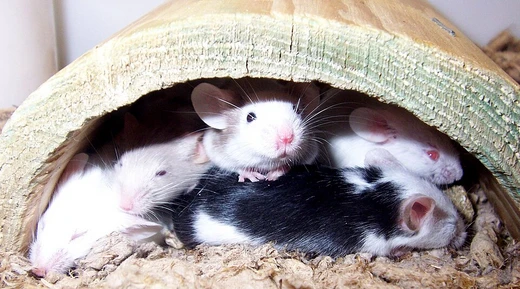
Shrew
Last updated
Shrews are tiny mammals, most no larger than a mouse, with the Etruscan shrew being the smallest living terrestrial mammal at about 3.5 cm and 1.8 g.[1] They have very high metabolic rates and must eat almost constantly, with captive shrews consuming up to twice their body weight daily.[2][3] Some shrew species possess venom and echolocation, traits that set them apart from most other mammals.[4]
Scientific classification
- KingdomAnimalia
- PhylumChordata
- InfraclassPlacentalia
- OrderEulipotyphla
- FamilySoricidae
Named by G. Fischer, 1814
Sources: Wikipedia taxobox: Shrew (CC BY-SA 4.0)
Biology and range
Shrews are terrestrial creatures that forage for seeds, insects, nuts, worms, and other foods in leaf litter and dense vegetation, though some specialize in climbing trees or hunting in water.[5] Female shrews can have up to 10 litters a year, with gestation periods of 17–32 days, and they often become pregnant within a day of giving birth.[6] Some shrews have dark red teeth due to iron in the enamel, which reinforces high-stress surfaces and prolongs tooth life.[7][8] Shrews have poor eyesight but compensate with strong hearing and smell.[5]
Burrowing is a common behavior among many shrew species, used both to capture prey and to evade predators.[5] Territorial aggression is a key trait in shrews, with individuals only tolerating each other for mating.[5] A shrew's lifespan typically falls between 12 and 30 months.[6] During winter, many shrew species undergo physical changes that shrink their bones and internal organs, leading to a 30% to 50% reduction in body weight.[9]
What the specialist sources record
John Wible notes that some shrews have white teeth while others, like the northern short-tailed shrew, have dark red and white patches on all teeth.[8] Wible also states that shrews without dark red teeth have a lower metabolic rate than those with them.[8] The Discover Wildlife account reports that some nocturnal shrews use ultrasonic squeaks to explore dark surroundings.[10] The same source lists shrews among the animals known to echolocate, alongside bats, whales, and tenrecs.[10]
References
- Wikipedia, "Shrew" (CC BY-SA 4.0), which cites: "Seasonal Changes in Weight and Reproductive Activity of Suncus murinus in West Bengal, India", Journal of Mammalogy, 1966, p. 73–78 (original not read by us) en.wikipedia.org
- Wikipedia, "Shrew" (CC BY-SA 4.0), which cites: "Metabolic Rates of Short-Tailed Shrews", Physiological Zoology, 1974, p. 75–90 (original not read by us) en.wikipedia.org
- Wikipedia, "Shrew" (CC BY-SA 4.0), which cites: "A Field Guide to the Mammals of Central America and Southeast Mexico", 2009, p. 63–64 (original not read by us) en.wikipedia.org
- Wikipedia, "Shrew" (CC BY-SA 4.0), which cites: Piper, "Extraordinary Animals: An Encyclopedia of Curious and Unusual Animals", Greenwood Press, 30 August 2007; "BioProspecting NB, Inc's novel ovarian cancer treatment found effective in animal cancer model.", 8 Apr 2009; Chai, "Evidence of Echolocation in the Common Shrew from Molecular Convergence with Other Echolocating Mammals", Zoological Studies, 2020-02-25, p. e4; "About the mammalian skull, and be able to define and/or identify on a specimen all underlined terms." (we also read that source) en.wikipedia.org
- Wikipedia, "Shrew" (CC BY-SA 4.0), which cites: "The Encyclopedia of Mammals", Facts on File, 1984, p. 758–763 (we also read that source) en.wikipedia.org
- Wikipedia, "Shrew" (CC BY-SA 4.0), which cites: "The Encyclopedia of Mammals", Facts on File, 1984, p. 758–763; "The Encyclopedia of Mammals", Oxford University Press, 2006 (we also read that source) en.wikipedia.org
- Wikipedia, "Shrew" (CC BY-SA 4.0), which cites: Wible, "Why Do Some Shrews Have Dark Red Teeth?", Carnegie Museum, 6 February 2018 (we also read that source) en.wikipedia.org
- Wible, "Why Do Some Shrews Have Dark Red Teeth?", Carnegie Museum, 6 February 2018. carnegiemnh.org
- Wikipedia, "Shrew" (CC BY-SA 4.0), which cites: Churchfield, "The natural history of shrews", Cornell University Press, January 1990 (we also read that source) en.wikipedia.org
- "What is echolocation and which animals use it?", Discover Wildlife. discoverwildlife.com
Each numbered sentence above was checked against the source it cites before publication. Sentences citing Wikipedia adapt text from the English Wikipedia article Shrew (contributors), used under CC BY-SA 4.0; this entry is available under the same licence. Other sources were used for facts only.
Also in the Codexery
More in Rodents & Small Mammals
Sources
Compiled from Wikipedia and the sources listed below. Text from Wikipedia is available under CC BY-SA 4.0; this entry is adapted from it.
- Wikipedia: Shrew (CC BY-SA 4.0).
- Word definitions: the Codexery glossary, each quoted from its Wikipedia article.
Spotted an error? Know more?
Reader corrections go straight into our review queue. Suggest an edit · How this site is sourced