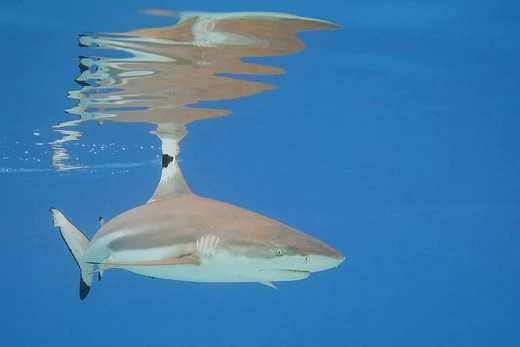
Dwarf black stingray
A small, little-known stingray of the Indo-Pacific continental shelves.

The dwarf black stingray (Hemitrygon parvonigra) is a poorly understood ray from the Dasyatidae family. It lives off northwestern Australia and possibly across Southeast Asia, in waters 60 to 185 meters deep. This ray reaches a width of 51 centimeters. Its body features an angular, diamond-shaped fin disc, a short line of spear-like thorns running down the middle of its back, and very few scale-like denticles elsewhere. The tail has a long fin fold underneath and a much shorter ridge on top, both located behind the stinging spine. The upper side is a plain brownish color, which can range from light to very dark.
**Taxonomy** Peter Last and William White first described this species in a 2008 CSIRO publication. Before that, it was known as *Dasyatis* "sp. A". The name *parvonigra* comes from Latin words for "little" and "black," because it looks like a smaller version of the much larger black stingray (*B. thetidis*). The type specimen is a male 38 centimeters wide, collected north of Cape Lambert in Western Australia. It appears to be most closely related to the longtail stingray (*H. longus*) and belongs to a poorly known group that also includes the red stingray (*H. akajei*).
**Distribution and habitat** The dwarf black stingray has been found off northwestern Australia (north of Port Hedland), Indonesia (including Bali and Sabah in Borneo), and Malaysia. There may also be records from West Papua and the Philippines, suggesting a wide range. Australian rays live on the outer continental shelf at depths of 125 to 185 meters, while Indonesian rays are found over insular and continental shelves at 60 to 125 meters. It is a bottom-dwelling species.
**Description** The disc is diamond-shaped, slightly wider than long, with angular outer corners and nearly straight front edges. The snout is broadly triangular with a pointed tip. The eyes are large and raised, with larger spiracles right behind them. Between the short, oval nostrils is a wide, skirt-like curtain of skin with a finely fringed rear edge. The mouth is medium-sized, strongly arched, and contains four papillae (nipple-like structures) across the floor, plus a tiny papilla near each jaw corner. Teeth are small, with about 43 rows in each jaw; those near the center have long, thin cusps, while those at the corners have very low crowns. The five pairs of gill slits are slightly S-shaped.
Quick Facts
- Genus
- Hemitrygon
- Species
- parvonigra
Facts from the source article.
Lore & Background
Peter Last and William White described the dwarf black stingray in a 2008 Commonwealth Scientific and Industrial Research Organisation (CSIRO) publication; it had previously been termed Dasyatis 'sp. A'. The specific epithet parvonigra, from the Latin parvus ('little') and nigra ('black'), refers to its superficial resemblance to the much larger black stingray (B. thetidis). The type specimen is a male 38 cm across, collected north of Cape Lambert in Western Australia. This species seems to be most related to the longtail stingray (H. longus), and belongs to a poorly known species complex that also includes the red stingray (H. akajei).
The dwarf black stingray has been found off northwestern Australia (north of Port Hedland), Indonesia (including Bali and Sabah in Borneo), and Malaysia. Possible records also exist off West Papua and the Philippines, suggesting it has a wide range. Australian rays inhabit the outer continental shelf at a depth of 125–185 m, while Indonesian rays occur over insular and continental shelves at a depth of 60–125 m. It is bottom-dwelling in nature.
The disc is diamond-shaped, slightly wider than long, with angular outer corners and nearly straight anterior corners. The snout is broadly triangular with a pointed tip. The eyes are large and elevated, followed by larger spiracles. The mouth forms a strong arch and contains four papillae across the floor and an additional tiny papilla near the corner of each jaw. The tail measures about 1.5 times the disc length, bearing one (rarely two) serrated stinging spines. There is a short row of closely spaced, spear-shaped thorns along the midline of the back. This species is plain ochre to dark grayish brown above, becoming lighter towards the disc margins, and white below.
Reader's Guide
The dwarf black stingray is notable primarily for its late formal recognition and its place within a poorly understood species complex. Described only in 2008, it had long been lumped under the designation Dasyatis 'sp. A', highlighting how little was known about the diversity of deepwater stingrays in the Indo-Australian region. Its specific epithet, meaning 'little black', draws a direct comparison to the much larger black stingray, underscoring the superficial similarity that can mask distinct species. The ray's distribution, though incompletely known, spans from northwestern Australia through Indonesia to Malaysia, with possible records extending to West Papua and the Philippines, suggesting a wide but patchy range across continental shelves. Ecologically, virtually nothing is known of its natural history; it is presumed aplacental viviparous like other stingrays, with males reaching sexual maturity at around 35 cm across. In Indonesian waters, it contributes to the bycatch of bottom trawl and trammel net fisheries and is sold for meat. The International Union for Conservation of Nature (IUCN) has not assessed its status, leaving its conservation needs entirely unaddressed. Its significance lies in representing the many cryptic, poorly documented elasmobranch species that inhabit deeper shelf waters, whose existence and potential vulnerability remain largely invisible to science and management.
Did You Know?
- The dwarf black stingray was formally described in 2008 by Peter Last and William White in a CSIRO publication.
- Its specific epithet parvonigra combines Latin for 'little' and 'black', referencing its resemblance to the much larger black stingray.
- The type specimen, a male 38 cm across, was collected north of Cape Lambert in Western Australia.
- In Indonesian waters, it is caught incidentally by bottom trawl and trammel net fisheries and sold for meat.
Anatomy and the Art of Defense
The whiptail stingrays of the family Dasyatidae are immediately recognizable by their flattened pectoral discs, which can appear oval or take on a more diamond-like silhouette depending on the species. What truly sets them apart, however, is the tail: a long, whip-like appendage that stretches well beyond the disc and carries no dorsal or caudal fins. For defense, nearly every member of this family—save the porcupine ray—bears one or more venomous barbs positioned near the tail's base. These stingers are sharp, pointed, and lined with jagged edges. When threatened, the ray jerks its tail, driving the stinger into the attacker; the barb then detaches and remains lodged in the wound, delivering its venom. Size varies enormously across the family, from a mere 0.18 meters to over two meters in species like the smalleye and giant freshwater stingrays. During the breeding season, males grip females with teeth that curve inward toward the corners of their mouths, a behavior that underscores how even these graceful, flat-bodied creatures carry formidable tools for survival.
Life on the Seafloor
Whiptail stingrays are found across tropical and temperate marine waters worldwide, with several species also venturing into freshwater systems in Africa, Asia, and Australia. Their flattened bodies make them naturally demersal, meaning they spend most of their lives at the bottom of the water column. They are commonly encountered buried in sand or mud along continental shelves, hovering near coral reefs, or tucked into mangrove swamps, while others roam the open ocean. Their preferred depth is typically between 100 and 200 meters along shallow coastlines, though some species push as deep as 600 meters. A key survival strategy is remaining camouflaged beneath the substrate with only their eyes peeking above the surface, a tactic that keeps them hidden from predators such as hammerhead sharks. The subfamily Potamotrygoninae represents a remarkable freshwater lineage, restricted to backwaters and shallow rivers in West Africa and the Atlantic drainages of South America, where they too bury themselves in sandy or muddy bottoms.
Hunting by Electric Sense
The feeding ecology of whiptail stingrays centers on a diverse menu of mollusks, crustaceans, jellyfish, and bony fish, all of which they extract by digging through sandy or muddy substrates. What makes their hunting particularly remarkable is their reliance on electroreception. Dispersed across their skin are electroreceptors that form a network of pores belonging to organs called the ampullae of Lorenzini. This sensory system allows the ray to detect the faint electric fields emitted by prey, enabling it to pinpoint the general location of a target even from a distance. In certain tourist destinations such as Stingray City in Grand Cayman and Hamelin Bay in Western Australia, rays have adapted to accept food scraps handed out by visitors, and they may also congregate near fishermen's cleaning stations to scavenge. This flexibility in foraging behavior, combined with their innate electroreceptive ability, gives whiptail stingrays a versatile approach to finding sustenance across a wide range of marine environments.
A Family Under Pressure
The conservation outlook for many whiptail stingray species is deeply concerning, with a significant number classified as threatened or endangered. Eight species—including the Smalltooth Stingray, Starrynose Cowtail Ray, Pakistan Whipray, Shorttail Whipray, Smooth Stingray, Colares Stingray, Wingfin Stingray, and Thorny Whipray—have been designated as critically endangered. The pressures driving these declines are multifaceted: bycatch resulting from overfishing, water contamination, habitat destruction, the impacts of tourism, and rising water temperatures linked to climate change. Despite these threats, humans continue to interact with these rays in various ways. In parts of South-West Asia, their flesh is salted and dried for consumption, while their skin is processed into leather goods such as wallets and shoes. They also feature in aquarium exhibits and ecotourism programs. Taxonomically, the family underwent a significant revision in 2016 by Peter Last, Gavin Naylor, and Mabel Manjaji-Matsumoto, drawing on both morphological and molecular phylogenetic data, though the placement of the genus Megatrygon remains provisional pending further research.
Frequently Asked Questions
Who is the Dwarf black stingray?
The Dwarf black stingray (Hemitrygon parvonigra) is a small, poorly understood member of the Dasyatidae family that ranges across the Indo-Pacific continental shelves, particularly off northwestern Australia and possibly throughout Southeast Asia.
What does the Dwarf black stingray look like?
It has a distinctive angular, diamond-shaped fin disc with a plain brownish upper surface, a short row of spear-like thorns running down the center of its back, and very few scale-like denticles elsewhere on its body. Its tail carries a long ventral fin fold and a shorter dorsal ridge positioned behind the stinging spine.
Where does the Dwarf black stingray live?
This ray inhabits relatively deep continental-shelf waters, typically between 60 and 185 meters below the surface, in the northwestern Australian and broader Southeast Asian regions.
How big does the Dwarf black stingray get?
It is a modestly sized ray, reaching a maximum disc width of about 51 centimeters and a total body length of roughly 1.1 meters, with the type specimen measuring 38 centimeters wide.
Why is the Dwarf black stingray notable to fans?
It remains one of the least-studied species in its family, with limited data on its behavior, reproduction, and full geographic range, making it a genuine mystery among Indo-Pacific rays.
More in Reef Sharks and Rays, Part 3 1-24
Spotted an error? Know more?
Reader corrections go straight into our review queue. Suggest an edit · How this site is sourced