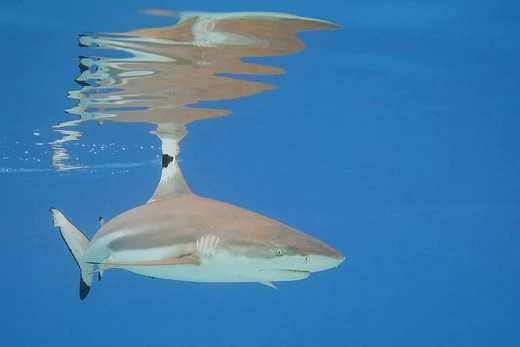
Blackedge whipray
A large, poorly known stingray with black marginal bands.

The blackedge whipray (Himantura marginata) is a stingray from the Dasyatidae family that remains poorly understood. It lives in coastal waters of the Bay of Bengal and the Gulf of Mannar. This ray can reach a disc width of 1.8 meters (5.9 feet) and is distinguished by broad, black bands along the edges of its underside.
English zoologist Edward Blyth first described this species as *Trygon marginatus* in an 1860 issue of the *Journal and Proceedings of the Asiatic Society of Bengal*. He based his description on a 1.2-meter-wide (3.9-foot) specimen bought at a Calcutta fish market, which has since been lost. The Latin name *marginatus* means "enclosed with a border." Later scientists moved it to the genus *Himantura*.
This ray appears off Myanmar, Bengal, Ganjam in India, and in the Gulf of Mannar. Its range might extend to Indonesia and Mozambique. It is less common than other stingrays in the same area. A bottom-dwelling species, it lives in coastal waters down to at least 44 meters (144 feet) and sometimes enters brackish water.
The pectoral fin disc is diamond-shaped, wider than long, and thick in the center. Its outer corners are narrowly rounded, and the leading edges meet at an obtuse angle. The snout tip projects slightly, with two small, shallow concavities on either side. The eyes are small, with larger spiracles behind them. A skin curtain sits between the nostrils. The mouth is small and bow-shaped, with a papilla near each corner. Teeth are numerous, arranged in a quincunx pattern; each tooth has an oval to rhomboid base, a prominent central ridge, and low side ridges. The pelvic fins extend past the disc.
The tail is much longer than the disc and carries a serrated stinging spine on top, located about one disc length from the base. The tail base is flattened, tapering to a whip-like shape past the sting, with no fin folds. The upper disc is densely covered in granules that get smaller toward the margin, starting in front of the disc and reaching the tail base. Large thorns with star-shaped bases run in a row along the midline of the back and are scattered elsewhere on the disc. These thorns resemble small limpets or salt crystals, giving the ray its Tamil name *uppan thirukai* ("salt-like ray"). The tail is smooth up to the spine, then entirely covered by small granules and prickles beyond.
Quick Facts
- Genus
- Himantura
- Species
- marginata
Facts from the source article.
Lore & Background
English zoologist Edward Blyth described the blackedge stingray as Trygon marginatus in an 1860 issue of the Journal and Proceedings of the Asiatic Society of Bengal, based on a specimen 1.2 m (3.9 ft) across obtained from a fish market in Calcutta, which has since been lost. The specific epithet marginatus means 'enclosed with a border' in Latin. Subsequent authors have placed this species in the genus Himantura.
The blackedge whipray is found off Myanmar, Bengal and Ganjam in India, and in the Gulf of Mannar, with its range possibly extending as far as Indonesia and Mozambique. It is fairly rare compared to other stingrays that share its range. This bottom-dwelling species inhabits coastal waters to at least a depth of 44 m (144 ft), and sometimes enters brackish water.
The pectoral fin disc is diamond-shaped, wider than long, and thick at the center, with a pair of small, shallow concavities flanking the snout tip. The dorsal surface is densely covered by granules and large thorns with star-shaped bases, which resemble small limpets or salt crystals, giving the ray its Tamil name uppan thirukai ('salt-like ray'). The underside is white with a wide, black, irregularly edged band running along the lateral and posterior disc margins. The tail is much longer than the disc, whip-like past the sting, and lacks fin folds.
Reader's Guide
The blackedge whipray is significant primarily as a little-known species for which the International Union for Conservation of Nature (IUCN) currently lacks sufficient data to assess beyond Data Deficient. Its description by Edward Blyth in 1860, based on a now-lost specimen from a Calcutta fish market, marks its entry into scientific literature, but subsequent knowledge remains sparse. The species is occasionally caught by artisanal and commercial fisheries, yet virtually nothing is known of its natural history, though it is presumably aplacental viviparous like other members of its family. A known parasite is the tapeworm Acanthobothrium dighaensis. Its legacy is that of a large, distinctive ray—characterized by wide black marginal bands on the underside and star-based thorns—that remains poorly understood, highlighting the gaps in knowledge of coastal elasmobranch diversity in the Bay of Bengal and Gulf of Mannar. The species' Tamil name, uppan thirukai ('salt-like ray'), reflects the appearance of its thorns, but its ecological role and population status are essentially unknown.
Did You Know?
- The blackedge whipray can reach a disc width of 1.8 m (5.9 ft) and a total length of 3.5 m (11 ft).
- Its Tamil name, uppan thirukai, means 'salt-like ray', referring to the star-shaped thorns that resemble salt crystals.
- The species was originally described as Trygon marginatus by Edward Blyth in 1860, based on a specimen from a Calcutta fish market that has since been lost.
- A known parasite of this ray is the tapeworm Acanthobothrium dighaensis.
Frequently Asked Questions
What is the Blackedge whipray?
The Blackedge whipray (Himantura marginata) is a large, poorly understood stingray belonging to the family Dasyatidae. It is found in the coastal waters of the Bay of Bengal and the Gulf of Mannar, where it inhabits depths ranging from the shore down to at least 44 metres.
How big can a Blackedge whipray get?
Adults can reach a disc width of roughly 1.8 metres (about 5.9 feet) and a total body length of up to 3.5 metres (around 11 feet), making it one of the larger whiprays in its range.
What makes the Blackedge whipray easy to spot?
Its most striking feature is a pair of broad, black bands running along the outer edges of its underside. This bold contrast against the paler ventral surface is what gives the species its common name.
Who first described the Blackedge whipray and how?
English zoologist Edward Blyth published the original description in 1860 under the name Trygon marginatus, in the Journal and Proceedings of the Asiatic Society of Bengal. He based his account on a 1.2-metre-wide specimen that had been purchased at a fish market in Calcutta.
Why is the Blackedge whipray still considered poorly known?
Despite being described over 160 years ago, relatively little is documented about its behaviour, reproduction, or population dynamics. Its coastal range in the Bay of Bengal and Gulf of Mannar has not been the focus of sustained scientific study, leaving many aspects of its ecology unresolved.
More in Reef Sharks and Rays, Part 3 1-24
Spotted an error? Know more?
Reader corrections go straight into our review queue. Suggest an edit · How this site is sourced