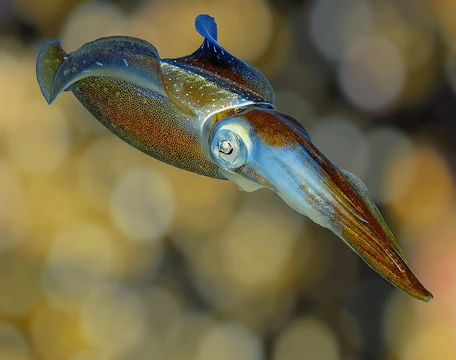
Octopus tetricus
A subtropical octopus from eastern Australia and northern New Zealand.
Last updated

Niki Hubbard · via Wikipedia: Octopus tetricus · CC BY 4.0
Scientific classification
- OrderOctopoda
- FamilyOctopodidae
- GenusOctopus
- SpeciesOctopus tetricus
Named by Gould, 1852
Close relatives
Other species of Octopus with a Codexery entry.
- Octopus australis Octopus australis
- Octopus bocki Octopus bocki
- Octopus chierchiae Octopus chierchiae
- Octopus cyanea Octopus cyanea
- Octopus mimus Octopus mimus
- Octopus minor Octopus minor
- Octopus pallidus Octopus pallidus
- Octopus sinensis Octopus sinensis
Sources: Wikipedia taxobox: Octopus tetricus (CC BY-SA 4.0) · order, family and genus agree with WoRMS AphiaID 342036 (CC BY 4.0)
Conservation status
Least Concern (LC)
- LC▲ this species
- NT
- VU
- EN
- CR
- EW
- EX
Source: IUCN Red List assessment · GBIF copy of the Red List category
How big is it?
Largest length in the source, 0.2 m, next to a 1.8 m person.
Diagram: drawn by Codexery, schematic shapes to scale (not a likeness). Length: Wikipedia: Octopus tetricus
Where the octopus tetricus has been recorded
Each dot is a place where the species has been observed and reported (4,122 records, half-degree grid) — not a modelled range. 31 inland records left out (institution coordinates).
Map: drawn by Codexery. Data: GBIF occurrence search (records CC0 / CC BY) · Natural Earth basemap (public domain) · place coordinates: Wikipedia (CC BY-SA 4.0)
Key facts and history
American conchologist Augustus Addison Gould described Octopus tetricus in 1852.[2] The species epithet tetricus means 'forbidding' or 'gloomy'.[3] It was first sighted in New Zealand in 1997 and is now common there.[4] The heaviest recorded individual weighed 2.6 kg.[5]
The IUCN Red List categorizes this species as 'Least Concern'.[6]
What the cited sources add
The Australian Museum account notes the distinctive white eye pupil and orange-rust red arms.[7] It describes the skin as having many small pavement-like patches and large papillae that produce a spiked appearance.[7] Females produce numerous small eggs (1-2 mm) attached in strings to rock crevices.[7] Sexual cannibalism has been observed, where the female eats the male after mating.[7]
A Newsweek article reports that researchers named a Jervis Bay shell bed "Octopolis" where octopuses signal and display to one another.[8] The same article states that octopuses raise their body, spread their legs, and turn dark brown during confrontations.[8] The Open Library record for "Octopus Biology and Ecology" lists its publisher as Elsevier and its publication year as 2022.[9]
References
- Wikipedia, "Octopus tetricus" (CC BY-SA 4.0), which cites: Amor, "Morphological assessment of the Octopus vulgaris species complex evaluated in light of molecular-based phylogenetic inferences", Zoologica Scripta, 2017, p. 275–288; "Allopatric speciation within a cryptic species complex of Australasian octopuses", PLOS ONE, 2014-06-25; Amor, "Octopus djinda (Cephalopoda: Octopodidae): a new member of the Octopus vulgaris group from southwest Australia", Zootaxa, 2021-11-03, p. 145–156 (original not read by us) en.wikipedia.org
- Wikipedia, "Octopus tetricus" (CC BY-SA 4.0), which cites: Gould, "Mollusca of the United States Exploring Expedition under Captain Charles Wilkes. Mollusca of the Wilkes Expedition", Printed by C. Sherman, 1852, p. 474; Gould, "United States exploring edition. Mollusca and Shells Atlas.", Printed by C. Sherman, 1856, p. plate 47 (original not read by us) en.wikipedia.org
- Wikipedia, "Octopus tetricus" (CC BY-SA 4.0), which cites: Amor, "Octopus djinda (Cephalopoda: Octopodidae): a new member of the Octopus vulgaris group from southwest Australia", Zootaxa, 2021-11-03, p. 145–156 (original not read by us) en.wikipedia.org
- Wikipedia, "Octopus tetricus" (CC BY-SA 4.0), which cites: Amor, "Octopus djinda (Cephalopoda: Octopodidae): a new member of the Octopus vulgaris group from southwest Australia", Zootaxa, 2021-11-03, p. 145–156; Patterson, "Novel Drone Technology Improves Habitat Mapping for a Coastal Octopus Species", Auckland University of Technology, 2022; ; Anderson TJ, "Habitat selection and shelter use by Octopus tetricus", Marine Ecology Progress Series, April 30, 1997, p. 137–48 (original not read by us) en.wikipedia.org
- Wikipedia, "Octopus tetricus" (CC BY-SA 4.0), which cites: "Common Sydney Octopus – Octopus tetricus", Australian Museum, 2012; "Atlas of Living Australia - Octopus tetricus (Gould, 1852)", Atlas of Living Australia; "Long-term high-density occupation of a site by Octopus tetricus and possible site modification due to foraging behavior", Marine and Freshwater Behaviour and Physiology, 2012-07-01, p. 261; Hall, "Octopus Biology and Ecology", Elsevier, September 27, 2024, p. 167–176 (we also read that source) en.wikipedia.org
- Wikipedia, "Octopus tetricus" (CC BY-SA 4.0), which cites: "The IUCN Red List of Threatened Species 2018.1", 2018-07-05 (original not read by us) en.wikipedia.org
- "Common Sydney Octopus – Octopus tetricus", Australian Museum, 2012. facts only, no text reused. australianmuseum.net.au
- "Octopuses More Social Than Thought, Denizens of 'Octopolis' Prove", Newsweek, 28 January 2016. facts only, no text reused. newsweek.com
- Open Library record, ISBN 9780128208946 ("Octopus Biology and Ecology"). CC0 (metadata); book content not read. openlibrary.org
Each numbered sentence above was checked against the source it cites before publication. Sentences citing Wikipedia adapt text from the English Wikipedia article Octopus tetricus (contributors), used under CC BY-SA 4.0; this entry is available under the same licence. Other sources were used for facts only; no text or images are copied from them.
More in Reef Cephalopods
Sources
Compiled from Wikipedia and the sources listed below. Text from Wikipedia is available under CC BY-SA 4.0; this entry is adapted from it.
- Wikipedia: Octopus tetricus (CC BY-SA 4.0).
- Classification: the source article's taxobox; order, family and genus checked against WoRMS, the World Register of Marine Species (CC BY 4.0).
- Conservation status: IUCN Red List assessment.
- Occurrence records: GBIF (CC0 / CC BY). Basemap: Natural Earth (public domain).
- Word definitions: the Codexery glossary, each quoted from its Wikipedia article.
Spotted an error? Know more?
Reader corrections go straight into our review queue. Suggest an edit · How this site is sourced