Strain (chemistry)
Molecular strain raises internal energy above a strain-free reference.
Last updated
In chemistry, a molecule is said to be under strain when its structure is distorted in a way that increases its internal energy relative to a similar, unstrained molecule. Internal energy is the total energy stored within a molecule. A strained molecule possesses extra internal energy—called strain energy—that an unstrained molecule lacks. This can be thought of like a compressed spring: just as a spring must be held in place to keep its potential energy from being released, a molecule can be locked into an energetically unfavorable shape by its own bonds.
Thermodynamics
Without those bonds, the strain energy would be released. The balance between two molecular shapes depends on the difference in their Gibbs free energy. From this difference, the equilibrium constant between the two forms can be calculated. If moving from one state to another lowers the Gibbs free energy, the change happens spontaneously, and the lower-energy state is more stable.
A highly strained, high-energy conformation will therefore spontaneously shift to a lower-energy one. Enthalpy and entropy relate to Gibbs free energy through a standard equation at constant temperature. Enthalpy is usually the more important factor for determining which conformation is more stable. Although strain energy comes from weakened bonds, and there are different types of strain, enthalpy typically dominates.
Entropy can often be ignored, but not always: if the enthalpy difference is small, entropy may play a larger role. For example, n-butane has two conformations, anti and gauche. The anti form is more stable by 0.9 kcal mol⁻¹, suggesting butane would be about 82% anti and 18% gauche at room temperature. However, there are two possible gauche conformations and only one anti conformation, so entropy adds 0.4 kcal in favor of the gauche form.
Determining molecular strain
The actual distribution is 70% anti and 30% gauche at room temperature. The standard heat of formation (ΔfH°) is the enthalpy change when a compound forms from its separate elements. If a compound's heat of formation differs from a predicted value or from a reference compound, that difference is often due to strain. For instance, cyclohexane has ΔfH° of -29.9 kcal mol⁻¹, while methylcyclopentane has ΔfH° of -25.5 kcal mol⁻¹.
Even though they have the same atoms and number of bonds, methylcyclopentane is higher in energy because of ring strain in the five-membered ring, which cyclohexane lacks. Experimentally, strain energy is often measured using heats of combustion, a straightforward procedure. To find strain energy, you need to know the expected internal energy without strain. One way is to compare with a similar compound that has no strain, like in the methylcyclopentane example.
But such a suitable reference compound is often hard to find. Another method is Benson group increment theory, which predicts ΔfH° if group increments are available for the atoms in the molecule. If the experimental ΔfH° differs from this prediction, the difference is attributed to strain energy. (or steric strain) happens when atoms are forced closer together than their Van der Waals radii allow. This type of strain involves atoms that are at least four bonds apart.
Van der Waals strain
The amount of steric strain depends on the size of the interacting groups: bulky tert-butyl groups take up more space than methyl groups and often cause greater steric interactions. Nobel laureate Herbert C. Brown and colleagues studied this in reactions of trialkylamines with trimethylboron. They found that as the alkyl groups on the amine got larger, the equilibrium constant decreased, due to steric strain between the alkyl groups and the methyl groups on boron.
Syn-pentane strain arises when seemingly identical conformations have different strain energies. In n-pentane, there are two ways to put both bonds on the central carbon into a gauche conformation. One way is 3 kcal mol⁻¹ higher in energy than the other. When the two methyl-substituted bonds are rotated from anti to gauche in opposite directions, the molecule takes on a cyclopentane-like shape, bringing the two terminal methyl groups close together.
Rotating them in the same direction avoids this. The steric strain between those terminal methyl groups accounts for the energy difference between the two similar but distinct conformations. (or A1,3 strain) involves the close proximity of allylic methyl and ethyl groups.
Quick Facts
- Field
- Chemistry
- Known for
- Molecular strain
- strain energy
- and types of steric and torsional strain
Facts from the source article.
Background
Strain in a molecule is defined as the additional internal energy it possesses compared to an unstrained reference compound. This strain energy is analogous to a compressed spring, held in place by the molecule's own bonds. The equilibrium between molecular conformations is determined by the difference in Gibbs free energy, with a spontaneous transformation from a higher-energy strained conformation to a lower-energy one. Enthalpy is typically the more important thermodynamic function for determining stability, though entropy can have a larger effect when enthalpy differences are small, as seen in the conformational distribution of n-butane.
Did You Know?
- The barrier to rotation between staggered conformations of ethane is approximately 2.9 kcal mol−1.
Frequently Asked Questions
What is strain in chemistry?
Molecular strain occurs when a molecule's geometry is forced into a configuration that stores more internal energy than a relaxed, strain-free reference structure would. This excess energy makes the molecule less stable and more reactive.
What is strain energy?
Strain energy is the extra internal energy a molecule holds beyond what its unstrained counterpart would possess. It is often compared to a compressed spring waiting to release that stored energy.
Why does molecular strain matter for reaction kinetics?
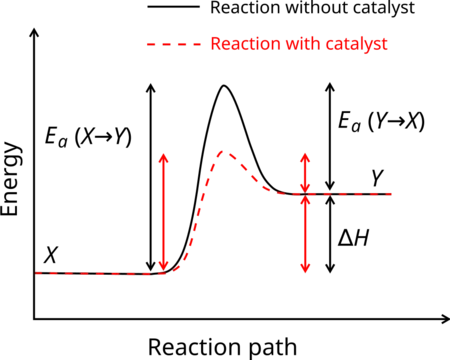
Because a strained molecule sits at a higher energy level, it faces a lower activation barrier to reach a transition state, which typically accelerates the reaction. This is why small rings like cyclopropane react far more readily than their unstrained analogues.
More in Reaction Mechanisms And Kinetics
Sources
Compiled from Wikipedia and the sources listed below. Text from Wikipedia is available under CC BY-SA 4.0; this entry is adapted from it.
- Wikipedia: Strain (chemistry) (CC BY-SA 4.0).
Spotted an error? Know more?
Reader corrections go straight into our review queue. Suggest an edit · How this site is sourced