Rotamer
Rotamers are conformers differing by single-bond rotation.
Last updated
In chemistry, rotamers are distinct chemical species that arise primarily from rotation around a single bond. They fall under the broader category of conformers, which are specific arrangements of atoms that represent local energy minima on a potential energy surface. While conformers can result from rotations about multiple bonds, rotamers are specifically those that differ by rotation around a single bond.
Because the energy differences between rotamers are typically small, they are almost never practically separable. When the rotation about a single bond faces a high enough energy barrier that the half-life for interconversion reaches 1000 seconds or longer, the species are called atropisomers. A common example of conformers is the ring-flip observed in substituted cyclohexanes.
The study of the energy changes associated with bond rotation is known as conformational analysis. This analysis can help predict and explain product selectivity, reaction mechanisms, and rates. It is also a key tool in rational, structure-based drug design.
Types
For simple molecules like ethane and propane, rotation around a carbon–carbon bond produces three equivalent energy minima, called staggered conformers, where the dihedral angles between substituents are 60°. The three eclipsed conformations, with dihedral angles of zero, serve as transition states between these minima. Butane is the simplest molecule where rotation yields two distinct types of conformers: the anti-conformer, where the four carbon atoms are coplanar and the methyl groups are 180° apart, and the gauche-conformer, where the methyl groups are 60° apart.
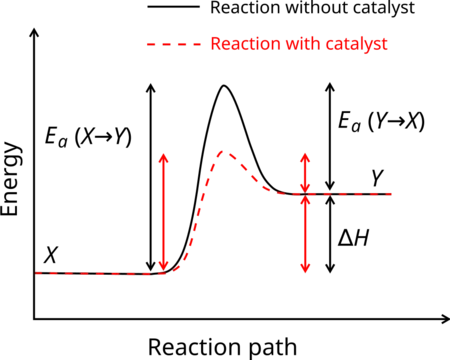
Butane has two enantiomeric gauche conformers and one anti conformer. The anti conformer is the most stable, with an energy difference of 0.9 kcal/mol relative to the gauche conformer. The three eclipsed conformations of butane are transition states, with the one where both methyl groups are eclipsed (0°) having a higher energy (≈5 kcal/mol) than the one where methyl groups eclipse hydrogens (≈3.5 kcal/mol).
Mathematical analysis
For unbranched linear alkanes with rotation around a central C–C bond, the energy profile is periodic with 120° periodicity due to the threefold symmetry of sp³-hybridized carbon atoms. This can be modeled using a sinusoidal potential energy function, often expressed as a truncated Fourier series. The dominant term in this series reflects the threefold rotational symmetry, while higher terms account for steric effects that vary with substituent size.
A simplified parameterization, using energy values from rotational spectroscopy and theoretical calculations, yields an equation where the energy (in kcal/mol) is a function of the dihedral angle. This function largely ignores angle strain and long-range interactions for the series of even-numbered chain alkanes. For more complex molecules, the Klyne–Prelog system is used to describe conformers. Specific examples of conformations, such as those in cyclohexane and other cycloalkanes, are detailed elsewhere.
Quick Facts
- Field
- Chemistry
Facts from the source article.
More in Reaction Mechanisms And Kinetics
Sources
Compiled from Wikipedia and the sources listed below. Text from Wikipedia is available under CC BY-SA 4.0; this entry is adapted from it.
- Wikipedia: Rotamer (CC BY-SA 4.0).
Spotted an error? Know more?
Reader corrections go straight into our review queue. Suggest an edit · How this site is sourced