Leaving group
Fragment that departs with an electron pair in heterolytic cleavage.
Last updated
In organic chemistry, a leaving group is a molecular fragment that departs with an electron pair during a reaction step involving heterolytic bond cleavage. The term is a less formal synonym of nucleofuge, though IUPAC gives a broader definition that includes groups departing without an electron pair (electrofuges) and those in homolytic cleavage. Leaving group ability affects reaction rate and mechanism, depending on context and the group's capacity to stabilize additional electron density.
Quick Facts
- Field
- Organic chemistry
Facts from the source article.
Background
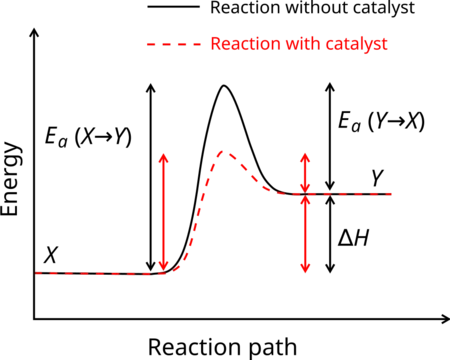
Leaving group ability manifests physically in fast reaction rates and low activation barriers. Because the leaving group often gains negative charge in the transition state, good leaving groups stabilize this charge and form stable anions. Strong bases such as OH−, OR−, and NR2− tend to be poor leaving groups, while extremely weak bases like OSO2CH3− leave easily. The correlation between leaving group ability and the dissociation constant of the conjugate acid (pKaH) is not perfect, as leaving group ability is a kinetic phenomenon while acidity is thermodynamic.
More in Reaction Mechanisms And Kinetics
Sources
Compiled from Wikipedia and the sources listed below. Text from Wikipedia is available under CC BY-SA 4.0; this entry is adapted from it.
- Wikipedia: Leaving group (CC BY-SA 4.0).
- Word definitions: the Codexery glossary, each quoted from its Wikipedia article.
Spotted an error? Know more?
Reader corrections go straight into our review queue. Suggest an edit · How this site is sourced