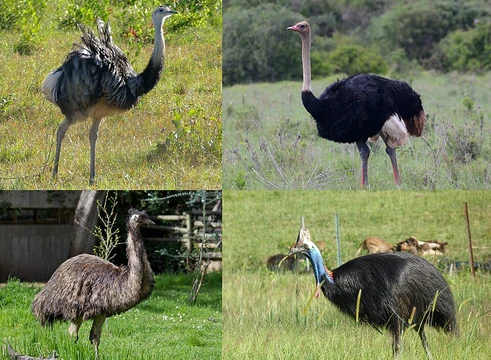
Red-legged tinamou
A flying ratite with rosy-red legs.
Last updated
The red-legged tinamou (Crypturellus erythropus) is a ground-dwelling bird of northern South America's tropics and lower subtropics. It is notable as a ratite that can fly, though it is not a strong flier.
Scientific classification
- KingdomAnimalia
- PhylumChordata
- ClassAves
- InfraclassPalaeognathae
- OrderTinamiformes
- FamilyTinamidae
- GenusCrypturellus
- SpeciesCrypturellus erythropus
Named by (Pelzeln, 1863)
Close relatives
Other species of Crypturellus with a Codexery entry.
- Barred tinamou Crypturellus casiquiare
- Pale-browed tinamou Crypturellus transfasciatus
Sources: Wikipedia taxobox: Red-legged tinamou (CC BY-SA 4.0)
Conservation status
Least Concern (LC)
- LC▲ this species
- NT
- VU
- EN
- CR
- EW
- EX
Source: IUCN Red List assessment · GBIF copy of the Red List category
Where the red-legged tinamou has been recorded
Each dot is a place where the species has been observed and reported (2,240 records, half-degree grid) — not a modelled range. 97 inland records left out (institution coordinates).
Map: drawn by Codexery. Data: GBIF occurrence search (records CC0 / CC BY) · Natural Earth basemap (public domain) · place coordinates: Wikipedia (CC BY-SA 4.0)
Quick Facts
- Scientific name
- Crypturellus erythropus
- Family
- Tinamidae
- Total length
- 27 cm / 10.6 in
- Iucn status
- Least Concern
- Occurrence range
- 1,800,000 km²
- Elevation preference
- below 1,300 m / 4,265 ft
- Egg color
- pale greyish-lavender with variable pink suffusion
Facts from the source article.
Taxonomy
All tinamous are part of the Tinamidae family and belong to the ratite group, but they stand out because they can actually fly, even if they aren’t very good at it. These birds are the closest living relatives of the ancient flying birds that all ratites evolved from. The red-legged tinamou includes several subspecies: C. e. erythropus lives in eastern Venezuela, Guyana, Suriname, and northeastern Brazil; C. e. cursitans is found east of the Andes in northern Colombia and northwestern Venezuela; C. e. spencei inhabits northern Venezuela; C. e. margaritae is restricted to Margarita Island; C. e. saltuarius, known as the Magdalena tinamou, lives in northeastern Colombia; C. e. columbianus, the Colombian tinamou, is found in north central Colombia; and C. e. idoneus, the Santa Marta tinamou, ranges across northeastern Colombia and northwestern Venezuela.
The classification beyond this is uncertain, as some experts treat saltuarius, idoneus, and columbianus as separate species, but the SACC rejected that change due to insufficient evidence. Several subspecies once grouped with the red-legged tinamou have also been linked to the thicket tinamou, Choco tinamou, and yellow-legged tinamou.
Did You Know?
- The red-legged tinamou is the only tinamou in its range with rosy-red legs.
- Its glossy eggs are pale greyish-lavender with a variable amount of pink suffusion.
- The name Crypturellus means small hidden tail.
More in Ratites
Test yourself
Three questions drawn from this entry’s sources. Pick an answer to check it.
Answers checked against the source article
Sources
Compiled from Wikipedia and the sources listed below. Text from Wikipedia is available under CC BY-SA 4.0; this entry is adapted from it.
- Wikipedia: Red-legged tinamou (CC BY-SA 4.0).
- Conservation status: IUCN Red List assessment.
- Occurrence records: GBIF (CC0 / CC BY). Basemap: Natural Earth (public domain).
- Word definitions: the Codexery glossary, each quoted from its Wikipedia article.
Spotted an error? Know more?
Reader corrections go straight into our review queue. Suggest an edit · How this site is sourced