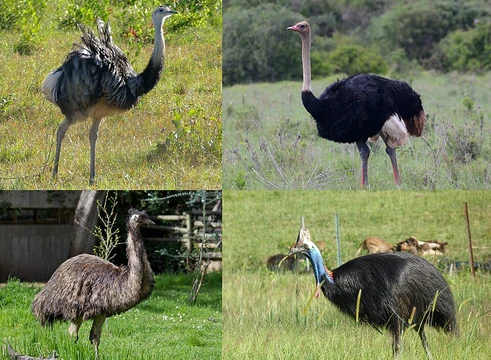
Darwin's rhea
Smaller flightless rhea of South American grasslands and plateaus.
Last updated
Darwin's rhea, also known as the lesser rhea (Rhea pennata), is a large flightless bird and the smaller of the two living rhea species. It inhabits the Altiplano and Patagonia regions of South America.
Scientific classification
- KingdomAnimalia
- PhylumChordata
- ClassAves
- InfraclassPalaeognathae
- OrderRheiformes
- FamilyRheidae
- GenusRhea
- SpeciesRhea pennata
Named by d'Orbigny, 1837
Sources: Wikipedia taxobox: Darwin's rhea (CC BY-SA 4.0)
Conservation status
Least Concern (LC)
- LC▲ this species
- NT
- VU
- EN
- CR
- EW
- EX
Source: IUCN Red List assessment · GBIF copy of the Red List category
Where the darwin's rhea has been recorded
Each dot is a place where the species has been observed and reported (21,942 records, half-degree grid) — not a modelled range. 223 inland records left out (institution coordinates).
Map: drawn by Codexery. Data: GBIF occurrence search (records CC0 / CC BY) · Natural Earth basemap (public domain) · place coordinates: Wikipedia (CC BY-SA 4.0)
History of the discovery of the genus Rhea
During the second voyage of HMS Beagle, Charles Darwin heard from gauchos near the Río Negro in northern Patagonia about a smaller rhea called Avestruz Petise. After months of fruitless searching, the Beagle reached Port Desire in southern Patagonia on 23 December. In early January, artist Conrad Martens shot a rhea that the crew ate before Darwin realized it was the smaller species; he preserved the head, neck, legs, one wing, and larger feathers, sending them to John Stevens Henslow.
On 26 January, at St Gregory's Bay in the Straits of Magellan, a half-Indian man told Darwin that only the smaller rhea occurred that far south. Later, along the Santa Cruz River, several smaller rheas were seen but could not be caught. In 1837, John Gould described the bird as Rhea darwinii (later synonymized with R. pennata) at a Zoological Society of London meeting, followed by Darwin reading a paper on the eggs and distribution of both rhea species.
Gould's confirmation that Darwin's rhea and the greater rhea were separate species posed a problem for Darwin, as they coexisted in an overlapping zone; this challenged the fixed-species view and contributed to his developing idea that species were not immutable.
Etymology
In Argentina, where most individuals live, it is called ñandú petiso or ñandú del norte, as well as suri and choique. The name ñandú derives from the Guaraní term for the greater rhea, ñandu guazu, meaning big spider, possibly referencing the wing movements during running. The specific name pennata, meaning winged, was given in 1837 by Alcide d'Orbigny, who first described the species to Europeans from a specimen collected near the lower Río Negro. Until 2008, it was placed in the monotypic genus Pterocnemia, from Greek words for feather and leg, referring to the feathered upper tarsus; that year the SACC merged Pterocnemia into Rhea.
Behavior
The lesser rhea is primarily herbivorous, feeding on saltbush, cactus fruits, grasses, roots, seeds, and leaves, occasionally taking small animals such as lizards, beetles, and grasshoppers. Chicks whistle mournfully, and males emit a booming call when seeking a mate.
During incubation, males become aggressive, even toward females, who then lay later eggs near the nest; the male moves most into the nest, while those left outside rot and attract flies that the male and chicks eat. Outside the breeding season, they are sociable, forming groups of 5 to 30 birds of both sexes and various ages. Young reach sexual maturity at 20 to 24 months.
Conservation
The two former northern subspecies, now classified by the IUCN as Rhea tarapacensis and considered near threatened, face primary threats from hunting, egg-collecting, and habitat fragmentation due to conversion to farmland or cattle pastures. Patagonia National Park in Chile's Aysén Region hosts a reproduction centre for Darwin's rhea, run by Tompkins Conservation with support from the National Forest Corporation.
Did You Know?
- The tarsus is 28 to 32 cm long and has 18 horizontal plates on the front.
- The bill measures 6.2 to 9.2 cm in length.
- The nominate subspecies prefers elevations below 1500 m, while the other subspecies typically range from 3000 m, locally down to 1220 m in the south.
More in Ratites
Test yourself
Three questions drawn from this entry’s sources. Pick an answer to check it.
Answers checked against the source article
Sources
Compiled from Wikipedia and the sources listed below. Text from Wikipedia is available under CC BY-SA 4.0; this entry is adapted from it.
- Wikipedia: Darwin's rhea (CC BY-SA 4.0).
- Conservation status: IUCN Red List assessment.
- Occurrence records: GBIF (CC0 / CC BY). Basemap: Natural Earth (public domain).
- Word definitions: the , each quoted from its Wikipedia article.
Spotted an error? Know more?
Reader corrections go straight into our review queue. Suggest an edit · How this site is sourced